


ThursdayJanuary 1, 2026
The Museum is ClosedCalendarSee Current Exhibition Details
- Galleries and Exhibition Themes
- 3F
- 2F
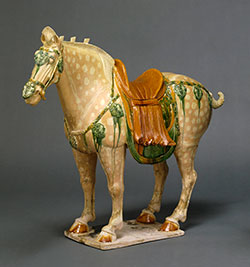
Galleries 2F-1, 2, 3 Feature Exhibition
New Year’s Feature Exhibition
Pony Tales: Celebrating the Year of the HorseGalleries 2F-1, 2, 3 Feature Exhibition
New Year’s Feature Exhibition
Pony Tales: Celebrating the Year of the HorseGalleries 2F-1, 2, 3 Feature Exhibition
New Year’s Feature Exhibition
Pony Tales: Celebrating the Year of the Horse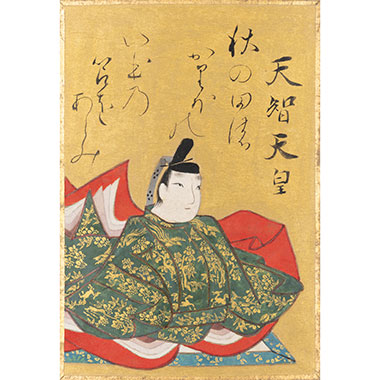
Galleries 2F-4, 5 Feature Exhibition
Feature Exhibition
Ogata Kōrin’s Karuta Playing Cards and the Konishi Family ArchivesGalleries 2F-4, 5 Feature Exhibition
Feature Exhibition
Ogata Kōrin’s Karuta Playing Cards and the Konishi Family Archives
- 1F
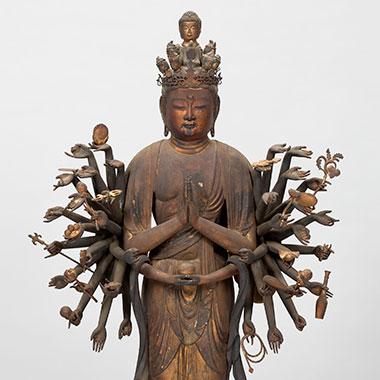
1F-1 Sculpture
Buddhist Sculpture of the Heian Period
Gallery 1F-2 Feature Exhibition
Feature Exhibition
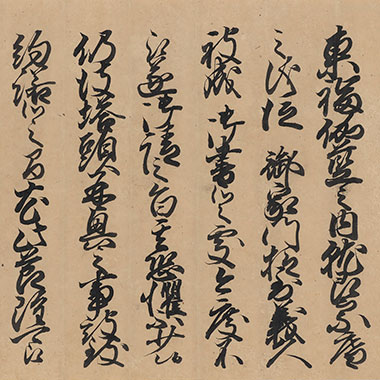
The Shimazu Clan of Satsuma and Tōfuku-ji’s Sokushū-in Temple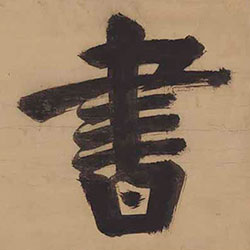
1F-3 Calligraphy
Ink Traces: Calligraphy from Tōfuku-ji Temple
1F-4 Textiles and Costumes
Auspicious Motifs in Japanese Textiles
1F-5 Metalwork
Sacred Offerings: Mirrors, Keman Ornaments, and Armor
1F-6 Lacquerware
Elegance Crafted in Kyoto: The Minoya Lacquer Collection
FridayJanuary 2, 2026
Exhibitions
- Galleries and Exhibition Themes
- 3F
- 2F
Galleries 2F-1, 2, 3 Feature Exhibition
New Year’s Feature Exhibition
Pony Tales: Celebrating the Year of the HorseGalleries 2F-1, 2, 3 Feature Exhibition
New Year’s Feature Exhibition
Pony Tales: Celebrating the Year of the HorseGalleries 2F-1, 2, 3 Feature Exhibition
New Year’s Feature Exhibition
Pony Tales: Celebrating the Year of the HorseGalleries 2F-4, 5 Feature Exhibition
Feature Exhibition
Ogata Kōrin’s Karuta Playing Cards and the Konishi Family ArchivesGalleries 2F-4, 5 Feature Exhibition
Feature Exhibition
Ogata Kōrin’s Karuta Playing Cards and the Konishi Family Archives
- 1F
1F-1 Sculpture
Buddhist Sculpture of the Heian Period
Gallery 1F-2 Feature Exhibition
Feature Exhibition
The Shimazu Clan of Satsuma and Tōfuku-ji’s Sokushū-in Temple1F-3 Calligraphy
Ink Traces: Calligraphy from Tōfuku-ji Temple
1F-4 Textiles and Costumes
Auspicious Motifs in Japanese Textiles
1F-5 Metalwork
Sacred Offerings: Mirrors, Keman Ornaments, and Armor
1F-6 Lacquerware
Elegance Crafted in Kyoto: The Minoya Lacquer Collection
SaturdayJanuary 3, 2026
Exhibitions
- Galleries and Exhibition Themes
- 3F
- 2F
Galleries 2F-1, 2, 3 Feature Exhibition
New Year’s Feature Exhibition
Pony Tales: Celebrating the Year of the HorseGalleries 2F-1, 2, 3 Feature Exhibition
New Year’s Feature Exhibition
Pony Tales: Celebrating the Year of the HorseGalleries 2F-1, 2, 3 Feature Exhibition
New Year’s Feature Exhibition
Pony Tales: Celebrating the Year of the HorseGalleries 2F-4, 5 Feature Exhibition
Feature Exhibition
Ogata Kōrin’s Karuta Playing Cards and the Konishi Family ArchivesGalleries 2F-4, 5 Feature Exhibition
Feature Exhibition
Ogata Kōrin’s Karuta Playing Cards and the Konishi Family Archives
- 1F
1F-1 Sculpture
Buddhist Sculpture of the Heian Period
Gallery 1F-2 Feature Exhibition
Feature Exhibition
The Shimazu Clan of Satsuma and Tōfuku-ji’s Sokushū-in Temple1F-3 Calligraphy
Ink Traces: Calligraphy from Tōfuku-ji Temple
1F-4 Textiles and Costumes
Auspicious Motifs in Japanese Textiles
1F-5 Metalwork
Sacred Offerings: Mirrors, Keman Ornaments, and Armor
1F-6 Lacquerware
Elegance Crafted in Kyoto: The Minoya Lacquer Collection
SundayJanuary 4, 2026
Exhibitions
- Galleries and Exhibition Themes
- 3F
- 2F
Galleries 2F-1, 2, 3 Feature Exhibition
New Year’s Feature Exhibition
Pony Tales: Celebrating the Year of the HorseGalleries 2F-1, 2, 3 Feature Exhibition
New Year’s Feature Exhibition
Pony Tales: Celebrating the Year of the HorseGalleries 2F-1, 2, 3 Feature Exhibition
New Year’s Feature Exhibition
Pony Tales: Celebrating the Year of the HorseGalleries 2F-4, 5 Feature Exhibition
Feature Exhibition
Ogata Kōrin’s Karuta Playing Cards and the Konishi Family ArchivesGalleries 2F-4, 5 Feature Exhibition
Feature Exhibition
Ogata Kōrin’s Karuta Playing Cards and the Konishi Family Archives
- 1F
1F-1 Sculpture
Buddhist Sculpture of the Heian Period
Gallery 1F-2 Feature Exhibition
Feature Exhibition
The Shimazu Clan of Satsuma and Tōfuku-ji’s Sokushū-in Temple1F-3 Calligraphy
Ink Traces: Calligraphy from Tōfuku-ji Temple
1F-4 Textiles and Costumes
Auspicious Motifs in Japanese Textiles
1F-5 Metalwork
Sacred Offerings: Mirrors, Keman Ornaments, and Armor
1F-6 Lacquerware
Elegance Crafted in Kyoto: The Minoya Lacquer Collection
MondayJanuary 5, 2026
The Museum is ClosedCalendarSee Current Exhibition Details
- Galleries and Exhibition Themes
- 3F
- 2F
Galleries 2F-1, 2, 3 Feature Exhibition
New Year’s Feature Exhibition
Pony Tales: Celebrating the Year of the HorseGalleries 2F-1, 2, 3 Feature Exhibition
New Year’s Feature Exhibition
Pony Tales: Celebrating the Year of the HorseGalleries 2F-1, 2, 3 Feature Exhibition
New Year’s Feature Exhibition
Pony Tales: Celebrating the Year of the HorseGalleries 2F-4, 5 Feature Exhibition
Feature Exhibition
Ogata Kōrin’s Karuta Playing Cards and the Konishi Family ArchivesGalleries 2F-4, 5 Feature Exhibition
Feature Exhibition
Ogata Kōrin’s Karuta Playing Cards and the Konishi Family Archives
- 1F
1F-1 Sculpture
Buddhist Sculpture of the Heian Period
Gallery 1F-2 Feature Exhibition
Feature Exhibition
The Shimazu Clan of Satsuma and Tōfuku-ji’s Sokushū-in Temple1F-3 Calligraphy
Ink Traces: Calligraphy from Tōfuku-ji Temple
1F-4 Textiles and Costumes
Auspicious Motifs in Japanese Textiles
1F-5 Metalwork
Sacred Offerings: Mirrors, Keman Ornaments, and Armor
1F-6 Lacquerware
Elegance Crafted in Kyoto: The Minoya Lacquer Collection
TuesdayJanuary 6, 2026
Exhibitions
- Galleries and Exhibition Themes
- 3F
- 2F
Galleries 2F-1, 2, 3 Feature Exhibition
New Year’s Feature Exhibition
Pony Tales: Celebrating the Year of the HorseGalleries 2F-1, 2, 3 Feature Exhibition
New Year’s Feature Exhibition
Pony Tales: Celebrating the Year of the HorseGalleries 2F-1, 2, 3 Feature Exhibition
New Year’s Feature Exhibition
Pony Tales: Celebrating the Year of the HorseGalleries 2F-4, 5 Feature Exhibition
Feature Exhibition
Ogata Kōrin’s Karuta Playing Cards and the Konishi Family ArchivesGalleries 2F-4, 5 Feature Exhibition
Feature Exhibition
Ogata Kōrin’s Karuta Playing Cards and the Konishi Family Archives
- 1F
1F-1 Sculpture
Buddhist Sculpture of the Heian Period
Gallery 1F-2 Feature Exhibition
Feature Exhibition
The Shimazu Clan of Satsuma and Tōfuku-ji’s Sokushū-in Temple1F-3 Calligraphy
Ink Traces: Calligraphy from Tōfuku-ji Temple
1F-4 Textiles and Costumes
Auspicious Motifs in Japanese Textiles
1F-5 Metalwork
Sacred Offerings: Mirrors, Keman Ornaments, and Armor
1F-6 Lacquerware
Elegance Crafted in Kyoto: The Minoya Lacquer Collection
WednesdayJanuary 7, 2026
Exhibitions
- Galleries and Exhibition Themes
- 3F
- 2F
Galleries 2F-1, 2, 3 Feature Exhibition
New Year’s Feature Exhibition
Pony Tales: Celebrating the Year of the HorseGalleries 2F-1, 2, 3 Feature Exhibition
New Year’s Feature Exhibition
Pony Tales: Celebrating the Year of the HorseGalleries 2F-1, 2, 3 Feature Exhibition
New Year’s Feature Exhibition
Pony Tales: Celebrating the Year of the HorseGalleries 2F-4, 5 Feature Exhibition
Feature Exhibition
Ogata Kōrin’s Karuta Playing Cards and the Konishi Family ArchivesGalleries 2F-4, 5 Feature Exhibition
Feature Exhibition
Ogata Kōrin’s Karuta Playing Cards and the Konishi Family Archives
- 1F
1F-1 Sculpture
Buddhist Sculpture of the Heian Period
Gallery 1F-2 Feature Exhibition
Feature Exhibition
The Shimazu Clan of Satsuma and Tōfuku-ji’s Sokushū-in Temple1F-3 Calligraphy
Ink Traces: Calligraphy from Tōfuku-ji Temple
1F-4 Textiles and Costumes
Auspicious Motifs in Japanese Textiles
1F-5 Metalwork
Sacred Offerings: Mirrors, Keman Ornaments, and Armor
1F-6 Lacquerware
Elegance Crafted in Kyoto: The Minoya Lacquer Collection
ThursdayJanuary 8, 2026
Exhibitions
- Galleries and Exhibition Themes
- 3F
- 2F
Galleries 2F-1, 2, 3 Feature Exhibition
New Year’s Feature Exhibition
Pony Tales: Celebrating the Year of the HorseGalleries 2F-1, 2, 3 Feature Exhibition
New Year’s Feature Exhibition
Pony Tales: Celebrating the Year of the HorseGalleries 2F-1, 2, 3 Feature Exhibition
New Year’s Feature Exhibition
Pony Tales: Celebrating the Year of the HorseGalleries 2F-4, 5 Feature Exhibition
Feature Exhibition
Ogata Kōrin’s Karuta Playing Cards and the Konishi Family ArchivesGalleries 2F-4, 5 Feature Exhibition
Feature Exhibition
Ogata Kōrin’s Karuta Playing Cards and the Konishi Family Archives
- 1F
1F-1 Sculpture
Buddhist Sculpture of the Heian Period
Gallery 1F-2 Feature Exhibition
Feature Exhibition
The Shimazu Clan of Satsuma and Tōfuku-ji’s Sokushū-in Temple1F-3 Calligraphy
Ink Traces: Calligraphy from Tōfuku-ji Temple
1F-4 Textiles and Costumes
Auspicious Motifs in Japanese Textiles
1F-5 Metalwork
Sacred Offerings: Mirrors, Keman Ornaments, and Armor
1F-6 Lacquerware
Elegance Crafted in Kyoto: The Minoya Lacquer Collection
FridayJanuary 9, 2026
Exhibitions
- Galleries and Exhibition Themes
- 3F
- 2F
Galleries 2F-1, 2, 3 Feature Exhibition
New Year’s Feature Exhibition
Pony Tales: Celebrating the Year of the HorseGalleries 2F-1, 2, 3 Feature Exhibition
New Year’s Feature Exhibition
Pony Tales: Celebrating the Year of the HorseGalleries 2F-1, 2, 3 Feature Exhibition
New Year’s Feature Exhibition
Pony Tales: Celebrating the Year of the HorseGalleries 2F-4, 5 Feature Exhibition
Feature Exhibition
Ogata Kōrin’s Karuta Playing Cards and the Konishi Family ArchivesGalleries 2F-4, 5 Feature Exhibition
Feature Exhibition
Ogata Kōrin’s Karuta Playing Cards and the Konishi Family Archives
- 1F
1F-1 Sculpture
Buddhist Sculpture of the Heian Period
Gallery 1F-2 Feature Exhibition
Feature Exhibition
The Shimazu Clan of Satsuma and Tōfuku-ji’s Sokushū-in Temple1F-3 Calligraphy
Ink Traces: Calligraphy from Tōfuku-ji Temple
1F-4 Textiles and Costumes
Auspicious Motifs in Japanese Textiles
1F-5 Metalwork
Sacred Offerings: Mirrors, Keman Ornaments, and Armor
1F-6 Lacquerware
Elegance Crafted in Kyoto: The Minoya Lacquer Collection
SaturdayJanuary 10, 2026
Exhibitions
- Galleries and Exhibition Themes
- 3F
- 2F
Galleries 2F-1, 2, 3 Feature Exhibition
New Year’s Feature Exhibition
Pony Tales: Celebrating the Year of the HorseGalleries 2F-1, 2, 3 Feature Exhibition
New Year’s Feature Exhibition
Pony Tales: Celebrating the Year of the HorseGalleries 2F-1, 2, 3 Feature Exhibition
New Year’s Feature Exhibition
Pony Tales: Celebrating the Year of the HorseGalleries 2F-4, 5 Feature Exhibition
Feature Exhibition
Ogata Kōrin’s Karuta Playing Cards and the Konishi Family ArchivesGalleries 2F-4, 5 Feature Exhibition
Feature Exhibition
Ogata Kōrin’s Karuta Playing Cards and the Konishi Family Archives
- 1F
1F-1 Sculpture
Buddhist Sculpture of the Heian Period
Gallery 1F-2 Feature Exhibition
Feature Exhibition
The Shimazu Clan of Satsuma and Tōfuku-ji’s Sokushū-in Temple1F-3 Calligraphy
Ink Traces: Calligraphy from Tōfuku-ji Temple
1F-4 Textiles and Costumes
Auspicious Motifs in Japanese Textiles
1F-5 Metalwork
Sacred Offerings: Mirrors, Keman Ornaments, and Armor
1F-6 Lacquerware
Elegance Crafted in Kyoto: The Minoya Lacquer Collection
SundayJanuary 11, 2026
Exhibitions
- Galleries and Exhibition Themes
- 3F
- 2F
Galleries 2F-1, 2, 3 Feature Exhibition
New Year’s Feature Exhibition
Pony Tales: Celebrating the Year of the HorseGalleries 2F-1, 2, 3 Feature Exhibition
New Year’s Feature Exhibition
Pony Tales: Celebrating the Year of the HorseGalleries 2F-1, 2, 3 Feature Exhibition
New Year’s Feature Exhibition
Pony Tales: Celebrating the Year of the HorseGalleries 2F-4, 5 Feature Exhibition
Feature Exhibition
Ogata Kōrin’s Karuta Playing Cards and the Konishi Family ArchivesGalleries 2F-4, 5 Feature Exhibition
Feature Exhibition
Ogata Kōrin’s Karuta Playing Cards and the Konishi Family Archives
- 1F
1F-1 Sculpture
Buddhist Sculpture of the Heian Period
Gallery 1F-2 Feature Exhibition
Feature Exhibition
The Shimazu Clan of Satsuma and Tōfuku-ji’s Sokushū-in Temple1F-3 Calligraphy
Ink Traces: Calligraphy from Tōfuku-ji Temple
1F-4 Textiles and Costumes
Auspicious Motifs in Japanese Textiles
1F-5 Metalwork
Sacred Offerings: Mirrors, Keman Ornaments, and Armor
1F-6 Lacquerware
Elegance Crafted in Kyoto: The Minoya Lacquer Collection
MondayJanuary 12, 2026
Exhibitions
- Galleries and Exhibition Themes
- 3F
- 2F
Galleries 2F-1, 2, 3 Feature Exhibition
New Year’s Feature Exhibition
Pony Tales: Celebrating the Year of the HorseGalleries 2F-1, 2, 3 Feature Exhibition
New Year’s Feature Exhibition
Pony Tales: Celebrating the Year of the HorseGalleries 2F-1, 2, 3 Feature Exhibition
New Year’s Feature Exhibition
Pony Tales: Celebrating the Year of the HorseGalleries 2F-4, 5 Feature Exhibition
Feature Exhibition
Ogata Kōrin’s Karuta Playing Cards and the Konishi Family ArchivesGalleries 2F-4, 5 Feature Exhibition
Feature Exhibition
Ogata Kōrin’s Karuta Playing Cards and the Konishi Family Archives
- 1F
1F-1 Sculpture
Buddhist Sculpture of the Heian Period
Gallery 1F-2 Feature Exhibition
Feature Exhibition
The Shimazu Clan of Satsuma and Tōfuku-ji’s Sokushū-in Temple1F-3 Calligraphy
Ink Traces: Calligraphy from Tōfuku-ji Temple
1F-4 Textiles and Costumes
Auspicious Motifs in Japanese Textiles
1F-5 Metalwork
Sacred Offerings: Mirrors, Keman Ornaments, and Armor
1F-6 Lacquerware
Elegance Crafted in Kyoto: The Minoya Lacquer Collection
TuesdayJanuary 13, 2026
The Museum is ClosedCalendarSee Current Exhibition Details
- Galleries and Exhibition Themes
- 3F
- 2F
Galleries 2F-1, 2, 3 Feature Exhibition
New Year’s Feature Exhibition
Pony Tales: Celebrating the Year of the HorseGalleries 2F-1, 2, 3 Feature Exhibition
New Year’s Feature Exhibition
Pony Tales: Celebrating the Year of the HorseGalleries 2F-1, 2, 3 Feature Exhibition
New Year’s Feature Exhibition
Pony Tales: Celebrating the Year of the HorseGalleries 2F-4, 5 Feature Exhibition
Feature Exhibition
Ogata Kōrin’s Karuta Playing Cards and the Konishi Family ArchivesGalleries 2F-4, 5 Feature Exhibition
Feature Exhibition
Ogata Kōrin’s Karuta Playing Cards and the Konishi Family Archives
- 1F
1F-1 Sculpture
Buddhist Sculpture of the Heian Period
Gallery 1F-2 Feature Exhibition
Feature Exhibition
The Shimazu Clan of Satsuma and Tōfuku-ji’s Sokushū-in Temple1F-3 Calligraphy
Ink Traces: Calligraphy from Tōfuku-ji Temple
1F-4 Textiles and Costumes
Auspicious Motifs in Japanese Textiles
1F-5 Metalwork
Sacred Offerings: Mirrors, Keman Ornaments, and Armor
1F-6 Lacquerware
Elegance Crafted in Kyoto: The Minoya Lacquer Collection
WednesdayJanuary 14, 2026
Exhibitions
- Galleries and Exhibition Themes
- 3F
- 2F
Galleries 2F-1, 2, 3 Feature Exhibition
New Year’s Feature Exhibition
Pony Tales: Celebrating the Year of the HorseGalleries 2F-1, 2, 3 Feature Exhibition
New Year’s Feature Exhibition
Pony Tales: Celebrating the Year of the HorseGalleries 2F-1, 2, 3 Feature Exhibition
New Year’s Feature Exhibition
Pony Tales: Celebrating the Year of the HorseGalleries 2F-4, 5 Feature Exhibition
Feature Exhibition
Ogata Kōrin’s Karuta Playing Cards and the Konishi Family ArchivesGalleries 2F-4, 5 Feature Exhibition
Feature Exhibition
Ogata Kōrin’s Karuta Playing Cards and the Konishi Family Archives
- 1F
1F-1 Sculpture
Buddhist Sculpture of the Heian Period
Gallery 1F-2 Feature Exhibition
Feature Exhibition
The Shimazu Clan of Satsuma and Tōfuku-ji’s Sokushū-in Temple1F-3 Calligraphy
Ink Traces: Calligraphy from Tōfuku-ji Temple
1F-4 Textiles and Costumes
Auspicious Motifs in Japanese Textiles
1F-5 Metalwork
Sacred Offerings: Mirrors, Keman Ornaments, and Armor
1F-6 Lacquerware
Elegance Crafted in Kyoto: The Minoya Lacquer Collection
ThursdayJanuary 15, 2026
Exhibitions
- Galleries and Exhibition Themes
- 3F
- 2F
Galleries 2F-1, 2, 3 Feature Exhibition
New Year’s Feature Exhibition
Pony Tales: Celebrating the Year of the HorseGalleries 2F-1, 2, 3 Feature Exhibition
New Year’s Feature Exhibition
Pony Tales: Celebrating the Year of the HorseGalleries 2F-1, 2, 3 Feature Exhibition
New Year’s Feature Exhibition
Pony Tales: Celebrating the Year of the HorseGalleries 2F-4, 5 Feature Exhibition
Feature Exhibition
Ogata Kōrin’s Karuta Playing Cards and the Konishi Family ArchivesGalleries 2F-4, 5 Feature Exhibition
Feature Exhibition
Ogata Kōrin’s Karuta Playing Cards and the Konishi Family Archives
- 1F
1F-1 Sculpture
Buddhist Sculpture of the Heian Period
Gallery 1F-2 Feature Exhibition
Feature Exhibition
The Shimazu Clan of Satsuma and Tōfuku-ji’s Sokushū-in Temple1F-3 Calligraphy
Ink Traces: Calligraphy from Tōfuku-ji Temple
1F-4 Textiles and Costumes
Auspicious Motifs in Japanese Textiles
1F-5 Metalwork
Sacred Offerings: Mirrors, Keman Ornaments, and Armor
1F-6 Lacquerware
Elegance Crafted in Kyoto: The Minoya Lacquer Collection
FridayJanuary 16, 2026
Exhibitions
- Galleries and Exhibition Themes
- 3F
- 2F
Galleries 2F-1, 2, 3 Feature Exhibition
New Year’s Feature Exhibition
Pony Tales: Celebrating the Year of the HorseGalleries 2F-1, 2, 3 Feature Exhibition
New Year’s Feature Exhibition
Pony Tales: Celebrating the Year of the HorseGalleries 2F-1, 2, 3 Feature Exhibition
New Year’s Feature Exhibition
Pony Tales: Celebrating the Year of the HorseGalleries 2F-4, 5 Feature Exhibition
Feature Exhibition
Ogata Kōrin’s Karuta Playing Cards and the Konishi Family ArchivesGalleries 2F-4, 5 Feature Exhibition
Feature Exhibition
Ogata Kōrin’s Karuta Playing Cards and the Konishi Family Archives
- 1F
1F-1 Sculpture
Buddhist Sculpture of the Heian Period
Gallery 1F-2 Feature Exhibition
Feature Exhibition
The Shimazu Clan of Satsuma and Tōfuku-ji’s Sokushū-in Temple1F-3 Calligraphy
Ink Traces: Calligraphy from Tōfuku-ji Temple
1F-4 Textiles and Costumes
Auspicious Motifs in Japanese Textiles
1F-5 Metalwork
Sacred Offerings: Mirrors, Keman Ornaments, and Armor
1F-6 Lacquerware
Elegance Crafted in Kyoto: The Minoya Lacquer Collection
SaturdayJanuary 17, 2026
Exhibitions
- Galleries and Exhibition Themes
- 3F
- 2F
Galleries 2F-1, 2, 3 Feature Exhibition
New Year’s Feature Exhibition
Pony Tales: Celebrating the Year of the HorseGalleries 2F-1, 2, 3 Feature Exhibition
New Year’s Feature Exhibition
Pony Tales: Celebrating the Year of the HorseGalleries 2F-1, 2, 3 Feature Exhibition
New Year’s Feature Exhibition
Pony Tales: Celebrating the Year of the HorseGalleries 2F-4, 5 Feature Exhibition
Feature Exhibition
Ogata Kōrin’s Karuta Playing Cards and the Konishi Family ArchivesGalleries 2F-4, 5 Feature Exhibition
Feature Exhibition
Ogata Kōrin’s Karuta Playing Cards and the Konishi Family Archives
- 1F
1F-1 Sculpture
Buddhist Sculpture of the Heian Period
Gallery 1F-2 Feature Exhibition
Feature Exhibition
The Shimazu Clan of Satsuma and Tōfuku-ji’s Sokushū-in Temple1F-3 Calligraphy
Ink Traces: Calligraphy from Tōfuku-ji Temple
1F-4 Textiles and Costumes
Auspicious Motifs in Japanese Textiles
1F-5 Metalwork
Sacred Offerings: Mirrors, Keman Ornaments, and Armor
1F-6 Lacquerware
Elegance Crafted in Kyoto: The Minoya Lacquer Collection
SundayJanuary 18, 2026
Exhibitions
- Galleries and Exhibition Themes
- 3F
- 2F
Galleries 2F-1, 2, 3 Feature Exhibition
New Year’s Feature Exhibition
Pony Tales: Celebrating the Year of the HorseGalleries 2F-1, 2, 3 Feature Exhibition
New Year’s Feature Exhibition
Pony Tales: Celebrating the Year of the HorseGalleries 2F-1, 2, 3 Feature Exhibition
New Year’s Feature Exhibition
Pony Tales: Celebrating the Year of the HorseGalleries 2F-4, 5 Feature Exhibition
Feature Exhibition
Ogata Kōrin’s Karuta Playing Cards and the Konishi Family ArchivesGalleries 2F-4, 5 Feature Exhibition
Feature Exhibition
Ogata Kōrin’s Karuta Playing Cards and the Konishi Family Archives
- 1F
1F-1 Sculpture
Buddhist Sculpture of the Heian Period
Gallery 1F-2 Feature Exhibition
Feature Exhibition
The Shimazu Clan of Satsuma and Tōfuku-ji’s Sokushū-in Temple1F-3 Calligraphy
Ink Traces: Calligraphy from Tōfuku-ji Temple
1F-4 Textiles and Costumes
Auspicious Motifs in Japanese Textiles
1F-5 Metalwork
Sacred Offerings: Mirrors, Keman Ornaments, and Armor
1F-6 Lacquerware
Elegance Crafted in Kyoto: The Minoya Lacquer Collection
MondayJanuary 19, 2026
The Museum is ClosedCalendarSee Current Exhibition Details
- Galleries and Exhibition Themes
- 3F
- 2F
Galleries 2F-1, 2, 3 Feature Exhibition
New Year’s Feature Exhibition
Pony Tales: Celebrating the Year of the HorseGalleries 2F-1, 2, 3 Feature Exhibition
New Year’s Feature Exhibition
Pony Tales: Celebrating the Year of the HorseGalleries 2F-1, 2, 3 Feature Exhibition
New Year’s Feature Exhibition
Pony Tales: Celebrating the Year of the HorseGalleries 2F-4, 5 Feature Exhibition
Feature Exhibition
Ogata Kōrin’s Karuta Playing Cards and the Konishi Family ArchivesGalleries 2F-4, 5 Feature Exhibition
Feature Exhibition
Ogata Kōrin’s Karuta Playing Cards and the Konishi Family Archives
- 1F
1F-1 Sculpture
Buddhist Sculpture of the Heian Period
Gallery 1F-2 Feature Exhibition
Feature Exhibition
The Shimazu Clan of Satsuma and Tōfuku-ji’s Sokushū-in Temple1F-3 Calligraphy
Ink Traces: Calligraphy from Tōfuku-ji Temple
1F-4 Textiles and Costumes
Auspicious Motifs in Japanese Textiles
1F-5 Metalwork
Sacred Offerings: Mirrors, Keman Ornaments, and Armor
1F-6 Lacquerware
Elegance Crafted in Kyoto: The Minoya Lacquer Collection
TuesdayJanuary 20, 2026
Exhibitions
- Galleries and Exhibition Themes
- 3F
- 2F
Galleries 2F-1, 2, 3 Feature Exhibition
New Year’s Feature Exhibition
Pony Tales: Celebrating the Year of the HorseGalleries 2F-1, 2, 3 Feature Exhibition
New Year’s Feature Exhibition
Pony Tales: Celebrating the Year of the HorseGalleries 2F-1, 2, 3 Feature Exhibition
New Year’s Feature Exhibition
Pony Tales: Celebrating the Year of the HorseGalleries 2F-4, 5 Feature Exhibition
Feature Exhibition
Ogata Kōrin’s Karuta Playing Cards and the Konishi Family ArchivesGalleries 2F-4, 5 Feature Exhibition
Feature Exhibition
Ogata Kōrin’s Karuta Playing Cards and the Konishi Family Archives
- 1F
1F-1 Sculpture
Buddhist Sculpture of the Heian Period
Gallery 1F-2 Feature Exhibition
Feature Exhibition
The Shimazu Clan of Satsuma and Tōfuku-ji’s Sokushū-in Temple1F-3 Calligraphy
Ink Traces: Calligraphy from Tōfuku-ji Temple
1F-4 Textiles and Costumes
Auspicious Motifs in Japanese Textiles
1F-5 Metalwork
Sacred Offerings: Mirrors, Keman Ornaments, and Armor
1F-6 Lacquerware
Elegance Crafted in Kyoto: The Minoya Lacquer Collection
WednesdayJanuary 21, 2026
Exhibitions
- Galleries and Exhibition Themes
- 3F
- 2F
Galleries 2F-1, 2, 3 Feature Exhibition
New Year’s Feature Exhibition
Pony Tales: Celebrating the Year of the HorseGalleries 2F-1, 2, 3 Feature Exhibition
New Year’s Feature Exhibition
Pony Tales: Celebrating the Year of the HorseGalleries 2F-1, 2, 3 Feature Exhibition
New Year’s Feature Exhibition
Pony Tales: Celebrating the Year of the HorseGalleries 2F-4, 5 Feature Exhibition
Feature Exhibition
Ogata Kōrin’s Karuta Playing Cards and the Konishi Family ArchivesGalleries 2F-4, 5 Feature Exhibition
Feature Exhibition
Ogata Kōrin’s Karuta Playing Cards and the Konishi Family Archives
- 1F
1F-1 Sculpture
Buddhist Sculpture of the Heian Period
Gallery 1F-2 Feature Exhibition
Feature Exhibition
The Shimazu Clan of Satsuma and Tōfuku-ji’s Sokushū-in Temple1F-3 Calligraphy
Ink Traces: Calligraphy from Tōfuku-ji Temple
1F-4 Textiles and Costumes
Auspicious Motifs in Japanese Textiles
1F-5 Metalwork
Sacred Offerings: Mirrors, Keman Ornaments, and Armor
1F-6 Lacquerware
Elegance Crafted in Kyoto: The Minoya Lacquer Collection
ThursdayJanuary 22, 2026
Exhibitions
- Galleries and Exhibition Themes
- 3F
- 2F
Galleries 2F-1, 2, 3 Feature Exhibition
New Year’s Feature Exhibition
Pony Tales: Celebrating the Year of the HorseGalleries 2F-1, 2, 3 Feature Exhibition
New Year’s Feature Exhibition
Pony Tales: Celebrating the Year of the HorseGalleries 2F-1, 2, 3 Feature Exhibition
New Year’s Feature Exhibition
Pony Tales: Celebrating the Year of the HorseGalleries 2F-4, 5 Feature Exhibition
Feature Exhibition
Ogata Kōrin’s Karuta Playing Cards and the Konishi Family ArchivesGalleries 2F-4, 5 Feature Exhibition
Feature Exhibition
Ogata Kōrin’s Karuta Playing Cards and the Konishi Family Archives
- 1F
1F-1 Sculpture
Buddhist Sculpture of the Heian Period
Gallery 1F-2 Feature Exhibition
Feature Exhibition
The Shimazu Clan of Satsuma and Tōfuku-ji’s Sokushū-in Temple1F-3 Calligraphy
Ink Traces: Calligraphy from Tōfuku-ji Temple
1F-4 Textiles and Costumes
Auspicious Motifs in Japanese Textiles
1F-5 Metalwork
Sacred Offerings: Mirrors, Keman Ornaments, and Armor
1F-6 Lacquerware
Elegance Crafted in Kyoto: The Minoya Lacquer Collection
FridayJanuary 23, 2026
Exhibitions
- Galleries and Exhibition Themes
- 3F
- 2F
Galleries 2F-1, 2, 3 Feature Exhibition
New Year’s Feature Exhibition
Pony Tales: Celebrating the Year of the HorseGalleries 2F-1, 2, 3 Feature Exhibition
New Year’s Feature Exhibition
Pony Tales: Celebrating the Year of the HorseGalleries 2F-1, 2, 3 Feature Exhibition
New Year’s Feature Exhibition
Pony Tales: Celebrating the Year of the HorseGalleries 2F-4, 5 Feature Exhibition
Feature Exhibition
Ogata Kōrin’s Karuta Playing Cards and the Konishi Family ArchivesGalleries 2F-4, 5 Feature Exhibition
Feature Exhibition
Ogata Kōrin’s Karuta Playing Cards and the Konishi Family Archives
- 1F
1F-1 Sculpture
Buddhist Sculpture of the Heian Period
Gallery 1F-2 Feature Exhibition
Feature Exhibition
The Shimazu Clan of Satsuma and Tōfuku-ji’s Sokushū-in Temple1F-3 Calligraphy
Ink Traces: Calligraphy from Tōfuku-ji Temple
1F-4 Textiles and Costumes
Auspicious Motifs in Japanese Textiles
1F-5 Metalwork
Sacred Offerings: Mirrors, Keman Ornaments, and Armor
1F-6 Lacquerware
Elegance Crafted in Kyoto: The Minoya Lacquer Collection
SaturdayJanuary 24, 2026
Exhibitions
- Galleries and Exhibition Themes
- 3F
- 2F
Galleries 2F-1, 2, 3 Feature Exhibition
New Year’s Feature Exhibition
Pony Tales: Celebrating the Year of the HorseGalleries 2F-1, 2, 3 Feature Exhibition
New Year’s Feature Exhibition
Pony Tales: Celebrating the Year of the HorseGalleries 2F-1, 2, 3 Feature Exhibition
New Year’s Feature Exhibition
Pony Tales: Celebrating the Year of the HorseGalleries 2F-4, 5 Feature Exhibition
Feature Exhibition
Ogata Kōrin’s Karuta Playing Cards and the Konishi Family ArchivesGalleries 2F-4, 5 Feature Exhibition
Feature Exhibition
Ogata Kōrin’s Karuta Playing Cards and the Konishi Family Archives
- 1F
1F-1 Sculpture
Buddhist Sculpture of the Heian Period
Gallery 1F-2 Feature Exhibition
Feature Exhibition
The Shimazu Clan of Satsuma and Tōfuku-ji’s Sokushū-in Temple1F-3 Calligraphy
Ink Traces: Calligraphy from Tōfuku-ji Temple
1F-4 Textiles and Costumes
Auspicious Motifs in Japanese Textiles
1F-5 Metalwork
Sacred Offerings: Mirrors, Keman Ornaments, and Armor
1F-6 Lacquerware
Elegance Crafted in Kyoto: The Minoya Lacquer Collection
SundayJanuary 25, 2026
Exhibitions
- Galleries and Exhibition Themes
- 3F
- 2F
Galleries 2F-1, 2, 3 Feature Exhibition
New Year’s Feature Exhibition
Pony Tales: Celebrating the Year of the HorseGalleries 2F-1, 2, 3 Feature Exhibition
New Year’s Feature Exhibition
Pony Tales: Celebrating the Year of the HorseGalleries 2F-1, 2, 3 Feature Exhibition
New Year’s Feature Exhibition
Pony Tales: Celebrating the Year of the HorseGalleries 2F-4, 5 Feature Exhibition
Feature Exhibition
Ogata Kōrin’s Karuta Playing Cards and the Konishi Family ArchivesGalleries 2F-4, 5 Feature Exhibition
Feature Exhibition
Ogata Kōrin’s Karuta Playing Cards and the Konishi Family Archives
- 1F
1F-1 Sculpture
Buddhist Sculpture of the Heian Period
Gallery 1F-2 Feature Exhibition
Feature Exhibition
The Shimazu Clan of Satsuma and Tōfuku-ji’s Sokushū-in Temple1F-3 Calligraphy
Ink Traces: Calligraphy from Tōfuku-ji Temple
1F-4 Textiles and Costumes
Auspicious Motifs in Japanese Textiles
1F-5 Metalwork
Sacred Offerings: Mirrors, Keman Ornaments, and Armor
1F-6 Lacquerware
Elegance Crafted in Kyoto: The Minoya Lacquer Collection
MondayJanuary 26, 2026
The Museum is ClosedCalendarSee Current Exhibition Details
- Galleries and Exhibition Themes
- 3F
- 2F
TuesdayJanuary 27, 2026
Exhibitions
- Galleries and Exhibition Themes
- 3F
- 2F
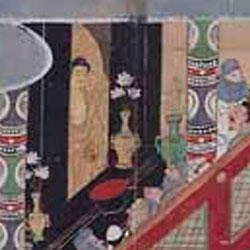
2F-1 Illustrated Handscrolls
Legendary Origins of the Yūzū Nenbutsu Sect: The Power of the Nenbutsu Prayer
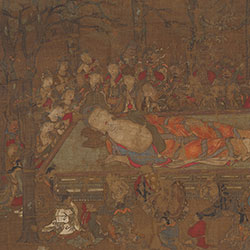
2F-2 Buddhist Paintings
Parinirvana: Picturing the Death of the Buddha
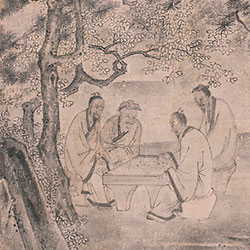
2F-3 Medieval Paintings
Sliding Door Paintings of Daitoku-ji’s Former Subtemple Yōtoku-in, PartⅠ
Galleries 2F-4, 5 Feature Exhibition
Feature Exhibition
Ogata Kōrin’s Karuta Playing Cards and the Konishi Family ArchivesGalleries 2F-4, 5 Feature Exhibition
Feature Exhibition
Ogata Kōrin’s Karuta Playing Cards and the Konishi Family Archives
- 1F
1F-1 Sculpture
Buddhist Sculpture of the Heian Period

1F-2
Closed
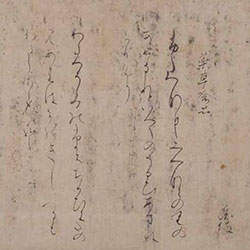
1F-3 Calligraphy
Waka Poems and Classical Texts
1F-4 Textiles and Costumes
Auspicious Motifs in Japanese Textiles
1F-5 Metalwork
Sacred Offerings: Mirrors, Keman Ornaments, and Armor
1F-6 Lacquerware
Elegance Crafted in Kyoto: The Minoya Lacquer Collection
WednesdayJanuary 28, 2026
Exhibitions
- Galleries and Exhibition Themes
- 3F
- 2F
2F-1 Illustrated Handscrolls
Legendary Origins of the Yūzū Nenbutsu Sect: The Power of the Nenbutsu Prayer
2F-2 Buddhist Paintings
Parinirvana: Picturing the Death of the Buddha
2F-3 Medieval Paintings
Sliding Door Paintings of Daitoku-ji’s Former Subtemple Yōtoku-in, PartⅠ
Galleries 2F-4, 5 Feature Exhibition
Feature Exhibition
Ogata Kōrin’s Karuta Playing Cards and the Konishi Family ArchivesGalleries 2F-4, 5 Feature Exhibition
Feature Exhibition
Ogata Kōrin’s Karuta Playing Cards and the Konishi Family Archives
- 1F
1F-1 Sculpture
Buddhist Sculpture of the Heian Period
1F-2
Closed
1F-3 Calligraphy
Waka Poems and Classical Texts
1F-4 Textiles and Costumes
Auspicious Motifs in Japanese Textiles
1F-5 Metalwork
Sacred Offerings: Mirrors, Keman Ornaments, and Armor
1F-6 Lacquerware
Elegance Crafted in Kyoto: The Minoya Lacquer Collection
ThursdayJanuary 29, 2026
Exhibitions
- Galleries and Exhibition Themes
- 3F
- 2F
2F-1 Illustrated Handscrolls
Legendary Origins of the Yūzū Nenbutsu Sect: The Power of the Nenbutsu Prayer
2F-2 Buddhist Paintings
Parinirvana: Picturing the Death of the Buddha
2F-3 Medieval Paintings
Sliding Door Paintings of Daitoku-ji’s Former Subtemple Yōtoku-in, PartⅠ
Galleries 2F-4, 5 Feature Exhibition
Feature Exhibition
Ogata Kōrin’s Karuta Playing Cards and the Konishi Family ArchivesGalleries 2F-4, 5 Feature Exhibition
Feature Exhibition
Ogata Kōrin’s Karuta Playing Cards and the Konishi Family Archives
- 1F
1F-1 Sculpture
Buddhist Sculpture of the Heian Period
1F-2
Closed
1F-3 Calligraphy
Waka Poems and Classical Texts
1F-4 Textiles and Costumes
Auspicious Motifs in Japanese Textiles
1F-5 Metalwork
Sacred Offerings: Mirrors, Keman Ornaments, and Armor
1F-6 Lacquerware
Elegance Crafted in Kyoto: The Minoya Lacquer Collection
FridayJanuary 30, 2026
Exhibitions
- Galleries and Exhibition Themes
- 3F
- 2F
2F-1 Illustrated Handscrolls
Legendary Origins of the Yūzū Nenbutsu Sect: The Power of the Nenbutsu Prayer
2F-2 Buddhist Paintings
Parinirvana: Picturing the Death of the Buddha
2F-3 Medieval Paintings
Sliding Door Paintings of Daitoku-ji’s Former Subtemple Yōtoku-in, PartⅠ
Galleries 2F-4, 5 Feature Exhibition
Feature Exhibition
Ogata Kōrin’s Karuta Playing Cards and the Konishi Family ArchivesGalleries 2F-4, 5 Feature Exhibition
Feature Exhibition
Ogata Kōrin’s Karuta Playing Cards and the Konishi Family Archives
- 1F
1F-1 Sculpture
Buddhist Sculpture of the Heian Period
1F-2
Closed
1F-3 Calligraphy
Waka Poems and Classical Texts
1F-4 Textiles and Costumes
Auspicious Motifs in Japanese Textiles
1F-5 Metalwork
Sacred Offerings: Mirrors, Keman Ornaments, and Armor
1F-6 Lacquerware
Elegance Crafted in Kyoto: The Minoya Lacquer Collection
SaturdayJanuary 31, 2026
Exhibitions
- Galleries and Exhibition Themes
- 3F
- 2F
2F-1 Illustrated Handscrolls
Legendary Origins of the Yūzū Nenbutsu Sect: The Power of the Nenbutsu Prayer
2F-2 Buddhist Paintings
Parinirvana: Picturing the Death of the Buddha
2F-3 Medieval Paintings
Sliding Door Paintings of Daitoku-ji’s Former Subtemple Yōtoku-in, PartⅠ
Galleries 2F-4, 5 Feature Exhibition
Feature Exhibition
Ogata Kōrin’s Karuta Playing Cards and the Konishi Family ArchivesGalleries 2F-4, 5 Feature Exhibition
Feature Exhibition
Ogata Kōrin’s Karuta Playing Cards and the Konishi Family Archives
- 1F
1F-1 Sculpture
Buddhist Sculpture of the Heian Period
1F-2
Closed
1F-3 Calligraphy
Waka Poems and Classical Texts
1F-4 Textiles and Costumes
Auspicious Motifs in Japanese Textiles
1F-5 Metalwork
Sacred Offerings: Mirrors, Keman Ornaments, and Armor
1F-6 Lacquerware
Elegance Crafted in Kyoto: The Minoya Lacquer Collection
Feature Exhibitions
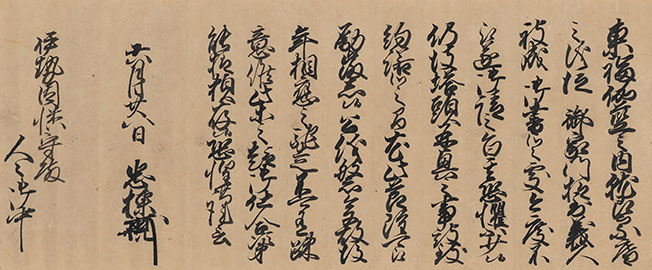
Feature Exhibition
Feature Exhibition
The Shimazu Clan of Satsuma and Tōfuku-ji’s Sokushū-in TempleDecember 16, 2025–January 25, 2026
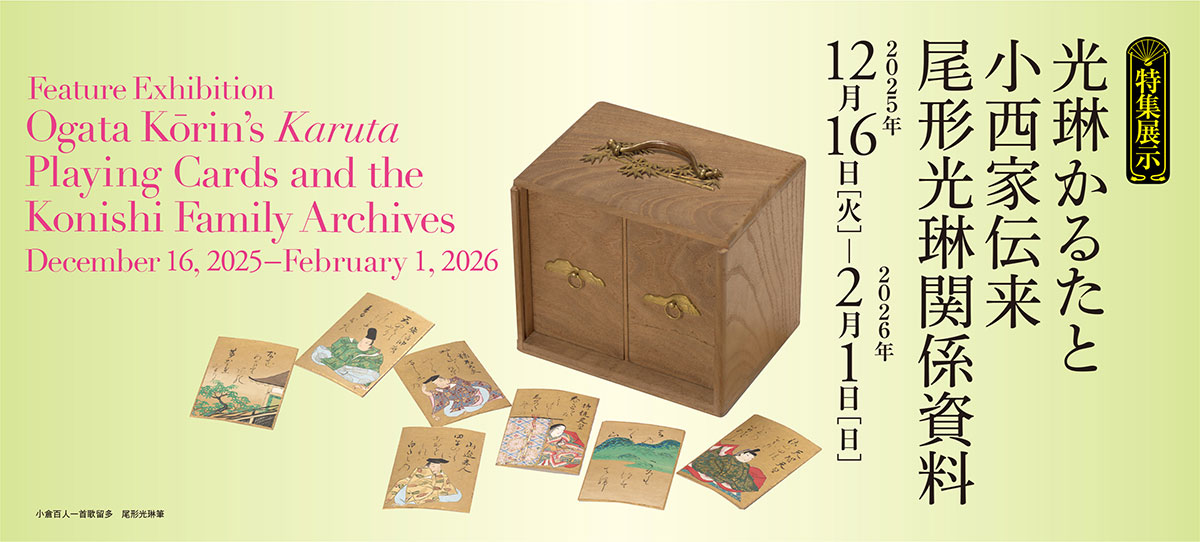
Feature Exhibition
Feature Exhibition
Ogata Kōrin’s Karuta Playing Cards and the Konishi Family ArchivesDecember 16, 2025–February 1, 2026
Feature Exhibition
New Year’s Feature Exhibition
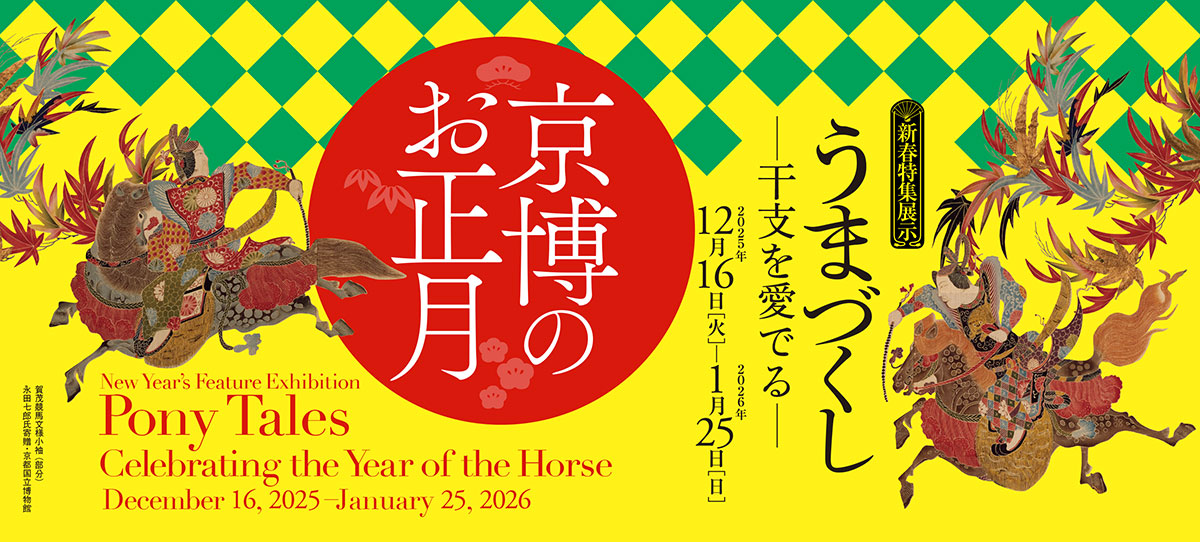
Pony Tales: Celebrating the Year of the HorseDecember 16, 2025–January 25, 2026
Feature Exhibitions
Feature Exhibition
Feature Exhibition
The Shimazu Clan of Satsuma and Tōfuku-ji’s Sokushū-in TempleDecember 16, 2025–January 25, 2026
Feature Exhibition
Feature Exhibition
Ogata Kōrin’s Karuta Playing Cards and the Konishi Family ArchivesDecember 16, 2025–February 1, 2026
Feature Exhibition
New Year’s Feature Exhibition
Pony Tales: Celebrating the Year of the HorseDecember 16, 2025–January 25, 2026
Feature Exhibitions
Feature Exhibition
Feature Exhibition
The Shimazu Clan of Satsuma and Tōfuku-ji’s Sokushū-in TempleDecember 16, 2025–January 25, 2026
Feature Exhibition
Feature Exhibition
Ogata Kōrin’s Karuta Playing Cards and the Konishi Family ArchivesDecember 16, 2025–February 1, 2026
Feature Exhibition
New Year’s Feature Exhibition
Pony Tales: Celebrating the Year of the HorseDecember 16, 2025–January 25, 2026
Feature Exhibitions
Feature Exhibition
Feature Exhibition
The Shimazu Clan of Satsuma and Tōfuku-ji’s Sokushū-in TempleDecember 16, 2025–January 25, 2026
Feature Exhibition
Feature Exhibition
Ogata Kōrin’s Karuta Playing Cards and the Konishi Family ArchivesDecember 16, 2025–February 1, 2026
Feature Exhibition
New Year’s Feature Exhibition
Pony Tales: Celebrating the Year of the HorseDecember 16, 2025–January 25, 2026
Feature Exhibitions
Feature Exhibition
Feature Exhibition
The Shimazu Clan of Satsuma and Tōfuku-ji’s Sokushū-in TempleDecember 16, 2025–January 25, 2026
Feature Exhibition
Feature Exhibition
Ogata Kōrin’s Karuta Playing Cards and the Konishi Family ArchivesDecember 16, 2025–February 1, 2026
Feature Exhibition
New Year’s Feature Exhibition
Pony Tales: Celebrating the Year of the HorseDecember 16, 2025–January 25, 2026
Feature Exhibitions
Feature Exhibition
Feature Exhibition
The Shimazu Clan of Satsuma and Tōfuku-ji’s Sokushū-in TempleDecember 16, 2025–January 25, 2026
Feature Exhibition
Feature Exhibition
Ogata Kōrin’s Karuta Playing Cards and the Konishi Family ArchivesDecember 16, 2025–February 1, 2026
Feature Exhibition
New Year’s Feature Exhibition
Pony Tales: Celebrating the Year of the HorseDecember 16, 2025–January 25, 2026
Feature Exhibitions
Feature Exhibition
Feature Exhibition
The Shimazu Clan of Satsuma and Tōfuku-ji’s Sokushū-in TempleDecember 16, 2025–January 25, 2026
Feature Exhibition
Feature Exhibition
Ogata Kōrin’s Karuta Playing Cards and the Konishi Family ArchivesDecember 16, 2025–February 1, 2026
Feature Exhibition
New Year’s Feature Exhibition
Pony Tales: Celebrating the Year of the HorseDecember 16, 2025–January 25, 2026
Feature Exhibitions
Feature Exhibition
Feature Exhibition
The Shimazu Clan of Satsuma and Tōfuku-ji’s Sokushū-in TempleDecember 16, 2025–January 25, 2026
Feature Exhibition
Feature Exhibition
Ogata Kōrin’s Karuta Playing Cards and the Konishi Family ArchivesDecember 16, 2025–February 1, 2026
Feature Exhibition
New Year’s Feature Exhibition
Pony Tales: Celebrating the Year of the HorseDecember 16, 2025–January 25, 2026
Feature Exhibitions
Feature Exhibition
Feature Exhibition
The Shimazu Clan of Satsuma and Tōfuku-ji’s Sokushū-in TempleDecember 16, 2025–January 25, 2026
Feature Exhibition
Feature Exhibition
Ogata Kōrin’s Karuta Playing Cards and the Konishi Family ArchivesDecember 16, 2025–February 1, 2026
Feature Exhibition
New Year’s Feature Exhibition
Pony Tales: Celebrating the Year of the HorseDecember 16, 2025–January 25, 2026
Feature Exhibitions
Feature Exhibition
Feature Exhibition
The Shimazu Clan of Satsuma and Tōfuku-ji’s Sokushū-in TempleDecember 16, 2025–January 25, 2026
Feature Exhibition
Feature Exhibition
Ogata Kōrin’s Karuta Playing Cards and the Konishi Family ArchivesDecember 16, 2025–February 1, 2026
Feature Exhibition
New Year’s Feature Exhibition
Pony Tales: Celebrating the Year of the HorseDecember 16, 2025–January 25, 2026
Feature Exhibitions
Feature Exhibition
Feature Exhibition
The Shimazu Clan of Satsuma and Tōfuku-ji’s Sokushū-in TempleDecember 16, 2025–January 25, 2026
Feature Exhibition
Feature Exhibition
Ogata Kōrin’s Karuta Playing Cards and the Konishi Family ArchivesDecember 16, 2025–February 1, 2026
Feature Exhibition
New Year’s Feature Exhibition
Pony Tales: Celebrating the Year of the HorseDecember 16, 2025–January 25, 2026
Feature Exhibitions
Feature Exhibition
Feature Exhibition
The Shimazu Clan of Satsuma and Tōfuku-ji’s Sokushū-in TempleDecember 16, 2025–January 25, 2026
Feature Exhibition
Feature Exhibition
Ogata Kōrin’s Karuta Playing Cards and the Konishi Family ArchivesDecember 16, 2025–February 1, 2026
Feature Exhibition
New Year’s Feature Exhibition
Pony Tales: Celebrating the Year of the HorseDecember 16, 2025–January 25, 2026
Feature Exhibitions
Feature Exhibition
Feature Exhibition
The Shimazu Clan of Satsuma and Tōfuku-ji’s Sokushū-in TempleDecember 16, 2025–January 25, 2026
Feature Exhibition
Feature Exhibition
Ogata Kōrin’s Karuta Playing Cards and the Konishi Family ArchivesDecember 16, 2025–February 1, 2026
Feature Exhibition
New Year’s Feature Exhibition
Pony Tales: Celebrating the Year of the HorseDecember 16, 2025–January 25, 2026
Feature Exhibitions
Feature Exhibition
Feature Exhibition
The Shimazu Clan of Satsuma and Tōfuku-ji’s Sokushū-in TempleDecember 16, 2025–January 25, 2026
Feature Exhibition
Feature Exhibition
Ogata Kōrin’s Karuta Playing Cards and the Konishi Family ArchivesDecember 16, 2025–February 1, 2026
Feature Exhibition
New Year’s Feature Exhibition
Pony Tales: Celebrating the Year of the HorseDecember 16, 2025–January 25, 2026
Feature Exhibitions
Feature Exhibition
Feature Exhibition
The Shimazu Clan of Satsuma and Tōfuku-ji’s Sokushū-in TempleDecember 16, 2025–January 25, 2026
Feature Exhibition
Feature Exhibition
Ogata Kōrin’s Karuta Playing Cards and the Konishi Family ArchivesDecember 16, 2025–February 1, 2026
Feature Exhibition
New Year’s Feature Exhibition
Pony Tales: Celebrating the Year of the HorseDecember 16, 2025–January 25, 2026
Feature Exhibitions
Feature Exhibition
Feature Exhibition
The Shimazu Clan of Satsuma and Tōfuku-ji’s Sokushū-in TempleDecember 16, 2025–January 25, 2026
Feature Exhibition
Feature Exhibition
Ogata Kōrin’s Karuta Playing Cards and the Konishi Family ArchivesDecember 16, 2025–February 1, 2026
Feature Exhibition
New Year’s Feature Exhibition
Pony Tales: Celebrating the Year of the HorseDecember 16, 2025–January 25, 2026
Feature Exhibitions
Feature Exhibition
Feature Exhibition
The Shimazu Clan of Satsuma and Tōfuku-ji’s Sokushū-in TempleDecember 16, 2025–January 25, 2026
Feature Exhibition
Feature Exhibition
Ogata Kōrin’s Karuta Playing Cards and the Konishi Family ArchivesDecember 16, 2025–February 1, 2026
Feature Exhibition
New Year’s Feature Exhibition
Pony Tales: Celebrating the Year of the HorseDecember 16, 2025–January 25, 2026
Feature Exhibitions
Feature Exhibition
Feature Exhibition
The Shimazu Clan of Satsuma and Tōfuku-ji’s Sokushū-in TempleDecember 16, 2025–January 25, 2026
Feature Exhibition
Feature Exhibition
Ogata Kōrin’s Karuta Playing Cards and the Konishi Family ArchivesDecember 16, 2025–February 1, 2026
Feature Exhibition
New Year’s Feature Exhibition
Pony Tales: Celebrating the Year of the HorseDecember 16, 2025–January 25, 2026
Feature Exhibitions
Feature Exhibition
Feature Exhibition
The Shimazu Clan of Satsuma and Tōfuku-ji’s Sokushū-in TempleDecember 16, 2025–January 25, 2026
Feature Exhibition
Feature Exhibition
Ogata Kōrin’s Karuta Playing Cards and the Konishi Family ArchivesDecember 16, 2025–February 1, 2026
Feature Exhibition
New Year’s Feature Exhibition
Pony Tales: Celebrating the Year of the HorseDecember 16, 2025–January 25, 2026
Feature Exhibitions
Feature Exhibition
Feature Exhibition
The Shimazu Clan of Satsuma and Tōfuku-ji’s Sokushū-in TempleDecember 16, 2025–January 25, 2026
Feature Exhibition
Feature Exhibition
Ogata Kōrin’s Karuta Playing Cards and the Konishi Family ArchivesDecember 16, 2025–February 1, 2026
Feature Exhibition
New Year’s Feature Exhibition
Pony Tales: Celebrating the Year of the HorseDecember 16, 2025–January 25, 2026
Feature Exhibitions
Feature Exhibition
Feature Exhibition
The Shimazu Clan of Satsuma and Tōfuku-ji’s Sokushū-in TempleDecember 16, 2025–January 25, 2026
Feature Exhibition
Feature Exhibition
Ogata Kōrin’s Karuta Playing Cards and the Konishi Family ArchivesDecember 16, 2025–February 1, 2026
Feature Exhibition
New Year’s Feature Exhibition
Pony Tales: Celebrating the Year of the HorseDecember 16, 2025–January 25, 2026
Feature Exhibitions
Feature Exhibition
Feature Exhibition
The Shimazu Clan of Satsuma and Tōfuku-ji’s Sokushū-in TempleDecember 16, 2025–January 25, 2026
Feature Exhibition
Feature Exhibition
Ogata Kōrin’s Karuta Playing Cards and the Konishi Family ArchivesDecember 16, 2025–February 1, 2026
Feature Exhibition
New Year’s Feature Exhibition
Pony Tales: Celebrating the Year of the HorseDecember 16, 2025–January 25, 2026
Feature Exhibitions
Feature Exhibition
Feature Exhibition
The Shimazu Clan of Satsuma and Tōfuku-ji’s Sokushū-in TempleDecember 16, 2025–January 25, 2026
Feature Exhibition
Feature Exhibition
Ogata Kōrin’s Karuta Playing Cards and the Konishi Family ArchivesDecember 16, 2025–February 1, 2026
Feature Exhibition
New Year’s Feature Exhibition
Pony Tales: Celebrating the Year of the HorseDecember 16, 2025–January 25, 2026
Feature Exhibitions
Feature Exhibition
Feature Exhibition
The Shimazu Clan of Satsuma and Tōfuku-ji’s Sokushū-in TempleDecember 16, 2025–January 25, 2026
Feature Exhibition
Feature Exhibition
Ogata Kōrin’s Karuta Playing Cards and the Konishi Family ArchivesDecember 16, 2025–February 1, 2026
Feature Exhibition
New Year’s Feature Exhibition
Pony Tales: Celebrating the Year of the HorseDecember 16, 2025–January 25, 2026
Feature Exhibitions
Feature Exhibition
Feature Exhibition
The Shimazu Clan of Satsuma and Tōfuku-ji’s Sokushū-in TempleDecember 16, 2025–January 25, 2026
Feature Exhibition
Feature Exhibition
Ogata Kōrin’s Karuta Playing Cards and the Konishi Family ArchivesDecember 16, 2025–February 1, 2026
Feature Exhibition
New Year’s Feature Exhibition
Pony Tales: Celebrating the Year of the HorseDecember 16, 2025–January 25, 2026
Also On View in the Collection Galleries特別展観覧料が必要
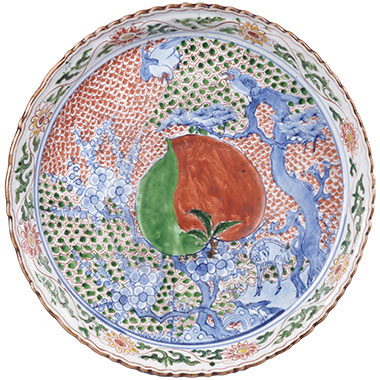
Polychrome Porcelain from the Late Ming and Early Qing Dynasties
December 16, 2025–March 15, 2026
Ceramics|3F-1 gallery
The late Ming and early Qing dynasties in China, spanning the end of the sixteenth to the seventeenth centuries, were an era of profound transformation, marked by intercultural exchange between the East and West as European culture spread throughout the globe. In Japan, such encounters exerted a wide-ranging influence and shaped the development of Edo-period (1615–1868) Japanese culture. This impacted numerous types of Japanese ceramics, ranging from Imari overglaze-enamel porcelain to Kyoto ware. This exhibition introduces a selection of Chinese polychrome porcelain——including iroe Shonzui, Nankin akae ("Nanjing red"), and famille verte (Kangxi wucai)——that shaped the emergence and development of Japan’s own overglaze enamel porcelain tradition.
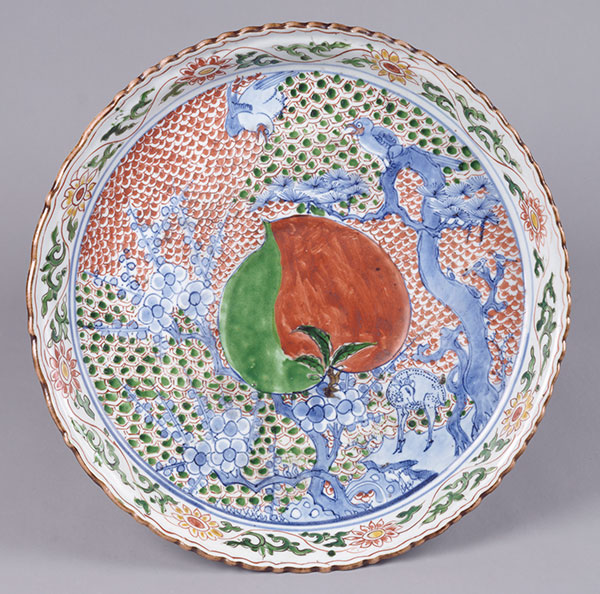
Lobed Dish with Peach, Pine, and Deer
Inscription: "Made during the Jiajing era of the Ming dynasty"
Kyoto National Museum
Ceramics of Japan and East Asia
December 16, 2025–March 15, 2026
Ceramics|3F-1 gallery
Ceramics are not only admired for their beauty but are also broadly used in daily life, making them one of the most familiar forms of decorative arts. East Asian ceramics in particular feature a rich variety of patterns, forms, and colors, and have equally wide-ranging uses. Additionally, the type of ware (such as earthenware or porcelain), clay, glazes, decor, and firing techniques each vary depending on the region of production. Focusing on Japan, China, and the Korean Peninsula, this gallery presents a diverse selection of East Asian ceramics, showcasing their distinctive qualities and artistic appeal.
Important Cultural Property
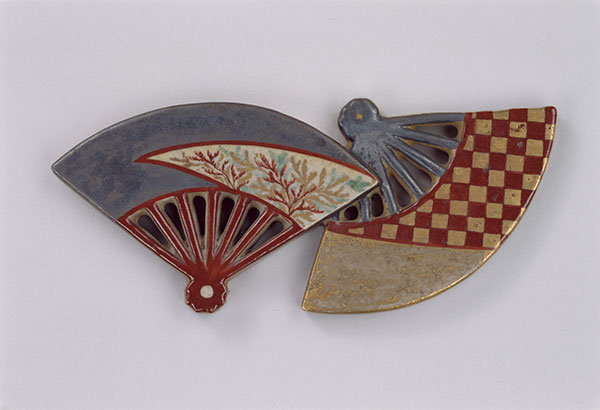
Decorative Nail Covers
Attributed to Nonomura Ninsei
Kyoto National Museum
Archaeological Materials from Northern Kyoto
December 16, 2025–March 15, 2026
Archaeological Relics|3F-2 gallery
Northern Kyoto Prefecture has long served as a hub of both domestic and international exchange. Comprising the Tango region and part of the Tamba region, the area is bordered by the Sea of Japan and mountains. Archaeological excavations have revealed that during the latter half of the early Jōmon period (pre-10,000–ca. 5th c. BCE), dugout canoes were used to travel across the open sea, while during the Yayoi (ca. 5th c. BCE–ca. 3rd c. CE) and Kofun (ca. 3rd c.–6th c.) periods, large tombs were constructed. The unique culture of northern Kyoto led to it being referred to as the “Tango Kingdom.” From the Heian period (794–1185) onward, the region maintained close ties with the capital yet also nurtured its own distinctive art and religious traditions, as evidenced by artifacts excavated from sutra mounds. This exhibition provides a glimpse into the rich culture of northern Kyoto through archaeological materials from the Jōmon period to the medieval era.
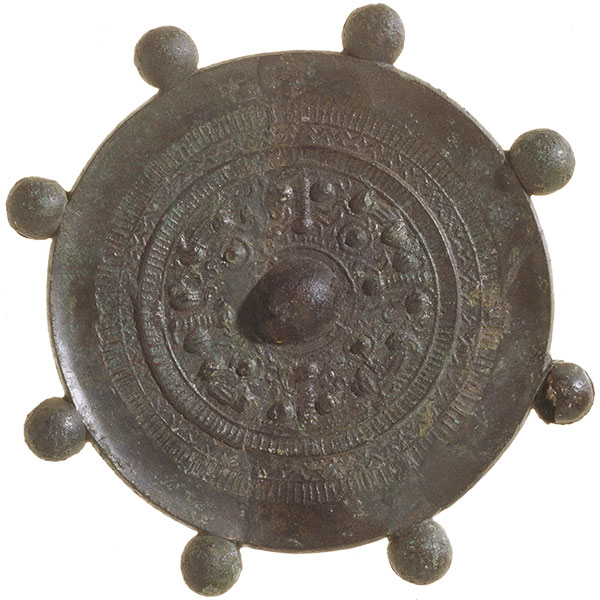
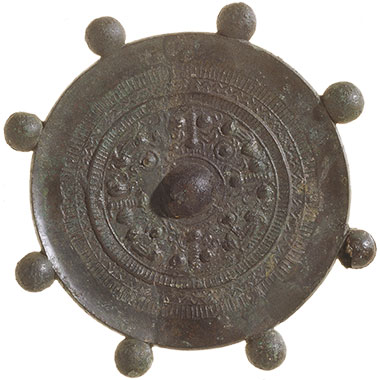
Mirror with Bells
Excavated from Benzai Tumulus No. 1, Kyoto
Kyoto National Museum
Archaeological Artifacts of Japan
December 16, 2025–March 15, 2026
Archaeological Relics|3F-2 gallery
This exhibition explores the history of Japan through introducing a variety of archaeological relics. Many of these artifacts were excavated from ancient ruins. Some are special tools used in rituals and ceremonies, while others are objects used by people in their daily lives. Through exploring Japanese archaeology, we can gain a sense of the lives and experiences of people of the past.
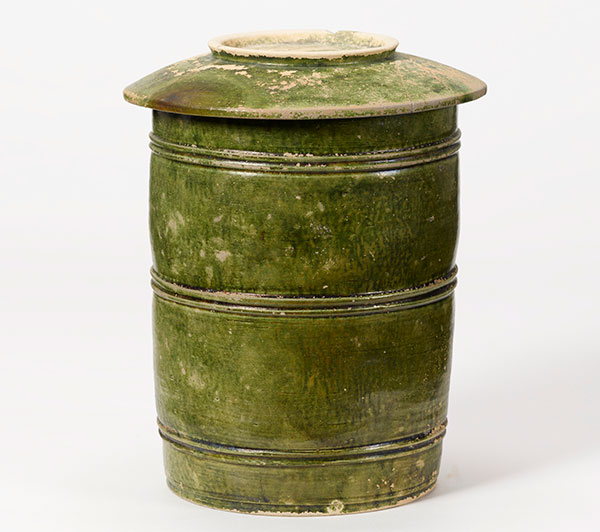
Important Cultural Property
Sutra Container
Reportedly excavated in Wakayama
Kyoto National Museum
Buddhist Sculpture of the Heian Period
December 16, 2025–March 22, 2026
Sculpture|1F-1 gallery
The Heian period (794–1185) was one of the most dynamic eras within the history of Japanese sculpture. The impression of Buddhist icons from the ninth century, during which the monks Saichō (767–822) and Kūkai (774–835) introduced Esoteric Buddhism from China, differs greatly from the serene air of twelfth-century statues.
Most temples were located in Kyoto’s surroundings until the middle of the Heian period. However, from the late Heian period onwards, temple construction within the capital itself increased, accompanied by the active production of Buddhist sculptures. Although unfortunately some works have been lost due to wars and natural disasters, many others have been carefully protected and passed down throughout generations. This exhibition presents a variety of sculptures capturing the spirit of the Heian period.
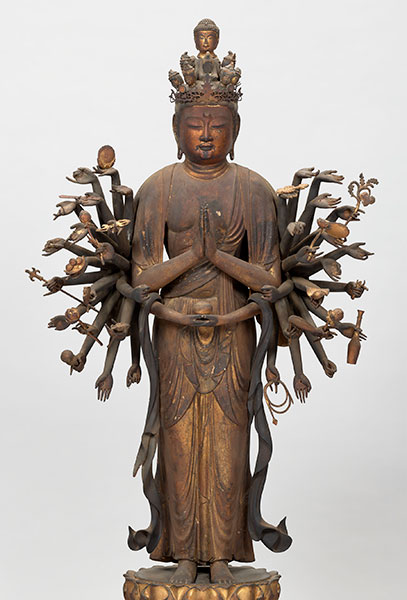
Important Cultural Property
Standing Thousand-Armed Kannon (Sahasrabhuja Avalokiteśvara) Bodhisattva
Zenkai-ji Temple, Kyoto
Shinto Deities and Pairs of Guardian Lions and Lion-Dogs
December 16, 2025–March 22, 2026
Sculpture|1F-1 gallery
Originally, indigenous Japanese deities (kami) were thought to be invisible to humans, but the influence of Buddhism lead to the production of statues of Shinto gods. Many of them were small in scale, as they were enclosed within miniature shrines. Shinto sculptures also distinguished between male and female deities and had a human-like appearance, sometimes being depicted wearing the clothing and armor of nobles or monks.
Lions and lion dogs are stationed at shrine entrances to guard the deity inside. Within this protective pair, the open-mouthed creature without horns is the lion, while the close-mouthed and horned figure is the lion-dog. Pairs of lions are sometimes placed before Buddha sculptures, as within Buddhism the roar of the "king of the beasts" is likened to the Buddha’s voice preaching the dharma. This exhibition presents a variety of sculptures, including stone figures from China and wooden statues from Japan.
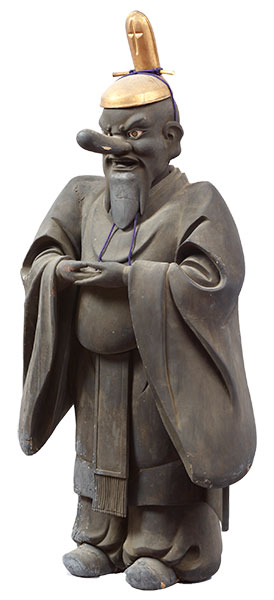
Standing Deity Traditionally Identified as Sarutahiko
Kyoto National Museum
Ink Traces: Calligraphy from Tōfuku-ji Temple
December 16, 2025–January 25, 2026
Calligraphy|1F-3 gallery
Bokuseki, literally "ink traces," refers to a form of calligraphy written by Zen Buddhist monks. Brushed in Chinese characters, the contents range widely from certificates of enlightenment to instructional literature to poems written at the time of death. These works, many of which are designated Important Cultural Properties, each provide insight essential to understanding Zen history and religious thought. The style of writing differs from the refined, delicate brushwork admired in earlier Japanese calligraphy, and is instead characterized by bold, heavy forms and assertive movement. Even if you cannot read what is written, we hope that you will enjoy the spontaneity and strength embodied in this selection of calligraphy from the great Zen temple Tōfuku-ji and its subtemples.
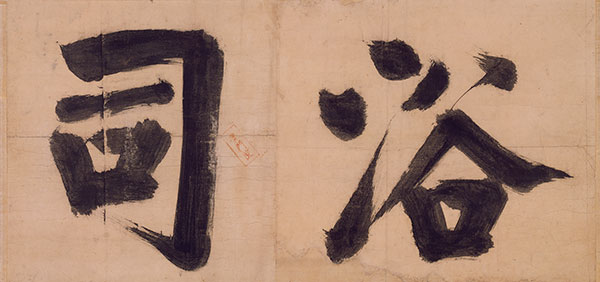
National Treasure
Calligraphy for a Zen Temple Plaque: "Bathhouse" (Yokusu)
By Zhang Jizhi
Tōfuku-ji Temple, Kyoto
Auspicious Motifs in Japanese Textiles
December 16, 2025–February 1, 2026
Textiles and Costumes|1F-4 gallery
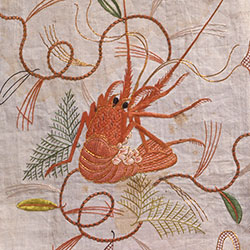
Since ancient times, the most prized patterns for clothing were those with auspicious associations. Patterns adorning garments and personal belongings were imbued with wishes for fundamental desires such as success, familial prosperity, and a long life. Some auspicious patterns originated in ancient China, while others developed out of Japanese customs. This exhibition, organized to celebrate the New Year, features textiles bearing celebratory motifs deriving from both cultures.
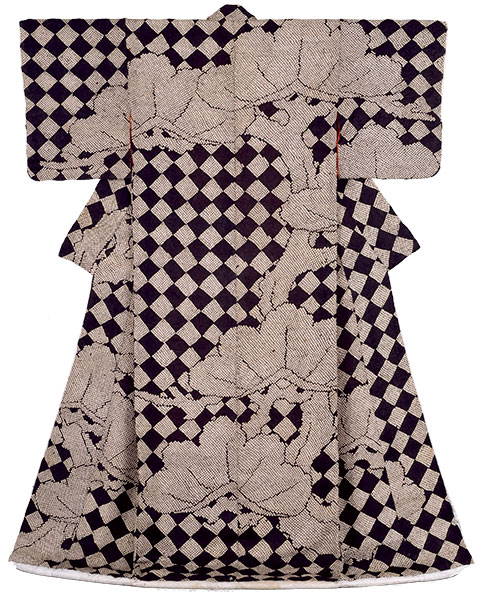
Kosode (Kimono) with Pine and Checks
Kyoto National Museum
Sacred Offerings: Mirrors, Keman Ornaments, and Armor
December 16, 2025–February 1, 2026
Metalwork|1F-5 gallery
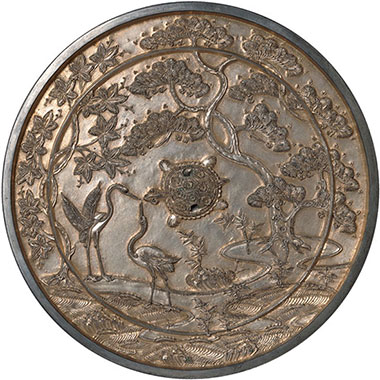
In Japan, people have long made a variety of offerings—— ranging from objects to performances of music and dance—— to honor Shinto and Buddhist deities and to express gratitude and prayer. Such offerings reflect the characteristics of the enshrined deity or principal image of worship, and, while following certain stylistic conventions, take a range of diverse forms. Among the many types of votive objects, this exhibition focuses on three principal themes: mirrors, Buddhist “flower garland” ornaments known as keman, and armor and garments dedicated to war deities.
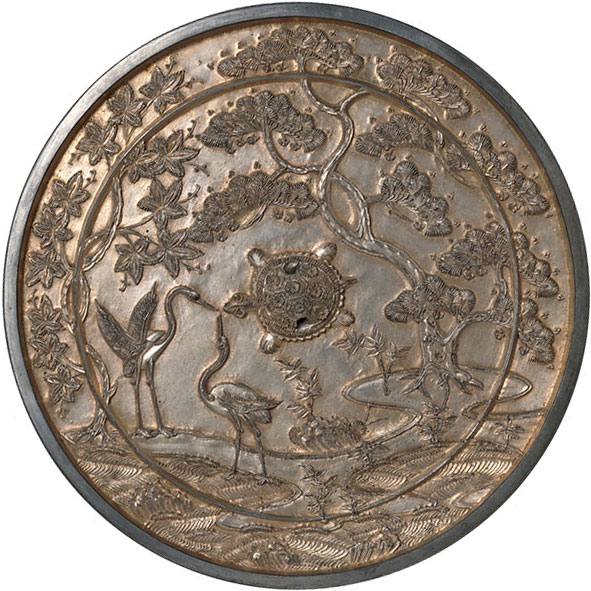
National Treasure
Mirror with Maples and Pair of Cranes
From the Sacred Treasures of Asuka Shrine
Kyoto National Museum
Elegance Crafted in Kyoto: The Minoya Lacquer Collection
December 16, 2025–February 1, 2026
Lacquerware|1F-6 gallery
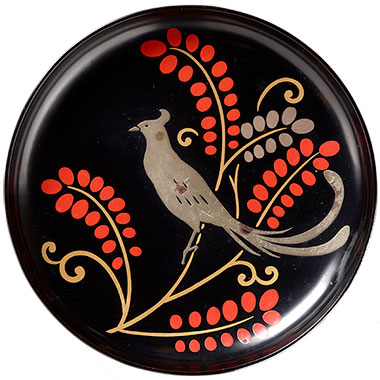
Founded in 1772, Minoya was a high-end lacquerware shop specializing in custom-made works reflecting the status and tastes of its clients. Unfortunately, the shop was forced to close its doors in 1945 due to concerns over declining quality amid shortages of materials and artisans. In 1990, the last head of Minoya generously donated several hundred sample works to the Kyoto National Museum. The collection reflects the meticulous craftsmanship that defined Minoya lacquers, produced through Kyoto’s distinctive system of divided labor: masters of woodturning and joinery crafted precise wooden bases, lacquer specialists applied perfectly even coats, and makie artists added intricate decorative motifs. This painstaking process would take one to three years from an initial order to delivery. We invite you to enjoy this selection of Kyoto lacquerware, whose subtle charm reflects Minoya’s rich collaboration with local workshops and the dedication of their artisans.
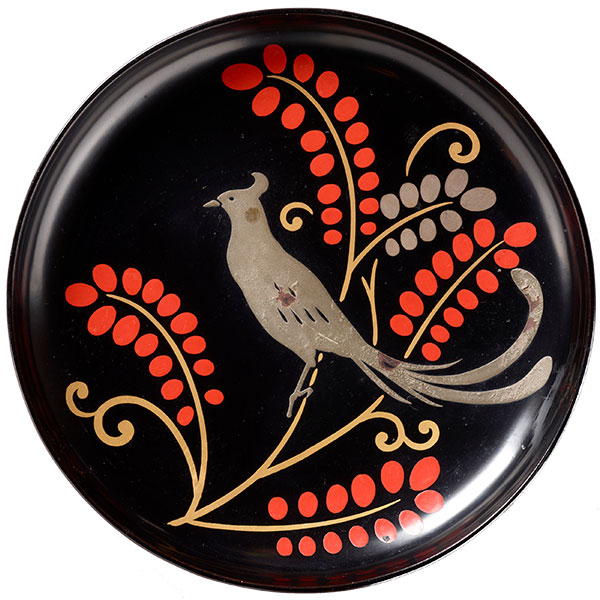
Dish for Sweets (Meimeibon) with Bird and Flowers
Kyoto National Museum
Also On View in the Collection Galleries特別展観覧料が必要
Polychrome Porcelain from the Late Ming and Early Qing Dynasties
December 16, 2025–March 15, 2026
Ceramics|3F-1 gallery
The late Ming and early Qing dynasties in China, spanning the end of the sixteenth to the seventeenth centuries, were an era of profound transformation, marked by intercultural exchange between the East and West as European culture spread throughout the globe. In Japan, such encounters exerted a wide-ranging influence and shaped the development of Edo-period (1615–1868) Japanese culture. This impacted numerous types of Japanese ceramics, ranging from Imari overglaze-enamel porcelain to Kyoto ware. This exhibition introduces a selection of Chinese polychrome porcelain——including iroe Shonzui, Nankin akae ("Nanjing red"), and famille verte (Kangxi wucai)——that shaped the emergence and development of Japan’s own overglaze enamel porcelain tradition.
Lobed Dish with Peach, Pine, and Deer
Inscription: "Made during the Jiajing era of the Ming dynasty"
Kyoto National Museum
Ceramics of Japan and East Asia
December 16, 2025–March 15, 2026
Ceramics|3F-1 gallery
Ceramics are not only admired for their beauty but are also broadly used in daily life, making them one of the most familiar forms of decorative arts. East Asian ceramics in particular feature a rich variety of patterns, forms, and colors, and have equally wide-ranging uses. Additionally, the type of ware (such as earthenware or porcelain), clay, glazes, decor, and firing techniques each vary depending on the region of production. Focusing on Japan, China, and the Korean Peninsula, this gallery presents a diverse selection of East Asian ceramics, showcasing their distinctive qualities and artistic appeal.
Important Cultural Property
Decorative Nail Covers
Attributed to Nonomura Ninsei
Kyoto National Museum
Archaeological Materials from Northern Kyoto
December 16, 2025–March 15, 2026
Archaeological Relics|3F-2 gallery
Northern Kyoto Prefecture has long served as a hub of both domestic and international exchange. Comprising the Tango region and part of the Tamba region, the area is bordered by the Sea of Japan and mountains. Archaeological excavations have revealed that during the latter half of the early Jōmon period (pre-10,000–ca. 5th c. BCE), dugout canoes were used to travel across the open sea, while during the Yayoi (ca. 5th c. BCE–ca. 3rd c. CE) and Kofun (ca. 3rd c.–6th c.) periods, large tombs were constructed. The unique culture of northern Kyoto led to it being referred to as the “Tango Kingdom.” From the Heian period (794–1185) onward, the region maintained close ties with the capital yet also nurtured its own distinctive art and religious traditions, as evidenced by artifacts excavated from sutra mounds. This exhibition provides a glimpse into the rich culture of northern Kyoto through archaeological materials from the Jōmon period to the medieval era.
Mirror with Bells
Excavated from Benzai Tumulus No. 1, Kyoto
Kyoto National Museum
Archaeological Artifacts of Japan
December 16, 2025–March 15, 2026
Archaeological Relics|3F-2 gallery
This exhibition explores the history of Japan through introducing a variety of archaeological relics. Many of these artifacts were excavated from ancient ruins. Some are special tools used in rituals and ceremonies, while others are objects used by people in their daily lives. Through exploring Japanese archaeology, we can gain a sense of the lives and experiences of people of the past.
Important Cultural Property
Sutra Container
Reportedly excavated in Wakayama
Kyoto National Museum
Buddhist Sculpture of the Heian Period
December 16, 2025–March 22, 2026
Sculpture|1F-1 gallery
The Heian period (794–1185) was one of the most dynamic eras within the history of Japanese sculpture. The impression of Buddhist icons from the ninth century, during which the monks Saichō (767–822) and Kūkai (774–835) introduced Esoteric Buddhism from China, differs greatly from the serene air of twelfth-century statues.
Most temples were located in Kyoto’s surroundings until the middle of the Heian period. However, from the late Heian period onwards, temple construction within the capital itself increased, accompanied by the active production of Buddhist sculptures. Although unfortunately some works have been lost due to wars and natural disasters, many others have been carefully protected and passed down throughout generations. This exhibition presents a variety of sculptures capturing the spirit of the Heian period.
Important Cultural Property
Standing Thousand-Armed Kannon (Sahasrabhuja Avalokiteśvara) Bodhisattva
Zenkai-ji Temple, Kyoto
Shinto Deities and Pairs of Guardian Lions and Lion-Dogs
December 16, 2025–March 22, 2026
Sculpture|1F-1 gallery
Originally, indigenous Japanese deities (kami) were thought to be invisible to humans, but the influence of Buddhism lead to the production of statues of Shinto gods. Many of them were small in scale, as they were enclosed within miniature shrines. Shinto sculptures also distinguished between male and female deities and had a human-like appearance, sometimes being depicted wearing the clothing and armor of nobles or monks.
Lions and lion dogs are stationed at shrine entrances to guard the deity inside. Within this protective pair, the open-mouthed creature without horns is the lion, while the close-mouthed and horned figure is the lion-dog. Pairs of lions are sometimes placed before Buddha sculptures, as within Buddhism the roar of the "king of the beasts" is likened to the Buddha’s voice preaching the dharma. This exhibition presents a variety of sculptures, including stone figures from China and wooden statues from Japan.
Standing Deity Traditionally Identified as Sarutahiko
Kyoto National Museum
Ink Traces: Calligraphy from Tōfuku-ji Temple
December 16, 2025–January 25, 2026
Calligraphy|1F-3 gallery
Bokuseki, literally "ink traces," refers to a form of calligraphy written by Zen Buddhist monks. Brushed in Chinese characters, the contents range widely from certificates of enlightenment to instructional literature to poems written at the time of death. These works, many of which are designated Important Cultural Properties, each provide insight essential to understanding Zen history and religious thought. The style of writing differs from the refined, delicate brushwork admired in earlier Japanese calligraphy, and is instead characterized by bold, heavy forms and assertive movement. Even if you cannot read what is written, we hope that you will enjoy the spontaneity and strength embodied in this selection of calligraphy from the great Zen temple Tōfuku-ji and its subtemples.
National Treasure
Calligraphy for a Zen Temple Plaque: "Bathhouse" (Yokusu)
By Zhang Jizhi
Tōfuku-ji Temple, Kyoto
Auspicious Motifs in Japanese Textiles
December 16, 2025–February 1, 2026
Textiles and Costumes|1F-4 gallery
Since ancient times, the most prized patterns for clothing were those with auspicious associations. Patterns adorning garments and personal belongings were imbued with wishes for fundamental desires such as success, familial prosperity, and a long life. Some auspicious patterns originated in ancient China, while others developed out of Japanese customs. This exhibition, organized to celebrate the New Year, features textiles bearing celebratory motifs deriving from both cultures.
Kosode (Kimono) with Pine and Checks
Kyoto National Museum
Sacred Offerings: Mirrors, Keman Ornaments, and Armor
December 16, 2025–February 1, 2026
Metalwork|1F-5 gallery
In Japan, people have long made a variety of offerings—— ranging from objects to performances of music and dance—— to honor Shinto and Buddhist deities and to express gratitude and prayer. Such offerings reflect the characteristics of the enshrined deity or principal image of worship, and, while following certain stylistic conventions, take a range of diverse forms. Among the many types of votive objects, this exhibition focuses on three principal themes: mirrors, Buddhist “flower garland” ornaments known as keman, and armor and garments dedicated to war deities.
National Treasure
Mirror with Maples and Pair of Cranes
From the Sacred Treasures of Asuka Shrine
Kyoto National Museum
Elegance Crafted in Kyoto: The Minoya Lacquer Collection
December 16, 2025–February 1, 2026
Lacquerware|1F-6 gallery
Founded in 1772, Minoya was a high-end lacquerware shop specializing in custom-made works reflecting the status and tastes of its clients. Unfortunately, the shop was forced to close its doors in 1945 due to concerns over declining quality amid shortages of materials and artisans. In 1990, the last head of Minoya generously donated several hundred sample works to the Kyoto National Museum. The collection reflects the meticulous craftsmanship that defined Minoya lacquers, produced through Kyoto’s distinctive system of divided labor: masters of woodturning and joinery crafted precise wooden bases, lacquer specialists applied perfectly even coats, and makie artists added intricate decorative motifs. This painstaking process would take one to three years from an initial order to delivery. We invite you to enjoy this selection of Kyoto lacquerware, whose subtle charm reflects Minoya’s rich collaboration with local workshops and the dedication of their artisans.
Dish for Sweets (Meimeibon) with Bird and Flowers
Kyoto National Museum
Also On View in the Collection Galleries特別展観覧料が必要
Polychrome Porcelain from the Late Ming and Early Qing Dynasties
December 16, 2025–March 15, 2026
Ceramics|3F-1 gallery
The late Ming and early Qing dynasties in China, spanning the end of the sixteenth to the seventeenth centuries, were an era of profound transformation, marked by intercultural exchange between the East and West as European culture spread throughout the globe. In Japan, such encounters exerted a wide-ranging influence and shaped the development of Edo-period (1615–1868) Japanese culture. This impacted numerous types of Japanese ceramics, ranging from Imari overglaze-enamel porcelain to Kyoto ware. This exhibition introduces a selection of Chinese polychrome porcelain——including iroe Shonzui, Nankin akae ("Nanjing red"), and famille verte (Kangxi wucai)——that shaped the emergence and development of Japan’s own overglaze enamel porcelain tradition.
Lobed Dish with Peach, Pine, and Deer
Inscription: "Made during the Jiajing era of the Ming dynasty"
Kyoto National Museum
Ceramics of Japan and East Asia
December 16, 2025–March 15, 2026
Ceramics|3F-1 gallery
Ceramics are not only admired for their beauty but are also broadly used in daily life, making them one of the most familiar forms of decorative arts. East Asian ceramics in particular feature a rich variety of patterns, forms, and colors, and have equally wide-ranging uses. Additionally, the type of ware (such as earthenware or porcelain), clay, glazes, decor, and firing techniques each vary depending on the region of production. Focusing on Japan, China, and the Korean Peninsula, this gallery presents a diverse selection of East Asian ceramics, showcasing their distinctive qualities and artistic appeal.
Important Cultural Property
Decorative Nail Covers
Attributed to Nonomura Ninsei
Kyoto National Museum
Archaeological Materials from Northern Kyoto
December 16, 2025–March 15, 2026
Archaeological Relics|3F-2 gallery
Northern Kyoto Prefecture has long served as a hub of both domestic and international exchange. Comprising the Tango region and part of the Tamba region, the area is bordered by the Sea of Japan and mountains. Archaeological excavations have revealed that during the latter half of the early Jōmon period (pre-10,000–ca. 5th c. BCE), dugout canoes were used to travel across the open sea, while during the Yayoi (ca. 5th c. BCE–ca. 3rd c. CE) and Kofun (ca. 3rd c.–6th c.) periods, large tombs were constructed. The unique culture of northern Kyoto led to it being referred to as the “Tango Kingdom.” From the Heian period (794–1185) onward, the region maintained close ties with the capital yet also nurtured its own distinctive art and religious traditions, as evidenced by artifacts excavated from sutra mounds. This exhibition provides a glimpse into the rich culture of northern Kyoto through archaeological materials from the Jōmon period to the medieval era.
Mirror with Bells
Excavated from Benzai Tumulus No. 1, Kyoto
Kyoto National Museum
Archaeological Artifacts of Japan
December 16, 2025–March 15, 2026
Archaeological Relics|3F-2 gallery
This exhibition explores the history of Japan through introducing a variety of archaeological relics. Many of these artifacts were excavated from ancient ruins. Some are special tools used in rituals and ceremonies, while others are objects used by people in their daily lives. Through exploring Japanese archaeology, we can gain a sense of the lives and experiences of people of the past.
Important Cultural Property
Sutra Container
Reportedly excavated in Wakayama
Kyoto National Museum
Buddhist Sculpture of the Heian Period
December 16, 2025–March 22, 2026
Sculpture|1F-1 gallery
The Heian period (794–1185) was one of the most dynamic eras within the history of Japanese sculpture. The impression of Buddhist icons from the ninth century, during which the monks Saichō (767–822) and Kūkai (774–835) introduced Esoteric Buddhism from China, differs greatly from the serene air of twelfth-century statues.
Most temples were located in Kyoto’s surroundings until the middle of the Heian period. However, from the late Heian period onwards, temple construction within the capital itself increased, accompanied by the active production of Buddhist sculptures. Although unfortunately some works have been lost due to wars and natural disasters, many others have been carefully protected and passed down throughout generations. This exhibition presents a variety of sculptures capturing the spirit of the Heian period.
Important Cultural Property
Standing Thousand-Armed Kannon (Sahasrabhuja Avalokiteśvara) Bodhisattva
Zenkai-ji Temple, Kyoto
Shinto Deities and Pairs of Guardian Lions and Lion-Dogs
December 16, 2025–March 22, 2026
Sculpture|1F-1 gallery
Originally, indigenous Japanese deities (kami) were thought to be invisible to humans, but the influence of Buddhism lead to the production of statues of Shinto gods. Many of them were small in scale, as they were enclosed within miniature shrines. Shinto sculptures also distinguished between male and female deities and had a human-like appearance, sometimes being depicted wearing the clothing and armor of nobles or monks.
Lions and lion dogs are stationed at shrine entrances to guard the deity inside. Within this protective pair, the open-mouthed creature without horns is the lion, while the close-mouthed and horned figure is the lion-dog. Pairs of lions are sometimes placed before Buddha sculptures, as within Buddhism the roar of the "king of the beasts" is likened to the Buddha’s voice preaching the dharma. This exhibition presents a variety of sculptures, including stone figures from China and wooden statues from Japan.
Standing Deity Traditionally Identified as Sarutahiko
Kyoto National Museum
Ink Traces: Calligraphy from Tōfuku-ji Temple
December 16, 2025–January 25, 2026
Calligraphy|1F-3 gallery
Bokuseki, literally "ink traces," refers to a form of calligraphy written by Zen Buddhist monks. Brushed in Chinese characters, the contents range widely from certificates of enlightenment to instructional literature to poems written at the time of death. These works, many of which are designated Important Cultural Properties, each provide insight essential to understanding Zen history and religious thought. The style of writing differs from the refined, delicate brushwork admired in earlier Japanese calligraphy, and is instead characterized by bold, heavy forms and assertive movement. Even if you cannot read what is written, we hope that you will enjoy the spontaneity and strength embodied in this selection of calligraphy from the great Zen temple Tōfuku-ji and its subtemples.
National Treasure
Calligraphy for a Zen Temple Plaque: "Bathhouse" (Yokusu)
By Zhang Jizhi
Tōfuku-ji Temple, Kyoto
Auspicious Motifs in Japanese Textiles
December 16, 2025–February 1, 2026
Textiles and Costumes|1F-4 gallery
Since ancient times, the most prized patterns for clothing were those with auspicious associations. Patterns adorning garments and personal belongings were imbued with wishes for fundamental desires such as success, familial prosperity, and a long life. Some auspicious patterns originated in ancient China, while others developed out of Japanese customs. This exhibition, organized to celebrate the New Year, features textiles bearing celebratory motifs deriving from both cultures.
Kosode (Kimono) with Pine and Checks
Kyoto National Museum
Sacred Offerings: Mirrors, Keman Ornaments, and Armor
December 16, 2025–February 1, 2026
Metalwork|1F-5 gallery
In Japan, people have long made a variety of offerings—— ranging from objects to performances of music and dance—— to honor Shinto and Buddhist deities and to express gratitude and prayer. Such offerings reflect the characteristics of the enshrined deity or principal image of worship, and, while following certain stylistic conventions, take a range of diverse forms. Among the many types of votive objects, this exhibition focuses on three principal themes: mirrors, Buddhist “flower garland” ornaments known as keman, and armor and garments dedicated to war deities.
National Treasure
Mirror with Maples and Pair of Cranes
From the Sacred Treasures of Asuka Shrine
Kyoto National Museum
Elegance Crafted in Kyoto: The Minoya Lacquer Collection
December 16, 2025–February 1, 2026
Lacquerware|1F-6 gallery
Founded in 1772, Minoya was a high-end lacquerware shop specializing in custom-made works reflecting the status and tastes of its clients. Unfortunately, the shop was forced to close its doors in 1945 due to concerns over declining quality amid shortages of materials and artisans. In 1990, the last head of Minoya generously donated several hundred sample works to the Kyoto National Museum. The collection reflects the meticulous craftsmanship that defined Minoya lacquers, produced through Kyoto’s distinctive system of divided labor: masters of woodturning and joinery crafted precise wooden bases, lacquer specialists applied perfectly even coats, and makie artists added intricate decorative motifs. This painstaking process would take one to three years from an initial order to delivery. We invite you to enjoy this selection of Kyoto lacquerware, whose subtle charm reflects Minoya’s rich collaboration with local workshops and the dedication of their artisans.
Dish for Sweets (Meimeibon) with Bird and Flowers
Kyoto National Museum
Also On View in the Collection Galleries特別展観覧料が必要
Polychrome Porcelain from the Late Ming and Early Qing Dynasties
December 16, 2025–March 15, 2026
Ceramics|3F-1 gallery
The late Ming and early Qing dynasties in China, spanning the end of the sixteenth to the seventeenth centuries, were an era of profound transformation, marked by intercultural exchange between the East and West as European culture spread throughout the globe. In Japan, such encounters exerted a wide-ranging influence and shaped the development of Edo-period (1615–1868) Japanese culture. This impacted numerous types of Japanese ceramics, ranging from Imari overglaze-enamel porcelain to Kyoto ware. This exhibition introduces a selection of Chinese polychrome porcelain——including iroe Shonzui, Nankin akae ("Nanjing red"), and famille verte (Kangxi wucai)——that shaped the emergence and development of Japan’s own overglaze enamel porcelain tradition.
Lobed Dish with Peach, Pine, and Deer
Inscription: "Made during the Jiajing era of the Ming dynasty"
Kyoto National Museum
Ceramics of Japan and East Asia
December 16, 2025–March 15, 2026
Ceramics|3F-1 gallery
Ceramics are not only admired for their beauty but are also broadly used in daily life, making them one of the most familiar forms of decorative arts. East Asian ceramics in particular feature a rich variety of patterns, forms, and colors, and have equally wide-ranging uses. Additionally, the type of ware (such as earthenware or porcelain), clay, glazes, decor, and firing techniques each vary depending on the region of production. Focusing on Japan, China, and the Korean Peninsula, this gallery presents a diverse selection of East Asian ceramics, showcasing their distinctive qualities and artistic appeal.
Important Cultural Property
Decorative Nail Covers
Attributed to Nonomura Ninsei
Kyoto National Museum
Archaeological Materials from Northern Kyoto
December 16, 2025–March 15, 2026
Archaeological Relics|3F-2 gallery
Northern Kyoto Prefecture has long served as a hub of both domestic and international exchange. Comprising the Tango region and part of the Tamba region, the area is bordered by the Sea of Japan and mountains. Archaeological excavations have revealed that during the latter half of the early Jōmon period (pre-10,000–ca. 5th c. BCE), dugout canoes were used to travel across the open sea, while during the Yayoi (ca. 5th c. BCE–ca. 3rd c. CE) and Kofun (ca. 3rd c.–6th c.) periods, large tombs were constructed. The unique culture of northern Kyoto led to it being referred to as the “Tango Kingdom.” From the Heian period (794–1185) onward, the region maintained close ties with the capital yet also nurtured its own distinctive art and religious traditions, as evidenced by artifacts excavated from sutra mounds. This exhibition provides a glimpse into the rich culture of northern Kyoto through archaeological materials from the Jōmon period to the medieval era.
Mirror with Bells
Excavated from Benzai Tumulus No. 1, Kyoto
Kyoto National Museum
Archaeological Artifacts of Japan
December 16, 2025–March 15, 2026
Archaeological Relics|3F-2 gallery
This exhibition explores the history of Japan through introducing a variety of archaeological relics. Many of these artifacts were excavated from ancient ruins. Some are special tools used in rituals and ceremonies, while others are objects used by people in their daily lives. Through exploring Japanese archaeology, we can gain a sense of the lives and experiences of people of the past.
Important Cultural Property
Sutra Container
Reportedly excavated in Wakayama
Kyoto National Museum
Buddhist Sculpture of the Heian Period
December 16, 2025–March 22, 2026
Sculpture|1F-1 gallery
The Heian period (794–1185) was one of the most dynamic eras within the history of Japanese sculpture. The impression of Buddhist icons from the ninth century, during which the monks Saichō (767–822) and Kūkai (774–835) introduced Esoteric Buddhism from China, differs greatly from the serene air of twelfth-century statues.
Most temples were located in Kyoto’s surroundings until the middle of the Heian period. However, from the late Heian period onwards, temple construction within the capital itself increased, accompanied by the active production of Buddhist sculptures. Although unfortunately some works have been lost due to wars and natural disasters, many others have been carefully protected and passed down throughout generations. This exhibition presents a variety of sculptures capturing the spirit of the Heian period.
Important Cultural Property
Standing Thousand-Armed Kannon (Sahasrabhuja Avalokiteśvara) Bodhisattva
Zenkai-ji Temple, Kyoto
Shinto Deities and Pairs of Guardian Lions and Lion-Dogs
December 16, 2025–March 22, 2026
Sculpture|1F-1 gallery
Originally, indigenous Japanese deities (kami) were thought to be invisible to humans, but the influence of Buddhism lead to the production of statues of Shinto gods. Many of them were small in scale, as they were enclosed within miniature shrines. Shinto sculptures also distinguished between male and female deities and had a human-like appearance, sometimes being depicted wearing the clothing and armor of nobles or monks.
Lions and lion dogs are stationed at shrine entrances to guard the deity inside. Within this protective pair, the open-mouthed creature without horns is the lion, while the close-mouthed and horned figure is the lion-dog. Pairs of lions are sometimes placed before Buddha sculptures, as within Buddhism the roar of the "king of the beasts" is likened to the Buddha’s voice preaching the dharma. This exhibition presents a variety of sculptures, including stone figures from China and wooden statues from Japan.
Standing Deity Traditionally Identified as Sarutahiko
Kyoto National Museum
Ink Traces: Calligraphy from Tōfuku-ji Temple
December 16, 2025–January 25, 2026
Calligraphy|1F-3 gallery
Bokuseki, literally "ink traces," refers to a form of calligraphy written by Zen Buddhist monks. Brushed in Chinese characters, the contents range widely from certificates of enlightenment to instructional literature to poems written at the time of death. These works, many of which are designated Important Cultural Properties, each provide insight essential to understanding Zen history and religious thought. The style of writing differs from the refined, delicate brushwork admired in earlier Japanese calligraphy, and is instead characterized by bold, heavy forms and assertive movement. Even if you cannot read what is written, we hope that you will enjoy the spontaneity and strength embodied in this selection of calligraphy from the great Zen temple Tōfuku-ji and its subtemples.
National Treasure
Calligraphy for a Zen Temple Plaque: "Bathhouse" (Yokusu)
By Zhang Jizhi
Tōfuku-ji Temple, Kyoto
Auspicious Motifs in Japanese Textiles
December 16, 2025–February 1, 2026
Textiles and Costumes|1F-4 gallery
Since ancient times, the most prized patterns for clothing were those with auspicious associations. Patterns adorning garments and personal belongings were imbued with wishes for fundamental desires such as success, familial prosperity, and a long life. Some auspicious patterns originated in ancient China, while others developed out of Japanese customs. This exhibition, organized to celebrate the New Year, features textiles bearing celebratory motifs deriving from both cultures.
Kosode (Kimono) with Pine and Checks
Kyoto National Museum
Sacred Offerings: Mirrors, Keman Ornaments, and Armor
December 16, 2025–February 1, 2026
Metalwork|1F-5 gallery
In Japan, people have long made a variety of offerings—— ranging from objects to performances of music and dance—— to honor Shinto and Buddhist deities and to express gratitude and prayer. Such offerings reflect the characteristics of the enshrined deity or principal image of worship, and, while following certain stylistic conventions, take a range of diverse forms. Among the many types of votive objects, this exhibition focuses on three principal themes: mirrors, Buddhist “flower garland” ornaments known as keman, and armor and garments dedicated to war deities.
National Treasure
Mirror with Maples and Pair of Cranes
From the Sacred Treasures of Asuka Shrine
Kyoto National Museum
Elegance Crafted in Kyoto: The Minoya Lacquer Collection
December 16, 2025–February 1, 2026
Lacquerware|1F-6 gallery
Founded in 1772, Minoya was a high-end lacquerware shop specializing in custom-made works reflecting the status and tastes of its clients. Unfortunately, the shop was forced to close its doors in 1945 due to concerns over declining quality amid shortages of materials and artisans. In 1990, the last head of Minoya generously donated several hundred sample works to the Kyoto National Museum. The collection reflects the meticulous craftsmanship that defined Minoya lacquers, produced through Kyoto’s distinctive system of divided labor: masters of woodturning and joinery crafted precise wooden bases, lacquer specialists applied perfectly even coats, and makie artists added intricate decorative motifs. This painstaking process would take one to three years from an initial order to delivery. We invite you to enjoy this selection of Kyoto lacquerware, whose subtle charm reflects Minoya’s rich collaboration with local workshops and the dedication of their artisans.
Dish for Sweets (Meimeibon) with Bird and Flowers
Kyoto National Museum
Also On View in the Collection Galleries特別展観覧料が必要
Polychrome Porcelain from the Late Ming and Early Qing Dynasties
December 16, 2025–March 15, 2026
Ceramics|3F-1 gallery
The late Ming and early Qing dynasties in China, spanning the end of the sixteenth to the seventeenth centuries, were an era of profound transformation, marked by intercultural exchange between the East and West as European culture spread throughout the globe. In Japan, such encounters exerted a wide-ranging influence and shaped the development of Edo-period (1615–1868) Japanese culture. This impacted numerous types of Japanese ceramics, ranging from Imari overglaze-enamel porcelain to Kyoto ware. This exhibition introduces a selection of Chinese polychrome porcelain——including iroe Shonzui, Nankin akae ("Nanjing red"), and famille verte (Kangxi wucai)——that shaped the emergence and development of Japan’s own overglaze enamel porcelain tradition.
Lobed Dish with Peach, Pine, and Deer
Inscription: "Made during the Jiajing era of the Ming dynasty"
Kyoto National Museum
Ceramics of Japan and East Asia
December 16, 2025–March 15, 2026
Ceramics|3F-1 gallery
Ceramics are not only admired for their beauty but are also broadly used in daily life, making them one of the most familiar forms of decorative arts. East Asian ceramics in particular feature a rich variety of patterns, forms, and colors, and have equally wide-ranging uses. Additionally, the type of ware (such as earthenware or porcelain), clay, glazes, decor, and firing techniques each vary depending on the region of production. Focusing on Japan, China, and the Korean Peninsula, this gallery presents a diverse selection of East Asian ceramics, showcasing their distinctive qualities and artistic appeal.
Important Cultural Property
Decorative Nail Covers
Attributed to Nonomura Ninsei
Kyoto National Museum
Archaeological Materials from Northern Kyoto
December 16, 2025–March 15, 2026
Archaeological Relics|3F-2 gallery
Northern Kyoto Prefecture has long served as a hub of both domestic and international exchange. Comprising the Tango region and part of the Tamba region, the area is bordered by the Sea of Japan and mountains. Archaeological excavations have revealed that during the latter half of the early Jōmon period (pre-10,000–ca. 5th c. BCE), dugout canoes were used to travel across the open sea, while during the Yayoi (ca. 5th c. BCE–ca. 3rd c. CE) and Kofun (ca. 3rd c.–6th c.) periods, large tombs were constructed. The unique culture of northern Kyoto led to it being referred to as the “Tango Kingdom.” From the Heian period (794–1185) onward, the region maintained close ties with the capital yet also nurtured its own distinctive art and religious traditions, as evidenced by artifacts excavated from sutra mounds. This exhibition provides a glimpse into the rich culture of northern Kyoto through archaeological materials from the Jōmon period to the medieval era.
Mirror with Bells
Excavated from Benzai Tumulus No. 1, Kyoto
Kyoto National Museum
Archaeological Artifacts of Japan
December 16, 2025–March 15, 2026
Archaeological Relics|3F-2 gallery
This exhibition explores the history of Japan through introducing a variety of archaeological relics. Many of these artifacts were excavated from ancient ruins. Some are special tools used in rituals and ceremonies, while others are objects used by people in their daily lives. Through exploring Japanese archaeology, we can gain a sense of the lives and experiences of people of the past.
Important Cultural Property
Sutra Container
Reportedly excavated in Wakayama
Kyoto National Museum
Buddhist Sculpture of the Heian Period
December 16, 2025–March 22, 2026
Sculpture|1F-1 gallery
The Heian period (794–1185) was one of the most dynamic eras within the history of Japanese sculpture. The impression of Buddhist icons from the ninth century, during which the monks Saichō (767–822) and Kūkai (774–835) introduced Esoteric Buddhism from China, differs greatly from the serene air of twelfth-century statues.
Most temples were located in Kyoto’s surroundings until the middle of the Heian period. However, from the late Heian period onwards, temple construction within the capital itself increased, accompanied by the active production of Buddhist sculptures. Although unfortunately some works have been lost due to wars and natural disasters, many others have been carefully protected and passed down throughout generations. This exhibition presents a variety of sculptures capturing the spirit of the Heian period.
Important Cultural Property
Standing Thousand-Armed Kannon (Sahasrabhuja Avalokiteśvara) Bodhisattva
Zenkai-ji Temple, Kyoto
Shinto Deities and Pairs of Guardian Lions and Lion-Dogs
December 16, 2025–March 22, 2026
Sculpture|1F-1 gallery
Originally, indigenous Japanese deities (kami) were thought to be invisible to humans, but the influence of Buddhism lead to the production of statues of Shinto gods. Many of them were small in scale, as they were enclosed within miniature shrines. Shinto sculptures also distinguished between male and female deities and had a human-like appearance, sometimes being depicted wearing the clothing and armor of nobles or monks.
Lions and lion dogs are stationed at shrine entrances to guard the deity inside. Within this protective pair, the open-mouthed creature without horns is the lion, while the close-mouthed and horned figure is the lion-dog. Pairs of lions are sometimes placed before Buddha sculptures, as within Buddhism the roar of the "king of the beasts" is likened to the Buddha’s voice preaching the dharma. This exhibition presents a variety of sculptures, including stone figures from China and wooden statues from Japan.
Standing Deity Traditionally Identified as Sarutahiko
Kyoto National Museum
Ink Traces: Calligraphy from Tōfuku-ji Temple
December 16, 2025–January 25, 2026
Calligraphy|1F-3 gallery
Bokuseki, literally "ink traces," refers to a form of calligraphy written by Zen Buddhist monks. Brushed in Chinese characters, the contents range widely from certificates of enlightenment to instructional literature to poems written at the time of death. These works, many of which are designated Important Cultural Properties, each provide insight essential to understanding Zen history and religious thought. The style of writing differs from the refined, delicate brushwork admired in earlier Japanese calligraphy, and is instead characterized by bold, heavy forms and assertive movement. Even if you cannot read what is written, we hope that you will enjoy the spontaneity and strength embodied in this selection of calligraphy from the great Zen temple Tōfuku-ji and its subtemples.
National Treasure
Calligraphy for a Zen Temple Plaque: "Bathhouse" (Yokusu)
By Zhang Jizhi
Tōfuku-ji Temple, Kyoto
Auspicious Motifs in Japanese Textiles
December 16, 2025–February 1, 2026
Textiles and Costumes|1F-4 gallery
Since ancient times, the most prized patterns for clothing were those with auspicious associations. Patterns adorning garments and personal belongings were imbued with wishes for fundamental desires such as success, familial prosperity, and a long life. Some auspicious patterns originated in ancient China, while others developed out of Japanese customs. This exhibition, organized to celebrate the New Year, features textiles bearing celebratory motifs deriving from both cultures.
Kosode (Kimono) with Pine and Checks
Kyoto National Museum
Sacred Offerings: Mirrors, Keman Ornaments, and Armor
December 16, 2025–February 1, 2026
Metalwork|1F-5 gallery
In Japan, people have long made a variety of offerings—— ranging from objects to performances of music and dance—— to honor Shinto and Buddhist deities and to express gratitude and prayer. Such offerings reflect the characteristics of the enshrined deity or principal image of worship, and, while following certain stylistic conventions, take a range of diverse forms. Among the many types of votive objects, this exhibition focuses on three principal themes: mirrors, Buddhist “flower garland” ornaments known as keman, and armor and garments dedicated to war deities.
National Treasure
Mirror with Maples and Pair of Cranes
From the Sacred Treasures of Asuka Shrine
Kyoto National Museum
Elegance Crafted in Kyoto: The Minoya Lacquer Collection
December 16, 2025–February 1, 2026
Lacquerware|1F-6 gallery
Founded in 1772, Minoya was a high-end lacquerware shop specializing in custom-made works reflecting the status and tastes of its clients. Unfortunately, the shop was forced to close its doors in 1945 due to concerns over declining quality amid shortages of materials and artisans. In 1990, the last head of Minoya generously donated several hundred sample works to the Kyoto National Museum. The collection reflects the meticulous craftsmanship that defined Minoya lacquers, produced through Kyoto’s distinctive system of divided labor: masters of woodturning and joinery crafted precise wooden bases, lacquer specialists applied perfectly even coats, and makie artists added intricate decorative motifs. This painstaking process would take one to three years from an initial order to delivery. We invite you to enjoy this selection of Kyoto lacquerware, whose subtle charm reflects Minoya’s rich collaboration with local workshops and the dedication of their artisans.
Dish for Sweets (Meimeibon) with Bird and Flowers
Kyoto National Museum
Also On View in the Collection Galleries特別展観覧料が必要
Polychrome Porcelain from the Late Ming and Early Qing Dynasties
December 16, 2025–March 15, 2026
Ceramics|3F-1 gallery
The late Ming and early Qing dynasties in China, spanning the end of the sixteenth to the seventeenth centuries, were an era of profound transformation, marked by intercultural exchange between the East and West as European culture spread throughout the globe. In Japan, such encounters exerted a wide-ranging influence and shaped the development of Edo-period (1615–1868) Japanese culture. This impacted numerous types of Japanese ceramics, ranging from Imari overglaze-enamel porcelain to Kyoto ware. This exhibition introduces a selection of Chinese polychrome porcelain——including iroe Shonzui, Nankin akae ("Nanjing red"), and famille verte (Kangxi wucai)——that shaped the emergence and development of Japan’s own overglaze enamel porcelain tradition.
Lobed Dish with Peach, Pine, and Deer
Inscription: "Made during the Jiajing era of the Ming dynasty"
Kyoto National Museum
Ceramics of Japan and East Asia
December 16, 2025–March 15, 2026
Ceramics|3F-1 gallery
Ceramics are not only admired for their beauty but are also broadly used in daily life, making them one of the most familiar forms of decorative arts. East Asian ceramics in particular feature a rich variety of patterns, forms, and colors, and have equally wide-ranging uses. Additionally, the type of ware (such as earthenware or porcelain), clay, glazes, decor, and firing techniques each vary depending on the region of production. Focusing on Japan, China, and the Korean Peninsula, this gallery presents a diverse selection of East Asian ceramics, showcasing their distinctive qualities and artistic appeal.
Important Cultural Property
Decorative Nail Covers
Attributed to Nonomura Ninsei
Kyoto National Museum
Archaeological Materials from Northern Kyoto
December 16, 2025–March 15, 2026
Archaeological Relics|3F-2 gallery
Northern Kyoto Prefecture has long served as a hub of both domestic and international exchange. Comprising the Tango region and part of the Tamba region, the area is bordered by the Sea of Japan and mountains. Archaeological excavations have revealed that during the latter half of the early Jōmon period (pre-10,000–ca. 5th c. BCE), dugout canoes were used to travel across the open sea, while during the Yayoi (ca. 5th c. BCE–ca. 3rd c. CE) and Kofun (ca. 3rd c.–6th c.) periods, large tombs were constructed. The unique culture of northern Kyoto led to it being referred to as the “Tango Kingdom.” From the Heian period (794–1185) onward, the region maintained close ties with the capital yet also nurtured its own distinctive art and religious traditions, as evidenced by artifacts excavated from sutra mounds. This exhibition provides a glimpse into the rich culture of northern Kyoto through archaeological materials from the Jōmon period to the medieval era.
Mirror with Bells
Excavated from Benzai Tumulus No. 1, Kyoto
Kyoto National Museum
Archaeological Artifacts of Japan
December 16, 2025–March 15, 2026
Archaeological Relics|3F-2 gallery
This exhibition explores the history of Japan through introducing a variety of archaeological relics. Many of these artifacts were excavated from ancient ruins. Some are special tools used in rituals and ceremonies, while others are objects used by people in their daily lives. Through exploring Japanese archaeology, we can gain a sense of the lives and experiences of people of the past.
Important Cultural Property
Sutra Container
Reportedly excavated in Wakayama
Kyoto National Museum
Buddhist Sculpture of the Heian Period
December 16, 2025–March 22, 2026
Sculpture|1F-1 gallery
The Heian period (794–1185) was one of the most dynamic eras within the history of Japanese sculpture. The impression of Buddhist icons from the ninth century, during which the monks Saichō (767–822) and Kūkai (774–835) introduced Esoteric Buddhism from China, differs greatly from the serene air of twelfth-century statues.
Most temples were located in Kyoto’s surroundings until the middle of the Heian period. However, from the late Heian period onwards, temple construction within the capital itself increased, accompanied by the active production of Buddhist sculptures. Although unfortunately some works have been lost due to wars and natural disasters, many others have been carefully protected and passed down throughout generations. This exhibition presents a variety of sculptures capturing the spirit of the Heian period.
Important Cultural Property
Standing Thousand-Armed Kannon (Sahasrabhuja Avalokiteśvara) Bodhisattva
Zenkai-ji Temple, Kyoto
Shinto Deities and Pairs of Guardian Lions and Lion-Dogs
December 16, 2025–March 22, 2026
Sculpture|1F-1 gallery
Originally, indigenous Japanese deities (kami) were thought to be invisible to humans, but the influence of Buddhism lead to the production of statues of Shinto gods. Many of them were small in scale, as they were enclosed within miniature shrines. Shinto sculptures also distinguished between male and female deities and had a human-like appearance, sometimes being depicted wearing the clothing and armor of nobles or monks.
Lions and lion dogs are stationed at shrine entrances to guard the deity inside. Within this protective pair, the open-mouthed creature without horns is the lion, while the close-mouthed and horned figure is the lion-dog. Pairs of lions are sometimes placed before Buddha sculptures, as within Buddhism the roar of the "king of the beasts" is likened to the Buddha’s voice preaching the dharma. This exhibition presents a variety of sculptures, including stone figures from China and wooden statues from Japan.
Standing Deity Traditionally Identified as Sarutahiko
Kyoto National Museum
Ink Traces: Calligraphy from Tōfuku-ji Temple
December 16, 2025–January 25, 2026
Calligraphy|1F-3 gallery
Bokuseki, literally "ink traces," refers to a form of calligraphy written by Zen Buddhist monks. Brushed in Chinese characters, the contents range widely from certificates of enlightenment to instructional literature to poems written at the time of death. These works, many of which are designated Important Cultural Properties, each provide insight essential to understanding Zen history and religious thought. The style of writing differs from the refined, delicate brushwork admired in earlier Japanese calligraphy, and is instead characterized by bold, heavy forms and assertive movement. Even if you cannot read what is written, we hope that you will enjoy the spontaneity and strength embodied in this selection of calligraphy from the great Zen temple Tōfuku-ji and its subtemples.
National Treasure
Calligraphy for a Zen Temple Plaque: "Bathhouse" (Yokusu)
By Zhang Jizhi
Tōfuku-ji Temple, Kyoto
Auspicious Motifs in Japanese Textiles
December 16, 2025–February 1, 2026
Textiles and Costumes|1F-4 gallery
Since ancient times, the most prized patterns for clothing were those with auspicious associations. Patterns adorning garments and personal belongings were imbued with wishes for fundamental desires such as success, familial prosperity, and a long life. Some auspicious patterns originated in ancient China, while others developed out of Japanese customs. This exhibition, organized to celebrate the New Year, features textiles bearing celebratory motifs deriving from both cultures.
Kosode (Kimono) with Pine and Checks
Kyoto National Museum
Sacred Offerings: Mirrors, Keman Ornaments, and Armor
December 16, 2025–February 1, 2026
Metalwork|1F-5 gallery
In Japan, people have long made a variety of offerings—— ranging from objects to performances of music and dance—— to honor Shinto and Buddhist deities and to express gratitude and prayer. Such offerings reflect the characteristics of the enshrined deity or principal image of worship, and, while following certain stylistic conventions, take a range of diverse forms. Among the many types of votive objects, this exhibition focuses on three principal themes: mirrors, Buddhist “flower garland” ornaments known as keman, and armor and garments dedicated to war deities.
National Treasure
Mirror with Maples and Pair of Cranes
From the Sacred Treasures of Asuka Shrine
Kyoto National Museum
Elegance Crafted in Kyoto: The Minoya Lacquer Collection
December 16, 2025–February 1, 2026
Lacquerware|1F-6 gallery
Founded in 1772, Minoya was a high-end lacquerware shop specializing in custom-made works reflecting the status and tastes of its clients. Unfortunately, the shop was forced to close its doors in 1945 due to concerns over declining quality amid shortages of materials and artisans. In 1990, the last head of Minoya generously donated several hundred sample works to the Kyoto National Museum. The collection reflects the meticulous craftsmanship that defined Minoya lacquers, produced through Kyoto’s distinctive system of divided labor: masters of woodturning and joinery crafted precise wooden bases, lacquer specialists applied perfectly even coats, and makie artists added intricate decorative motifs. This painstaking process would take one to three years from an initial order to delivery. We invite you to enjoy this selection of Kyoto lacquerware, whose subtle charm reflects Minoya’s rich collaboration with local workshops and the dedication of their artisans.
Dish for Sweets (Meimeibon) with Bird and Flowers
Kyoto National Museum
Also On View in the Collection Galleries特別展観覧料が必要
Polychrome Porcelain from the Late Ming and Early Qing Dynasties
December 16, 2025–March 15, 2026
Ceramics|3F-1 gallery
The late Ming and early Qing dynasties in China, spanning the end of the sixteenth to the seventeenth centuries, were an era of profound transformation, marked by intercultural exchange between the East and West as European culture spread throughout the globe. In Japan, such encounters exerted a wide-ranging influence and shaped the development of Edo-period (1615–1868) Japanese culture. This impacted numerous types of Japanese ceramics, ranging from Imari overglaze-enamel porcelain to Kyoto ware. This exhibition introduces a selection of Chinese polychrome porcelain——including iroe Shonzui, Nankin akae ("Nanjing red"), and famille verte (Kangxi wucai)——that shaped the emergence and development of Japan’s own overglaze enamel porcelain tradition.
Lobed Dish with Peach, Pine, and Deer
Inscription: "Made during the Jiajing era of the Ming dynasty"
Kyoto National Museum
Ceramics of Japan and East Asia
December 16, 2025–March 15, 2026
Ceramics|3F-1 gallery
Ceramics are not only admired for their beauty but are also broadly used in daily life, making them one of the most familiar forms of decorative arts. East Asian ceramics in particular feature a rich variety of patterns, forms, and colors, and have equally wide-ranging uses. Additionally, the type of ware (such as earthenware or porcelain), clay, glazes, decor, and firing techniques each vary depending on the region of production. Focusing on Japan, China, and the Korean Peninsula, this gallery presents a diverse selection of East Asian ceramics, showcasing their distinctive qualities and artistic appeal.
Important Cultural Property
Decorative Nail Covers
Attributed to Nonomura Ninsei
Kyoto National Museum
Archaeological Materials from Northern Kyoto
December 16, 2025–March 15, 2026
Archaeological Relics|3F-2 gallery
Northern Kyoto Prefecture has long served as a hub of both domestic and international exchange. Comprising the Tango region and part of the Tamba region, the area is bordered by the Sea of Japan and mountains. Archaeological excavations have revealed that during the latter half of the early Jōmon period (pre-10,000–ca. 5th c. BCE), dugout canoes were used to travel across the open sea, while during the Yayoi (ca. 5th c. BCE–ca. 3rd c. CE) and Kofun (ca. 3rd c.–6th c.) periods, large tombs were constructed. The unique culture of northern Kyoto led to it being referred to as the “Tango Kingdom.” From the Heian period (794–1185) onward, the region maintained close ties with the capital yet also nurtured its own distinctive art and religious traditions, as evidenced by artifacts excavated from sutra mounds. This exhibition provides a glimpse into the rich culture of northern Kyoto through archaeological materials from the Jōmon period to the medieval era.
Mirror with Bells
Excavated from Benzai Tumulus No. 1, Kyoto
Kyoto National Museum
Archaeological Artifacts of Japan
December 16, 2025–March 15, 2026
Archaeological Relics|3F-2 gallery
This exhibition explores the history of Japan through introducing a variety of archaeological relics. Many of these artifacts were excavated from ancient ruins. Some are special tools used in rituals and ceremonies, while others are objects used by people in their daily lives. Through exploring Japanese archaeology, we can gain a sense of the lives and experiences of people of the past.
Important Cultural Property
Sutra Container
Reportedly excavated in Wakayama
Kyoto National Museum
Buddhist Sculpture of the Heian Period
December 16, 2025–March 22, 2026
Sculpture|1F-1 gallery
The Heian period (794–1185) was one of the most dynamic eras within the history of Japanese sculpture. The impression of Buddhist icons from the ninth century, during which the monks Saichō (767–822) and Kūkai (774–835) introduced Esoteric Buddhism from China, differs greatly from the serene air of twelfth-century statues.
Most temples were located in Kyoto’s surroundings until the middle of the Heian period. However, from the late Heian period onwards, temple construction within the capital itself increased, accompanied by the active production of Buddhist sculptures. Although unfortunately some works have been lost due to wars and natural disasters, many others have been carefully protected and passed down throughout generations. This exhibition presents a variety of sculptures capturing the spirit of the Heian period.
Important Cultural Property
Standing Thousand-Armed Kannon (Sahasrabhuja Avalokiteśvara) Bodhisattva
Zenkai-ji Temple, Kyoto
Shinto Deities and Pairs of Guardian Lions and Lion-Dogs
December 16, 2025–March 22, 2026
Sculpture|1F-1 gallery
Originally, indigenous Japanese deities (kami) were thought to be invisible to humans, but the influence of Buddhism lead to the production of statues of Shinto gods. Many of them were small in scale, as they were enclosed within miniature shrines. Shinto sculptures also distinguished between male and female deities and had a human-like appearance, sometimes being depicted wearing the clothing and armor of nobles or monks.
Lions and lion dogs are stationed at shrine entrances to guard the deity inside. Within this protective pair, the open-mouthed creature without horns is the lion, while the close-mouthed and horned figure is the lion-dog. Pairs of lions are sometimes placed before Buddha sculptures, as within Buddhism the roar of the "king of the beasts" is likened to the Buddha’s voice preaching the dharma. This exhibition presents a variety of sculptures, including stone figures from China and wooden statues from Japan.
Standing Deity Traditionally Identified as Sarutahiko
Kyoto National Museum
Ink Traces: Calligraphy from Tōfuku-ji Temple
December 16, 2025–January 25, 2026
Calligraphy|1F-3 gallery
Bokuseki, literally "ink traces," refers to a form of calligraphy written by Zen Buddhist monks. Brushed in Chinese characters, the contents range widely from certificates of enlightenment to instructional literature to poems written at the time of death. These works, many of which are designated Important Cultural Properties, each provide insight essential to understanding Zen history and religious thought. The style of writing differs from the refined, delicate brushwork admired in earlier Japanese calligraphy, and is instead characterized by bold, heavy forms and assertive movement. Even if you cannot read what is written, we hope that you will enjoy the spontaneity and strength embodied in this selection of calligraphy from the great Zen temple Tōfuku-ji and its subtemples.
National Treasure
Calligraphy for a Zen Temple Plaque: "Bathhouse" (Yokusu)
By Zhang Jizhi
Tōfuku-ji Temple, Kyoto
Auspicious Motifs in Japanese Textiles
December 16, 2025–February 1, 2026
Textiles and Costumes|1F-4 gallery
Since ancient times, the most prized patterns for clothing were those with auspicious associations. Patterns adorning garments and personal belongings were imbued with wishes for fundamental desires such as success, familial prosperity, and a long life. Some auspicious patterns originated in ancient China, while others developed out of Japanese customs. This exhibition, organized to celebrate the New Year, features textiles bearing celebratory motifs deriving from both cultures.
Kosode (Kimono) with Pine and Checks
Kyoto National Museum
Sacred Offerings: Mirrors, Keman Ornaments, and Armor
December 16, 2025–February 1, 2026
Metalwork|1F-5 gallery
In Japan, people have long made a variety of offerings—— ranging from objects to performances of music and dance—— to honor Shinto and Buddhist deities and to express gratitude and prayer. Such offerings reflect the characteristics of the enshrined deity or principal image of worship, and, while following certain stylistic conventions, take a range of diverse forms. Among the many types of votive objects, this exhibition focuses on three principal themes: mirrors, Buddhist “flower garland” ornaments known as keman, and armor and garments dedicated to war deities.
National Treasure
Mirror with Maples and Pair of Cranes
From the Sacred Treasures of Asuka Shrine
Kyoto National Museum
Elegance Crafted in Kyoto: The Minoya Lacquer Collection
December 16, 2025–February 1, 2026
Lacquerware|1F-6 gallery
Founded in 1772, Minoya was a high-end lacquerware shop specializing in custom-made works reflecting the status and tastes of its clients. Unfortunately, the shop was forced to close its doors in 1945 due to concerns over declining quality amid shortages of materials and artisans. In 1990, the last head of Minoya generously donated several hundred sample works to the Kyoto National Museum. The collection reflects the meticulous craftsmanship that defined Minoya lacquers, produced through Kyoto’s distinctive system of divided labor: masters of woodturning and joinery crafted precise wooden bases, lacquer specialists applied perfectly even coats, and makie artists added intricate decorative motifs. This painstaking process would take one to three years from an initial order to delivery. We invite you to enjoy this selection of Kyoto lacquerware, whose subtle charm reflects Minoya’s rich collaboration with local workshops and the dedication of their artisans.
Dish for Sweets (Meimeibon) with Bird and Flowers
Kyoto National Museum
Also On View in the Collection Galleries特別展観覧料が必要
Polychrome Porcelain from the Late Ming and Early Qing Dynasties
December 16, 2025–March 15, 2026
Ceramics|3F-1 gallery
The late Ming and early Qing dynasties in China, spanning the end of the sixteenth to the seventeenth centuries, were an era of profound transformation, marked by intercultural exchange between the East and West as European culture spread throughout the globe. In Japan, such encounters exerted a wide-ranging influence and shaped the development of Edo-period (1615–1868) Japanese culture. This impacted numerous types of Japanese ceramics, ranging from Imari overglaze-enamel porcelain to Kyoto ware. This exhibition introduces a selection of Chinese polychrome porcelain——including iroe Shonzui, Nankin akae ("Nanjing red"), and famille verte (Kangxi wucai)——that shaped the emergence and development of Japan’s own overglaze enamel porcelain tradition.
Lobed Dish with Peach, Pine, and Deer
Inscription: "Made during the Jiajing era of the Ming dynasty"
Kyoto National Museum
Ceramics of Japan and East Asia
December 16, 2025–March 15, 2026
Ceramics|3F-1 gallery
Ceramics are not only admired for their beauty but are also broadly used in daily life, making them one of the most familiar forms of decorative arts. East Asian ceramics in particular feature a rich variety of patterns, forms, and colors, and have equally wide-ranging uses. Additionally, the type of ware (such as earthenware or porcelain), clay, glazes, decor, and firing techniques each vary depending on the region of production. Focusing on Japan, China, and the Korean Peninsula, this gallery presents a diverse selection of East Asian ceramics, showcasing their distinctive qualities and artistic appeal.
Important Cultural Property
Decorative Nail Covers
Attributed to Nonomura Ninsei
Kyoto National Museum
Archaeological Materials from Northern Kyoto
December 16, 2025–March 15, 2026
Archaeological Relics|3F-2 gallery
Northern Kyoto Prefecture has long served as a hub of both domestic and international exchange. Comprising the Tango region and part of the Tamba region, the area is bordered by the Sea of Japan and mountains. Archaeological excavations have revealed that during the latter half of the early Jōmon period (pre-10,000–ca. 5th c. BCE), dugout canoes were used to travel across the open sea, while during the Yayoi (ca. 5th c. BCE–ca. 3rd c. CE) and Kofun (ca. 3rd c.–6th c.) periods, large tombs were constructed. The unique culture of northern Kyoto led to it being referred to as the “Tango Kingdom.” From the Heian period (794–1185) onward, the region maintained close ties with the capital yet also nurtured its own distinctive art and religious traditions, as evidenced by artifacts excavated from sutra mounds. This exhibition provides a glimpse into the rich culture of northern Kyoto through archaeological materials from the Jōmon period to the medieval era.
Mirror with Bells
Excavated from Benzai Tumulus No. 1, Kyoto
Kyoto National Museum
Archaeological Artifacts of Japan
December 16, 2025–March 15, 2026
Archaeological Relics|3F-2 gallery
This exhibition explores the history of Japan through introducing a variety of archaeological relics. Many of these artifacts were excavated from ancient ruins. Some are special tools used in rituals and ceremonies, while others are objects used by people in their daily lives. Through exploring Japanese archaeology, we can gain a sense of the lives and experiences of people of the past.
Important Cultural Property
Sutra Container
Reportedly excavated in Wakayama
Kyoto National Museum
Buddhist Sculpture of the Heian Period
December 16, 2025–March 22, 2026
Sculpture|1F-1 gallery
The Heian period (794–1185) was one of the most dynamic eras within the history of Japanese sculpture. The impression of Buddhist icons from the ninth century, during which the monks Saichō (767–822) and Kūkai (774–835) introduced Esoteric Buddhism from China, differs greatly from the serene air of twelfth-century statues.
Most temples were located in Kyoto’s surroundings until the middle of the Heian period. However, from the late Heian period onwards, temple construction within the capital itself increased, accompanied by the active production of Buddhist sculptures. Although unfortunately some works have been lost due to wars and natural disasters, many others have been carefully protected and passed down throughout generations. This exhibition presents a variety of sculptures capturing the spirit of the Heian period.
Important Cultural Property
Standing Thousand-Armed Kannon (Sahasrabhuja Avalokiteśvara) Bodhisattva
Zenkai-ji Temple, Kyoto
Shinto Deities and Pairs of Guardian Lions and Lion-Dogs
December 16, 2025–March 22, 2026
Sculpture|1F-1 gallery
Originally, indigenous Japanese deities (kami) were thought to be invisible to humans, but the influence of Buddhism lead to the production of statues of Shinto gods. Many of them were small in scale, as they were enclosed within miniature shrines. Shinto sculptures also distinguished between male and female deities and had a human-like appearance, sometimes being depicted wearing the clothing and armor of nobles or monks.
Lions and lion dogs are stationed at shrine entrances to guard the deity inside. Within this protective pair, the open-mouthed creature without horns is the lion, while the close-mouthed and horned figure is the lion-dog. Pairs of lions are sometimes placed before Buddha sculptures, as within Buddhism the roar of the "king of the beasts" is likened to the Buddha’s voice preaching the dharma. This exhibition presents a variety of sculptures, including stone figures from China and wooden statues from Japan.
Standing Deity Traditionally Identified as Sarutahiko
Kyoto National Museum
Ink Traces: Calligraphy from Tōfuku-ji Temple
December 16, 2025–January 25, 2026
Calligraphy|1F-3 gallery
Bokuseki, literally "ink traces," refers to a form of calligraphy written by Zen Buddhist monks. Brushed in Chinese characters, the contents range widely from certificates of enlightenment to instructional literature to poems written at the time of death. These works, many of which are designated Important Cultural Properties, each provide insight essential to understanding Zen history and religious thought. The style of writing differs from the refined, delicate brushwork admired in earlier Japanese calligraphy, and is instead characterized by bold, heavy forms and assertive movement. Even if you cannot read what is written, we hope that you will enjoy the spontaneity and strength embodied in this selection of calligraphy from the great Zen temple Tōfuku-ji and its subtemples.
National Treasure
Calligraphy for a Zen Temple Plaque: "Bathhouse" (Yokusu)
By Zhang Jizhi
Tōfuku-ji Temple, Kyoto
Auspicious Motifs in Japanese Textiles
December 16, 2025–February 1, 2026
Textiles and Costumes|1F-4 gallery
Since ancient times, the most prized patterns for clothing were those with auspicious associations. Patterns adorning garments and personal belongings were imbued with wishes for fundamental desires such as success, familial prosperity, and a long life. Some auspicious patterns originated in ancient China, while others developed out of Japanese customs. This exhibition, organized to celebrate the New Year, features textiles bearing celebratory motifs deriving from both cultures.
Kosode (Kimono) with Pine and Checks
Kyoto National Museum
Sacred Offerings: Mirrors, Keman Ornaments, and Armor
December 16, 2025–February 1, 2026
Metalwork|1F-5 gallery
In Japan, people have long made a variety of offerings—— ranging from objects to performances of music and dance—— to honor Shinto and Buddhist deities and to express gratitude and prayer. Such offerings reflect the characteristics of the enshrined deity or principal image of worship, and, while following certain stylistic conventions, take a range of diverse forms. Among the many types of votive objects, this exhibition focuses on three principal themes: mirrors, Buddhist “flower garland” ornaments known as keman, and armor and garments dedicated to war deities.
National Treasure
Mirror with Maples and Pair of Cranes
From the Sacred Treasures of Asuka Shrine
Kyoto National Museum
Elegance Crafted in Kyoto: The Minoya Lacquer Collection
December 16, 2025–February 1, 2026
Lacquerware|1F-6 gallery
Founded in 1772, Minoya was a high-end lacquerware shop specializing in custom-made works reflecting the status and tastes of its clients. Unfortunately, the shop was forced to close its doors in 1945 due to concerns over declining quality amid shortages of materials and artisans. In 1990, the last head of Minoya generously donated several hundred sample works to the Kyoto National Museum. The collection reflects the meticulous craftsmanship that defined Minoya lacquers, produced through Kyoto’s distinctive system of divided labor: masters of woodturning and joinery crafted precise wooden bases, lacquer specialists applied perfectly even coats, and makie artists added intricate decorative motifs. This painstaking process would take one to three years from an initial order to delivery. We invite you to enjoy this selection of Kyoto lacquerware, whose subtle charm reflects Minoya’s rich collaboration with local workshops and the dedication of their artisans.
Dish for Sweets (Meimeibon) with Bird and Flowers
Kyoto National Museum
Also On View in the Collection Galleries特別展観覧料が必要
Polychrome Porcelain from the Late Ming and Early Qing Dynasties
December 16, 2025–March 15, 2026
Ceramics|3F-1 gallery
The late Ming and early Qing dynasties in China, spanning the end of the sixteenth to the seventeenth centuries, were an era of profound transformation, marked by intercultural exchange between the East and West as European culture spread throughout the globe. In Japan, such encounters exerted a wide-ranging influence and shaped the development of Edo-period (1615–1868) Japanese culture. This impacted numerous types of Japanese ceramics, ranging from Imari overglaze-enamel porcelain to Kyoto ware. This exhibition introduces a selection of Chinese polychrome porcelain——including iroe Shonzui, Nankin akae ("Nanjing red"), and famille verte (Kangxi wucai)——that shaped the emergence and development of Japan’s own overglaze enamel porcelain tradition.
Lobed Dish with Peach, Pine, and Deer
Inscription: "Made during the Jiajing era of the Ming dynasty"
Kyoto National Museum
Ceramics of Japan and East Asia
December 16, 2025–March 15, 2026
Ceramics|3F-1 gallery
Ceramics are not only admired for their beauty but are also broadly used in daily life, making them one of the most familiar forms of decorative arts. East Asian ceramics in particular feature a rich variety of patterns, forms, and colors, and have equally wide-ranging uses. Additionally, the type of ware (such as earthenware or porcelain), clay, glazes, decor, and firing techniques each vary depending on the region of production. Focusing on Japan, China, and the Korean Peninsula, this gallery presents a diverse selection of East Asian ceramics, showcasing their distinctive qualities and artistic appeal.
Important Cultural Property
Decorative Nail Covers
Attributed to Nonomura Ninsei
Kyoto National Museum
Archaeological Materials from Northern Kyoto
December 16, 2025–March 15, 2026
Archaeological Relics|3F-2 gallery
Northern Kyoto Prefecture has long served as a hub of both domestic and international exchange. Comprising the Tango region and part of the Tamba region, the area is bordered by the Sea of Japan and mountains. Archaeological excavations have revealed that during the latter half of the early Jōmon period (pre-10,000–ca. 5th c. BCE), dugout canoes were used to travel across the open sea, while during the Yayoi (ca. 5th c. BCE–ca. 3rd c. CE) and Kofun (ca. 3rd c.–6th c.) periods, large tombs were constructed. The unique culture of northern Kyoto led to it being referred to as the “Tango Kingdom.” From the Heian period (794–1185) onward, the region maintained close ties with the capital yet also nurtured its own distinctive art and religious traditions, as evidenced by artifacts excavated from sutra mounds. This exhibition provides a glimpse into the rich culture of northern Kyoto through archaeological materials from the Jōmon period to the medieval era.
Mirror with Bells
Excavated from Benzai Tumulus No. 1, Kyoto
Kyoto National Museum
Archaeological Artifacts of Japan
December 16, 2025–March 15, 2026
Archaeological Relics|3F-2 gallery
This exhibition explores the history of Japan through introducing a variety of archaeological relics. Many of these artifacts were excavated from ancient ruins. Some are special tools used in rituals and ceremonies, while others are objects used by people in their daily lives. Through exploring Japanese archaeology, we can gain a sense of the lives and experiences of people of the past.
Important Cultural Property
Sutra Container
Reportedly excavated in Wakayama
Kyoto National Museum
Buddhist Sculpture of the Heian Period
December 16, 2025–March 22, 2026
Sculpture|1F-1 gallery
The Heian period (794–1185) was one of the most dynamic eras within the history of Japanese sculpture. The impression of Buddhist icons from the ninth century, during which the monks Saichō (767–822) and Kūkai (774–835) introduced Esoteric Buddhism from China, differs greatly from the serene air of twelfth-century statues.
Most temples were located in Kyoto’s surroundings until the middle of the Heian period. However, from the late Heian period onwards, temple construction within the capital itself increased, accompanied by the active production of Buddhist sculptures. Although unfortunately some works have been lost due to wars and natural disasters, many others have been carefully protected and passed down throughout generations. This exhibition presents a variety of sculptures capturing the spirit of the Heian period.
Important Cultural Property
Standing Thousand-Armed Kannon (Sahasrabhuja Avalokiteśvara) Bodhisattva
Zenkai-ji Temple, Kyoto
Shinto Deities and Pairs of Guardian Lions and Lion-Dogs
December 16, 2025–March 22, 2026
Sculpture|1F-1 gallery
Originally, indigenous Japanese deities (kami) were thought to be invisible to humans, but the influence of Buddhism lead to the production of statues of Shinto gods. Many of them were small in scale, as they were enclosed within miniature shrines. Shinto sculptures also distinguished between male and female deities and had a human-like appearance, sometimes being depicted wearing the clothing and armor of nobles or monks.
Lions and lion dogs are stationed at shrine entrances to guard the deity inside. Within this protective pair, the open-mouthed creature without horns is the lion, while the close-mouthed and horned figure is the lion-dog. Pairs of lions are sometimes placed before Buddha sculptures, as within Buddhism the roar of the "king of the beasts" is likened to the Buddha’s voice preaching the dharma. This exhibition presents a variety of sculptures, including stone figures from China and wooden statues from Japan.
Standing Deity Traditionally Identified as Sarutahiko
Kyoto National Museum
Ink Traces: Calligraphy from Tōfuku-ji Temple
December 16, 2025–January 25, 2026
Calligraphy|1F-3 gallery
Bokuseki, literally "ink traces," refers to a form of calligraphy written by Zen Buddhist monks. Brushed in Chinese characters, the contents range widely from certificates of enlightenment to instructional literature to poems written at the time of death. These works, many of which are designated Important Cultural Properties, each provide insight essential to understanding Zen history and religious thought. The style of writing differs from the refined, delicate brushwork admired in earlier Japanese calligraphy, and is instead characterized by bold, heavy forms and assertive movement. Even if you cannot read what is written, we hope that you will enjoy the spontaneity and strength embodied in this selection of calligraphy from the great Zen temple Tōfuku-ji and its subtemples.
National Treasure
Calligraphy for a Zen Temple Plaque: "Bathhouse" (Yokusu)
By Zhang Jizhi
Tōfuku-ji Temple, Kyoto
Auspicious Motifs in Japanese Textiles
December 16, 2025–February 1, 2026
Textiles and Costumes|1F-4 gallery
Since ancient times, the most prized patterns for clothing were those with auspicious associations. Patterns adorning garments and personal belongings were imbued with wishes for fundamental desires such as success, familial prosperity, and a long life. Some auspicious patterns originated in ancient China, while others developed out of Japanese customs. This exhibition, organized to celebrate the New Year, features textiles bearing celebratory motifs deriving from both cultures.
Kosode (Kimono) with Pine and Checks
Kyoto National Museum
Sacred Offerings: Mirrors, Keman Ornaments, and Armor
December 16, 2025–February 1, 2026
Metalwork|1F-5 gallery
In Japan, people have long made a variety of offerings—— ranging from objects to performances of music and dance—— to honor Shinto and Buddhist deities and to express gratitude and prayer. Such offerings reflect the characteristics of the enshrined deity or principal image of worship, and, while following certain stylistic conventions, take a range of diverse forms. Among the many types of votive objects, this exhibition focuses on three principal themes: mirrors, Buddhist “flower garland” ornaments known as keman, and armor and garments dedicated to war deities.
National Treasure
Mirror with Maples and Pair of Cranes
From the Sacred Treasures of Asuka Shrine
Kyoto National Museum
Elegance Crafted in Kyoto: The Minoya Lacquer Collection
December 16, 2025–February 1, 2026
Lacquerware|1F-6 gallery
Founded in 1772, Minoya was a high-end lacquerware shop specializing in custom-made works reflecting the status and tastes of its clients. Unfortunately, the shop was forced to close its doors in 1945 due to concerns over declining quality amid shortages of materials and artisans. In 1990, the last head of Minoya generously donated several hundred sample works to the Kyoto National Museum. The collection reflects the meticulous craftsmanship that defined Minoya lacquers, produced through Kyoto’s distinctive system of divided labor: masters of woodturning and joinery crafted precise wooden bases, lacquer specialists applied perfectly even coats, and makie artists added intricate decorative motifs. This painstaking process would take one to three years from an initial order to delivery. We invite you to enjoy this selection of Kyoto lacquerware, whose subtle charm reflects Minoya’s rich collaboration with local workshops and the dedication of their artisans.
Dish for Sweets (Meimeibon) with Bird and Flowers
Kyoto National Museum
Also On View in the Collection Galleries特別展観覧料が必要
Polychrome Porcelain from the Late Ming and Early Qing Dynasties
December 16, 2025–March 15, 2026
Ceramics|3F-1 gallery
The late Ming and early Qing dynasties in China, spanning the end of the sixteenth to the seventeenth centuries, were an era of profound transformation, marked by intercultural exchange between the East and West as European culture spread throughout the globe. In Japan, such encounters exerted a wide-ranging influence and shaped the development of Edo-period (1615–1868) Japanese culture. This impacted numerous types of Japanese ceramics, ranging from Imari overglaze-enamel porcelain to Kyoto ware. This exhibition introduces a selection of Chinese polychrome porcelain——including iroe Shonzui, Nankin akae ("Nanjing red"), and famille verte (Kangxi wucai)——that shaped the emergence and development of Japan’s own overglaze enamel porcelain tradition.
Lobed Dish with Peach, Pine, and Deer
Inscription: "Made during the Jiajing era of the Ming dynasty"
Kyoto National Museum
Ceramics of Japan and East Asia
December 16, 2025–March 15, 2026
Ceramics|3F-1 gallery
Ceramics are not only admired for their beauty but are also broadly used in daily life, making them one of the most familiar forms of decorative arts. East Asian ceramics in particular feature a rich variety of patterns, forms, and colors, and have equally wide-ranging uses. Additionally, the type of ware (such as earthenware or porcelain), clay, glazes, decor, and firing techniques each vary depending on the region of production. Focusing on Japan, China, and the Korean Peninsula, this gallery presents a diverse selection of East Asian ceramics, showcasing their distinctive qualities and artistic appeal.
Important Cultural Property
Decorative Nail Covers
Attributed to Nonomura Ninsei
Kyoto National Museum
Archaeological Materials from Northern Kyoto
December 16, 2025–March 15, 2026
Archaeological Relics|3F-2 gallery
Northern Kyoto Prefecture has long served as a hub of both domestic and international exchange. Comprising the Tango region and part of the Tamba region, the area is bordered by the Sea of Japan and mountains. Archaeological excavations have revealed that during the latter half of the early Jōmon period (pre-10,000–ca. 5th c. BCE), dugout canoes were used to travel across the open sea, while during the Yayoi (ca. 5th c. BCE–ca. 3rd c. CE) and Kofun (ca. 3rd c.–6th c.) periods, large tombs were constructed. The unique culture of northern Kyoto led to it being referred to as the “Tango Kingdom.” From the Heian period (794–1185) onward, the region maintained close ties with the capital yet also nurtured its own distinctive art and religious traditions, as evidenced by artifacts excavated from sutra mounds. This exhibition provides a glimpse into the rich culture of northern Kyoto through archaeological materials from the Jōmon period to the medieval era.
Mirror with Bells
Excavated from Benzai Tumulus No. 1, Kyoto
Kyoto National Museum
Archaeological Artifacts of Japan
December 16, 2025–March 15, 2026
Archaeological Relics|3F-2 gallery
This exhibition explores the history of Japan through introducing a variety of archaeological relics. Many of these artifacts were excavated from ancient ruins. Some are special tools used in rituals and ceremonies, while others are objects used by people in their daily lives. Through exploring Japanese archaeology, we can gain a sense of the lives and experiences of people of the past.
Important Cultural Property
Sutra Container
Reportedly excavated in Wakayama
Kyoto National Museum
Buddhist Sculpture of the Heian Period
December 16, 2025–March 22, 2026
Sculpture|1F-1 gallery
The Heian period (794–1185) was one of the most dynamic eras within the history of Japanese sculpture. The impression of Buddhist icons from the ninth century, during which the monks Saichō (767–822) and Kūkai (774–835) introduced Esoteric Buddhism from China, differs greatly from the serene air of twelfth-century statues.
Most temples were located in Kyoto’s surroundings until the middle of the Heian period. However, from the late Heian period onwards, temple construction within the capital itself increased, accompanied by the active production of Buddhist sculptures. Although unfortunately some works have been lost due to wars and natural disasters, many others have been carefully protected and passed down throughout generations. This exhibition presents a variety of sculptures capturing the spirit of the Heian period.
Important Cultural Property
Standing Thousand-Armed Kannon (Sahasrabhuja Avalokiteśvara) Bodhisattva
Zenkai-ji Temple, Kyoto
Shinto Deities and Pairs of Guardian Lions and Lion-Dogs
December 16, 2025–March 22, 2026
Sculpture|1F-1 gallery
Originally, indigenous Japanese deities (kami) were thought to be invisible to humans, but the influence of Buddhism lead to the production of statues of Shinto gods. Many of them were small in scale, as they were enclosed within miniature shrines. Shinto sculptures also distinguished between male and female deities and had a human-like appearance, sometimes being depicted wearing the clothing and armor of nobles or monks.
Lions and lion dogs are stationed at shrine entrances to guard the deity inside. Within this protective pair, the open-mouthed creature without horns is the lion, while the close-mouthed and horned figure is the lion-dog. Pairs of lions are sometimes placed before Buddha sculptures, as within Buddhism the roar of the "king of the beasts" is likened to the Buddha’s voice preaching the dharma. This exhibition presents a variety of sculptures, including stone figures from China and wooden statues from Japan.
Standing Deity Traditionally Identified as Sarutahiko
Kyoto National Museum
Ink Traces: Calligraphy from Tōfuku-ji Temple
December 16, 2025–January 25, 2026
Calligraphy|1F-3 gallery
Bokuseki, literally "ink traces," refers to a form of calligraphy written by Zen Buddhist monks. Brushed in Chinese characters, the contents range widely from certificates of enlightenment to instructional literature to poems written at the time of death. These works, many of which are designated Important Cultural Properties, each provide insight essential to understanding Zen history and religious thought. The style of writing differs from the refined, delicate brushwork admired in earlier Japanese calligraphy, and is instead characterized by bold, heavy forms and assertive movement. Even if you cannot read what is written, we hope that you will enjoy the spontaneity and strength embodied in this selection of calligraphy from the great Zen temple Tōfuku-ji and its subtemples.
National Treasure
Calligraphy for a Zen Temple Plaque: "Bathhouse" (Yokusu)
By Zhang Jizhi
Tōfuku-ji Temple, Kyoto
Auspicious Motifs in Japanese Textiles
December 16, 2025–February 1, 2026
Textiles and Costumes|1F-4 gallery
Since ancient times, the most prized patterns for clothing were those with auspicious associations. Patterns adorning garments and personal belongings were imbued with wishes for fundamental desires such as success, familial prosperity, and a long life. Some auspicious patterns originated in ancient China, while others developed out of Japanese customs. This exhibition, organized to celebrate the New Year, features textiles bearing celebratory motifs deriving from both cultures.
Kosode (Kimono) with Pine and Checks
Kyoto National Museum
Sacred Offerings: Mirrors, Keman Ornaments, and Armor
December 16, 2025–February 1, 2026
Metalwork|1F-5 gallery
In Japan, people have long made a variety of offerings—— ranging from objects to performances of music and dance—— to honor Shinto and Buddhist deities and to express gratitude and prayer. Such offerings reflect the characteristics of the enshrined deity or principal image of worship, and, while following certain stylistic conventions, take a range of diverse forms. Among the many types of votive objects, this exhibition focuses on three principal themes: mirrors, Buddhist “flower garland” ornaments known as keman, and armor and garments dedicated to war deities.
National Treasure
Mirror with Maples and Pair of Cranes
From the Sacred Treasures of Asuka Shrine
Kyoto National Museum
Elegance Crafted in Kyoto: The Minoya Lacquer Collection
December 16, 2025–February 1, 2026
Lacquerware|1F-6 gallery
Founded in 1772, Minoya was a high-end lacquerware shop specializing in custom-made works reflecting the status and tastes of its clients. Unfortunately, the shop was forced to close its doors in 1945 due to concerns over declining quality amid shortages of materials and artisans. In 1990, the last head of Minoya generously donated several hundred sample works to the Kyoto National Museum. The collection reflects the meticulous craftsmanship that defined Minoya lacquers, produced through Kyoto’s distinctive system of divided labor: masters of woodturning and joinery crafted precise wooden bases, lacquer specialists applied perfectly even coats, and makie artists added intricate decorative motifs. This painstaking process would take one to three years from an initial order to delivery. We invite you to enjoy this selection of Kyoto lacquerware, whose subtle charm reflects Minoya’s rich collaboration with local workshops and the dedication of their artisans.
Dish for Sweets (Meimeibon) with Bird and Flowers
Kyoto National Museum
Also On View in the Collection Galleries特別展観覧料が必要
Polychrome Porcelain from the Late Ming and Early Qing Dynasties
December 16, 2025–March 15, 2026
Ceramics|3F-1 gallery
The late Ming and early Qing dynasties in China, spanning the end of the sixteenth to the seventeenth centuries, were an era of profound transformation, marked by intercultural exchange between the East and West as European culture spread throughout the globe. In Japan, such encounters exerted a wide-ranging influence and shaped the development of Edo-period (1615–1868) Japanese culture. This impacted numerous types of Japanese ceramics, ranging from Imari overglaze-enamel porcelain to Kyoto ware. This exhibition introduces a selection of Chinese polychrome porcelain——including iroe Shonzui, Nankin akae ("Nanjing red"), and famille verte (Kangxi wucai)——that shaped the emergence and development of Japan’s own overglaze enamel porcelain tradition.
Lobed Dish with Peach, Pine, and Deer
Inscription: "Made during the Jiajing era of the Ming dynasty"
Kyoto National Museum
Ceramics of Japan and East Asia
December 16, 2025–March 15, 2026
Ceramics|3F-1 gallery
Ceramics are not only admired for their beauty but are also broadly used in daily life, making them one of the most familiar forms of decorative arts. East Asian ceramics in particular feature a rich variety of patterns, forms, and colors, and have equally wide-ranging uses. Additionally, the type of ware (such as earthenware or porcelain), clay, glazes, decor, and firing techniques each vary depending on the region of production. Focusing on Japan, China, and the Korean Peninsula, this gallery presents a diverse selection of East Asian ceramics, showcasing their distinctive qualities and artistic appeal.
Important Cultural Property
Decorative Nail Covers
Attributed to Nonomura Ninsei
Kyoto National Museum
Archaeological Materials from Northern Kyoto
December 16, 2025–March 15, 2026
Archaeological Relics|3F-2 gallery
Northern Kyoto Prefecture has long served as a hub of both domestic and international exchange. Comprising the Tango region and part of the Tamba region, the area is bordered by the Sea of Japan and mountains. Archaeological excavations have revealed that during the latter half of the early Jōmon period (pre-10,000–ca. 5th c. BCE), dugout canoes were used to travel across the open sea, while during the Yayoi (ca. 5th c. BCE–ca. 3rd c. CE) and Kofun (ca. 3rd c.–6th c.) periods, large tombs were constructed. The unique culture of northern Kyoto led to it being referred to as the “Tango Kingdom.” From the Heian period (794–1185) onward, the region maintained close ties with the capital yet also nurtured its own distinctive art and religious traditions, as evidenced by artifacts excavated from sutra mounds. This exhibition provides a glimpse into the rich culture of northern Kyoto through archaeological materials from the Jōmon period to the medieval era.
Mirror with Bells
Excavated from Benzai Tumulus No. 1, Kyoto
Kyoto National Museum
Archaeological Artifacts of Japan
December 16, 2025–March 15, 2026
Archaeological Relics|3F-2 gallery
This exhibition explores the history of Japan through introducing a variety of archaeological relics. Many of these artifacts were excavated from ancient ruins. Some are special tools used in rituals and ceremonies, while others are objects used by people in their daily lives. Through exploring Japanese archaeology, we can gain a sense of the lives and experiences of people of the past.
Important Cultural Property
Sutra Container
Reportedly excavated in Wakayama
Kyoto National Museum
Buddhist Sculpture of the Heian Period
December 16, 2025–March 22, 2026
Sculpture|1F-1 gallery
The Heian period (794–1185) was one of the most dynamic eras within the history of Japanese sculpture. The impression of Buddhist icons from the ninth century, during which the monks Saichō (767–822) and Kūkai (774–835) introduced Esoteric Buddhism from China, differs greatly from the serene air of twelfth-century statues.
Most temples were located in Kyoto’s surroundings until the middle of the Heian period. However, from the late Heian period onwards, temple construction within the capital itself increased, accompanied by the active production of Buddhist sculptures. Although unfortunately some works have been lost due to wars and natural disasters, many others have been carefully protected and passed down throughout generations. This exhibition presents a variety of sculptures capturing the spirit of the Heian period.
Important Cultural Property
Standing Thousand-Armed Kannon (Sahasrabhuja Avalokiteśvara) Bodhisattva
Zenkai-ji Temple, Kyoto
Shinto Deities and Pairs of Guardian Lions and Lion-Dogs
December 16, 2025–March 22, 2026
Sculpture|1F-1 gallery
Originally, indigenous Japanese deities (kami) were thought to be invisible to humans, but the influence of Buddhism lead to the production of statues of Shinto gods. Many of them were small in scale, as they were enclosed within miniature shrines. Shinto sculptures also distinguished between male and female deities and had a human-like appearance, sometimes being depicted wearing the clothing and armor of nobles or monks.
Lions and lion dogs are stationed at shrine entrances to guard the deity inside. Within this protective pair, the open-mouthed creature without horns is the lion, while the close-mouthed and horned figure is the lion-dog. Pairs of lions are sometimes placed before Buddha sculptures, as within Buddhism the roar of the "king of the beasts" is likened to the Buddha’s voice preaching the dharma. This exhibition presents a variety of sculptures, including stone figures from China and wooden statues from Japan.
Standing Deity Traditionally Identified as Sarutahiko
Kyoto National Museum
Ink Traces: Calligraphy from Tōfuku-ji Temple
December 16, 2025–January 25, 2026
Calligraphy|1F-3 gallery
Bokuseki, literally "ink traces," refers to a form of calligraphy written by Zen Buddhist monks. Brushed in Chinese characters, the contents range widely from certificates of enlightenment to instructional literature to poems written at the time of death. These works, many of which are designated Important Cultural Properties, each provide insight essential to understanding Zen history and religious thought. The style of writing differs from the refined, delicate brushwork admired in earlier Japanese calligraphy, and is instead characterized by bold, heavy forms and assertive movement. Even if you cannot read what is written, we hope that you will enjoy the spontaneity and strength embodied in this selection of calligraphy from the great Zen temple Tōfuku-ji and its subtemples.
National Treasure
Calligraphy for a Zen Temple Plaque: "Bathhouse" (Yokusu)
By Zhang Jizhi
Tōfuku-ji Temple, Kyoto
Auspicious Motifs in Japanese Textiles
December 16, 2025–February 1, 2026
Textiles and Costumes|1F-4 gallery
Since ancient times, the most prized patterns for clothing were those with auspicious associations. Patterns adorning garments and personal belongings were imbued with wishes for fundamental desires such as success, familial prosperity, and a long life. Some auspicious patterns originated in ancient China, while others developed out of Japanese customs. This exhibition, organized to celebrate the New Year, features textiles bearing celebratory motifs deriving from both cultures.
Kosode (Kimono) with Pine and Checks
Kyoto National Museum
Sacred Offerings: Mirrors, Keman Ornaments, and Armor
December 16, 2025–February 1, 2026
Metalwork|1F-5 gallery
In Japan, people have long made a variety of offerings—— ranging from objects to performances of music and dance—— to honor Shinto and Buddhist deities and to express gratitude and prayer. Such offerings reflect the characteristics of the enshrined deity or principal image of worship, and, while following certain stylistic conventions, take a range of diverse forms. Among the many types of votive objects, this exhibition focuses on three principal themes: mirrors, Buddhist “flower garland” ornaments known as keman, and armor and garments dedicated to war deities.
National Treasure
Mirror with Maples and Pair of Cranes
From the Sacred Treasures of Asuka Shrine
Kyoto National Museum
Elegance Crafted in Kyoto: The Minoya Lacquer Collection
December 16, 2025–February 1, 2026
Lacquerware|1F-6 gallery
Founded in 1772, Minoya was a high-end lacquerware shop specializing in custom-made works reflecting the status and tastes of its clients. Unfortunately, the shop was forced to close its doors in 1945 due to concerns over declining quality amid shortages of materials and artisans. In 1990, the last head of Minoya generously donated several hundred sample works to the Kyoto National Museum. The collection reflects the meticulous craftsmanship that defined Minoya lacquers, produced through Kyoto’s distinctive system of divided labor: masters of woodturning and joinery crafted precise wooden bases, lacquer specialists applied perfectly even coats, and makie artists added intricate decorative motifs. This painstaking process would take one to three years from an initial order to delivery. We invite you to enjoy this selection of Kyoto lacquerware, whose subtle charm reflects Minoya’s rich collaboration with local workshops and the dedication of their artisans.
Dish for Sweets (Meimeibon) with Bird and Flowers
Kyoto National Museum
Also On View in the Collection Galleries特別展観覧料が必要
Polychrome Porcelain from the Late Ming and Early Qing Dynasties
December 16, 2025–March 15, 2026
Ceramics|3F-1 gallery
The late Ming and early Qing dynasties in China, spanning the end of the sixteenth to the seventeenth centuries, were an era of profound transformation, marked by intercultural exchange between the East and West as European culture spread throughout the globe. In Japan, such encounters exerted a wide-ranging influence and shaped the development of Edo-period (1615–1868) Japanese culture. This impacted numerous types of Japanese ceramics, ranging from Imari overglaze-enamel porcelain to Kyoto ware. This exhibition introduces a selection of Chinese polychrome porcelain——including iroe Shonzui, Nankin akae ("Nanjing red"), and famille verte (Kangxi wucai)——that shaped the emergence and development of Japan’s own overglaze enamel porcelain tradition.
Lobed Dish with Peach, Pine, and Deer
Inscription: "Made during the Jiajing era of the Ming dynasty"
Kyoto National Museum
Ceramics of Japan and East Asia
December 16, 2025–March 15, 2026
Ceramics|3F-1 gallery
Ceramics are not only admired for their beauty but are also broadly used in daily life, making them one of the most familiar forms of decorative arts. East Asian ceramics in particular feature a rich variety of patterns, forms, and colors, and have equally wide-ranging uses. Additionally, the type of ware (such as earthenware or porcelain), clay, glazes, decor, and firing techniques each vary depending on the region of production. Focusing on Japan, China, and the Korean Peninsula, this gallery presents a diverse selection of East Asian ceramics, showcasing their distinctive qualities and artistic appeal.
Important Cultural Property
Decorative Nail Covers
Attributed to Nonomura Ninsei
Kyoto National Museum
Archaeological Materials from Northern Kyoto
December 16, 2025–March 15, 2026
Archaeological Relics|3F-2 gallery
Northern Kyoto Prefecture has long served as a hub of both domestic and international exchange. Comprising the Tango region and part of the Tamba region, the area is bordered by the Sea of Japan and mountains. Archaeological excavations have revealed that during the latter half of the early Jōmon period (pre-10,000–ca. 5th c. BCE), dugout canoes were used to travel across the open sea, while during the Yayoi (ca. 5th c. BCE–ca. 3rd c. CE) and Kofun (ca. 3rd c.–6th c.) periods, large tombs were constructed. The unique culture of northern Kyoto led to it being referred to as the “Tango Kingdom.” From the Heian period (794–1185) onward, the region maintained close ties with the capital yet also nurtured its own distinctive art and religious traditions, as evidenced by artifacts excavated from sutra mounds. This exhibition provides a glimpse into the rich culture of northern Kyoto through archaeological materials from the Jōmon period to the medieval era.
Mirror with Bells
Excavated from Benzai Tumulus No. 1, Kyoto
Kyoto National Museum
Archaeological Artifacts of Japan
December 16, 2025–March 15, 2026
Archaeological Relics|3F-2 gallery
This exhibition explores the history of Japan through introducing a variety of archaeological relics. Many of these artifacts were excavated from ancient ruins. Some are special tools used in rituals and ceremonies, while others are objects used by people in their daily lives. Through exploring Japanese archaeology, we can gain a sense of the lives and experiences of people of the past.
Important Cultural Property
Sutra Container
Reportedly excavated in Wakayama
Kyoto National Museum
Buddhist Sculpture of the Heian Period
December 16, 2025–March 22, 2026
Sculpture|1F-1 gallery
The Heian period (794–1185) was one of the most dynamic eras within the history of Japanese sculpture. The impression of Buddhist icons from the ninth century, during which the monks Saichō (767–822) and Kūkai (774–835) introduced Esoteric Buddhism from China, differs greatly from the serene air of twelfth-century statues.
Most temples were located in Kyoto’s surroundings until the middle of the Heian period. However, from the late Heian period onwards, temple construction within the capital itself increased, accompanied by the active production of Buddhist sculptures. Although unfortunately some works have been lost due to wars and natural disasters, many others have been carefully protected and passed down throughout generations. This exhibition presents a variety of sculptures capturing the spirit of the Heian period.
Important Cultural Property
Standing Thousand-Armed Kannon (Sahasrabhuja Avalokiteśvara) Bodhisattva
Zenkai-ji Temple, Kyoto
Shinto Deities and Pairs of Guardian Lions and Lion-Dogs
December 16, 2025–March 22, 2026
Sculpture|1F-1 gallery
Originally, indigenous Japanese deities (kami) were thought to be invisible to humans, but the influence of Buddhism lead to the production of statues of Shinto gods. Many of them were small in scale, as they were enclosed within miniature shrines. Shinto sculptures also distinguished between male and female deities and had a human-like appearance, sometimes being depicted wearing the clothing and armor of nobles or monks.
Lions and lion dogs are stationed at shrine entrances to guard the deity inside. Within this protective pair, the open-mouthed creature without horns is the lion, while the close-mouthed and horned figure is the lion-dog. Pairs of lions are sometimes placed before Buddha sculptures, as within Buddhism the roar of the "king of the beasts" is likened to the Buddha’s voice preaching the dharma. This exhibition presents a variety of sculptures, including stone figures from China and wooden statues from Japan.
Standing Deity Traditionally Identified as Sarutahiko
Kyoto National Museum
Ink Traces: Calligraphy from Tōfuku-ji Temple
December 16, 2025–January 25, 2026
Calligraphy|1F-3 gallery
Bokuseki, literally "ink traces," refers to a form of calligraphy written by Zen Buddhist monks. Brushed in Chinese characters, the contents range widely from certificates of enlightenment to instructional literature to poems written at the time of death. These works, many of which are designated Important Cultural Properties, each provide insight essential to understanding Zen history and religious thought. The style of writing differs from the refined, delicate brushwork admired in earlier Japanese calligraphy, and is instead characterized by bold, heavy forms and assertive movement. Even if you cannot read what is written, we hope that you will enjoy the spontaneity and strength embodied in this selection of calligraphy from the great Zen temple Tōfuku-ji and its subtemples.
National Treasure
Calligraphy for a Zen Temple Plaque: "Bathhouse" (Yokusu)
By Zhang Jizhi
Tōfuku-ji Temple, Kyoto
Auspicious Motifs in Japanese Textiles
December 16, 2025–February 1, 2026
Textiles and Costumes|1F-4 gallery
Since ancient times, the most prized patterns for clothing were those with auspicious associations. Patterns adorning garments and personal belongings were imbued with wishes for fundamental desires such as success, familial prosperity, and a long life. Some auspicious patterns originated in ancient China, while others developed out of Japanese customs. This exhibition, organized to celebrate the New Year, features textiles bearing celebratory motifs deriving from both cultures.
Kosode (Kimono) with Pine and Checks
Kyoto National Museum
Sacred Offerings: Mirrors, Keman Ornaments, and Armor
December 16, 2025–February 1, 2026
Metalwork|1F-5 gallery
In Japan, people have long made a variety of offerings—— ranging from objects to performances of music and dance—— to honor Shinto and Buddhist deities and to express gratitude and prayer. Such offerings reflect the characteristics of the enshrined deity or principal image of worship, and, while following certain stylistic conventions, take a range of diverse forms. Among the many types of votive objects, this exhibition focuses on three principal themes: mirrors, Buddhist “flower garland” ornaments known as keman, and armor and garments dedicated to war deities.
National Treasure
Mirror with Maples and Pair of Cranes
From the Sacred Treasures of Asuka Shrine
Kyoto National Museum
Elegance Crafted in Kyoto: The Minoya Lacquer Collection
December 16, 2025–February 1, 2026
Lacquerware|1F-6 gallery
Founded in 1772, Minoya was a high-end lacquerware shop specializing in custom-made works reflecting the status and tastes of its clients. Unfortunately, the shop was forced to close its doors in 1945 due to concerns over declining quality amid shortages of materials and artisans. In 1990, the last head of Minoya generously donated several hundred sample works to the Kyoto National Museum. The collection reflects the meticulous craftsmanship that defined Minoya lacquers, produced through Kyoto’s distinctive system of divided labor: masters of woodturning and joinery crafted precise wooden bases, lacquer specialists applied perfectly even coats, and makie artists added intricate decorative motifs. This painstaking process would take one to three years from an initial order to delivery. We invite you to enjoy this selection of Kyoto lacquerware, whose subtle charm reflects Minoya’s rich collaboration with local workshops and the dedication of their artisans.
Dish for Sweets (Meimeibon) with Bird and Flowers
Kyoto National Museum
Also On View in the Collection Galleries特別展観覧料が必要
Polychrome Porcelain from the Late Ming and Early Qing Dynasties
December 16, 2025–March 15, 2026
Ceramics|3F-1 gallery
The late Ming and early Qing dynasties in China, spanning the end of the sixteenth to the seventeenth centuries, were an era of profound transformation, marked by intercultural exchange between the East and West as European culture spread throughout the globe. In Japan, such encounters exerted a wide-ranging influence and shaped the development of Edo-period (1615–1868) Japanese culture. This impacted numerous types of Japanese ceramics, ranging from Imari overglaze-enamel porcelain to Kyoto ware. This exhibition introduces a selection of Chinese polychrome porcelain——including iroe Shonzui, Nankin akae ("Nanjing red"), and famille verte (Kangxi wucai)——that shaped the emergence and development of Japan’s own overglaze enamel porcelain tradition.
Lobed Dish with Peach, Pine, and Deer
Inscription: "Made during the Jiajing era of the Ming dynasty"
Kyoto National Museum
Ceramics of Japan and East Asia
December 16, 2025–March 15, 2026
Ceramics|3F-1 gallery
Ceramics are not only admired for their beauty but are also broadly used in daily life, making them one of the most familiar forms of decorative arts. East Asian ceramics in particular feature a rich variety of patterns, forms, and colors, and have equally wide-ranging uses. Additionally, the type of ware (such as earthenware or porcelain), clay, glazes, decor, and firing techniques each vary depending on the region of production. Focusing on Japan, China, and the Korean Peninsula, this gallery presents a diverse selection of East Asian ceramics, showcasing their distinctive qualities and artistic appeal.
Important Cultural Property
Decorative Nail Covers
Attributed to Nonomura Ninsei
Kyoto National Museum
Archaeological Materials from Northern Kyoto
December 16, 2025–March 15, 2026
Archaeological Relics|3F-2 gallery
Northern Kyoto Prefecture has long served as a hub of both domestic and international exchange. Comprising the Tango region and part of the Tamba region, the area is bordered by the Sea of Japan and mountains. Archaeological excavations have revealed that during the latter half of the early Jōmon period (pre-10,000–ca. 5th c. BCE), dugout canoes were used to travel across the open sea, while during the Yayoi (ca. 5th c. BCE–ca. 3rd c. CE) and Kofun (ca. 3rd c.–6th c.) periods, large tombs were constructed. The unique culture of northern Kyoto led to it being referred to as the “Tango Kingdom.” From the Heian period (794–1185) onward, the region maintained close ties with the capital yet also nurtured its own distinctive art and religious traditions, as evidenced by artifacts excavated from sutra mounds. This exhibition provides a glimpse into the rich culture of northern Kyoto through archaeological materials from the Jōmon period to the medieval era.
Mirror with Bells
Excavated from Benzai Tumulus No. 1, Kyoto
Kyoto National Museum
Archaeological Artifacts of Japan
December 16, 2025–March 15, 2026
Archaeological Relics|3F-2 gallery
This exhibition explores the history of Japan through introducing a variety of archaeological relics. Many of these artifacts were excavated from ancient ruins. Some are special tools used in rituals and ceremonies, while others are objects used by people in their daily lives. Through exploring Japanese archaeology, we can gain a sense of the lives and experiences of people of the past.
Important Cultural Property
Sutra Container
Reportedly excavated in Wakayama
Kyoto National Museum
Buddhist Sculpture of the Heian Period
December 16, 2025–March 22, 2026
Sculpture|1F-1 gallery
The Heian period (794–1185) was one of the most dynamic eras within the history of Japanese sculpture. The impression of Buddhist icons from the ninth century, during which the monks Saichō (767–822) and Kūkai (774–835) introduced Esoteric Buddhism from China, differs greatly from the serene air of twelfth-century statues.
Most temples were located in Kyoto’s surroundings until the middle of the Heian period. However, from the late Heian period onwards, temple construction within the capital itself increased, accompanied by the active production of Buddhist sculptures. Although unfortunately some works have been lost due to wars and natural disasters, many others have been carefully protected and passed down throughout generations. This exhibition presents a variety of sculptures capturing the spirit of the Heian period.
Important Cultural Property
Standing Thousand-Armed Kannon (Sahasrabhuja Avalokiteśvara) Bodhisattva
Zenkai-ji Temple, Kyoto
Shinto Deities and Pairs of Guardian Lions and Lion-Dogs
December 16, 2025–March 22, 2026
Sculpture|1F-1 gallery
Originally, indigenous Japanese deities (kami) were thought to be invisible to humans, but the influence of Buddhism lead to the production of statues of Shinto gods. Many of them were small in scale, as they were enclosed within miniature shrines. Shinto sculptures also distinguished between male and female deities and had a human-like appearance, sometimes being depicted wearing the clothing and armor of nobles or monks.
Lions and lion dogs are stationed at shrine entrances to guard the deity inside. Within this protective pair, the open-mouthed creature without horns is the lion, while the close-mouthed and horned figure is the lion-dog. Pairs of lions are sometimes placed before Buddha sculptures, as within Buddhism the roar of the "king of the beasts" is likened to the Buddha’s voice preaching the dharma. This exhibition presents a variety of sculptures, including stone figures from China and wooden statues from Japan.
Standing Deity Traditionally Identified as Sarutahiko
Kyoto National Museum
Ink Traces: Calligraphy from Tōfuku-ji Temple
December 16, 2025–January 25, 2026
Calligraphy|1F-3 gallery
Bokuseki, literally "ink traces," refers to a form of calligraphy written by Zen Buddhist monks. Brushed in Chinese characters, the contents range widely from certificates of enlightenment to instructional literature to poems written at the time of death. These works, many of which are designated Important Cultural Properties, each provide insight essential to understanding Zen history and religious thought. The style of writing differs from the refined, delicate brushwork admired in earlier Japanese calligraphy, and is instead characterized by bold, heavy forms and assertive movement. Even if you cannot read what is written, we hope that you will enjoy the spontaneity and strength embodied in this selection of calligraphy from the great Zen temple Tōfuku-ji and its subtemples.
National Treasure
Calligraphy for a Zen Temple Plaque: "Bathhouse" (Yokusu)
By Zhang Jizhi
Tōfuku-ji Temple, Kyoto
Auspicious Motifs in Japanese Textiles
December 16, 2025–February 1, 2026
Textiles and Costumes|1F-4 gallery
Since ancient times, the most prized patterns for clothing were those with auspicious associations. Patterns adorning garments and personal belongings were imbued with wishes for fundamental desires such as success, familial prosperity, and a long life. Some auspicious patterns originated in ancient China, while others developed out of Japanese customs. This exhibition, organized to celebrate the New Year, features textiles bearing celebratory motifs deriving from both cultures.
Kosode (Kimono) with Pine and Checks
Kyoto National Museum
Sacred Offerings: Mirrors, Keman Ornaments, and Armor
December 16, 2025–February 1, 2026
Metalwork|1F-5 gallery
In Japan, people have long made a variety of offerings—— ranging from objects to performances of music and dance—— to honor Shinto and Buddhist deities and to express gratitude and prayer. Such offerings reflect the characteristics of the enshrined deity or principal image of worship, and, while following certain stylistic conventions, take a range of diverse forms. Among the many types of votive objects, this exhibition focuses on three principal themes: mirrors, Buddhist “flower garland” ornaments known as keman, and armor and garments dedicated to war deities.
National Treasure
Mirror with Maples and Pair of Cranes
From the Sacred Treasures of Asuka Shrine
Kyoto National Museum
Elegance Crafted in Kyoto: The Minoya Lacquer Collection
December 16, 2025–February 1, 2026
Lacquerware|1F-6 gallery
Founded in 1772, Minoya was a high-end lacquerware shop specializing in custom-made works reflecting the status and tastes of its clients. Unfortunately, the shop was forced to close its doors in 1945 due to concerns over declining quality amid shortages of materials and artisans. In 1990, the last head of Minoya generously donated several hundred sample works to the Kyoto National Museum. The collection reflects the meticulous craftsmanship that defined Minoya lacquers, produced through Kyoto’s distinctive system of divided labor: masters of woodturning and joinery crafted precise wooden bases, lacquer specialists applied perfectly even coats, and makie artists added intricate decorative motifs. This painstaking process would take one to three years from an initial order to delivery. We invite you to enjoy this selection of Kyoto lacquerware, whose subtle charm reflects Minoya’s rich collaboration with local workshops and the dedication of their artisans.
Dish for Sweets (Meimeibon) with Bird and Flowers
Kyoto National Museum
Also On View in the Collection Galleries特別展観覧料が必要
Polychrome Porcelain from the Late Ming and Early Qing Dynasties
December 16, 2025–March 15, 2026
Ceramics|3F-1 gallery
The late Ming and early Qing dynasties in China, spanning the end of the sixteenth to the seventeenth centuries, were an era of profound transformation, marked by intercultural exchange between the East and West as European culture spread throughout the globe. In Japan, such encounters exerted a wide-ranging influence and shaped the development of Edo-period (1615–1868) Japanese culture. This impacted numerous types of Japanese ceramics, ranging from Imari overglaze-enamel porcelain to Kyoto ware. This exhibition introduces a selection of Chinese polychrome porcelain——including iroe Shonzui, Nankin akae ("Nanjing red"), and famille verte (Kangxi wucai)——that shaped the emergence and development of Japan’s own overglaze enamel porcelain tradition.
Lobed Dish with Peach, Pine, and Deer
Inscription: "Made during the Jiajing era of the Ming dynasty"
Kyoto National Museum
Ceramics of Japan and East Asia
December 16, 2025–March 15, 2026
Ceramics|3F-1 gallery
Ceramics are not only admired for their beauty but are also broadly used in daily life, making them one of the most familiar forms of decorative arts. East Asian ceramics in particular feature a rich variety of patterns, forms, and colors, and have equally wide-ranging uses. Additionally, the type of ware (such as earthenware or porcelain), clay, glazes, decor, and firing techniques each vary depending on the region of production. Focusing on Japan, China, and the Korean Peninsula, this gallery presents a diverse selection of East Asian ceramics, showcasing their distinctive qualities and artistic appeal.
Important Cultural Property
Decorative Nail Covers
Attributed to Nonomura Ninsei
Kyoto National Museum
Archaeological Materials from Northern Kyoto
December 16, 2025–March 15, 2026
Archaeological Relics|3F-2 gallery
Northern Kyoto Prefecture has long served as a hub of both domestic and international exchange. Comprising the Tango region and part of the Tamba region, the area is bordered by the Sea of Japan and mountains. Archaeological excavations have revealed that during the latter half of the early Jōmon period (pre-10,000–ca. 5th c. BCE), dugout canoes were used to travel across the open sea, while during the Yayoi (ca. 5th c. BCE–ca. 3rd c. CE) and Kofun (ca. 3rd c.–6th c.) periods, large tombs were constructed. The unique culture of northern Kyoto led to it being referred to as the “Tango Kingdom.” From the Heian period (794–1185) onward, the region maintained close ties with the capital yet also nurtured its own distinctive art and religious traditions, as evidenced by artifacts excavated from sutra mounds. This exhibition provides a glimpse into the rich culture of northern Kyoto through archaeological materials from the Jōmon period to the medieval era.
Mirror with Bells
Excavated from Benzai Tumulus No. 1, Kyoto
Kyoto National Museum
Archaeological Artifacts of Japan
December 16, 2025–March 15, 2026
Archaeological Relics|3F-2 gallery
This exhibition explores the history of Japan through introducing a variety of archaeological relics. Many of these artifacts were excavated from ancient ruins. Some are special tools used in rituals and ceremonies, while others are objects used by people in their daily lives. Through exploring Japanese archaeology, we can gain a sense of the lives and experiences of people of the past.
Important Cultural Property
Sutra Container
Reportedly excavated in Wakayama
Kyoto National Museum
Buddhist Sculpture of the Heian Period
December 16, 2025–March 22, 2026
Sculpture|1F-1 gallery
The Heian period (794–1185) was one of the most dynamic eras within the history of Japanese sculpture. The impression of Buddhist icons from the ninth century, during which the monks Saichō (767–822) and Kūkai (774–835) introduced Esoteric Buddhism from China, differs greatly from the serene air of twelfth-century statues.
Most temples were located in Kyoto’s surroundings until the middle of the Heian period. However, from the late Heian period onwards, temple construction within the capital itself increased, accompanied by the active production of Buddhist sculptures. Although unfortunately some works have been lost due to wars and natural disasters, many others have been carefully protected and passed down throughout generations. This exhibition presents a variety of sculptures capturing the spirit of the Heian period.
Important Cultural Property
Standing Thousand-Armed Kannon (Sahasrabhuja Avalokiteśvara) Bodhisattva
Zenkai-ji Temple, Kyoto
Shinto Deities and Pairs of Guardian Lions and Lion-Dogs
December 16, 2025–March 22, 2026
Sculpture|1F-1 gallery
Originally, indigenous Japanese deities (kami) were thought to be invisible to humans, but the influence of Buddhism lead to the production of statues of Shinto gods. Many of them were small in scale, as they were enclosed within miniature shrines. Shinto sculptures also distinguished between male and female deities and had a human-like appearance, sometimes being depicted wearing the clothing and armor of nobles or monks.
Lions and lion dogs are stationed at shrine entrances to guard the deity inside. Within this protective pair, the open-mouthed creature without horns is the lion, while the close-mouthed and horned figure is the lion-dog. Pairs of lions are sometimes placed before Buddha sculptures, as within Buddhism the roar of the "king of the beasts" is likened to the Buddha’s voice preaching the dharma. This exhibition presents a variety of sculptures, including stone figures from China and wooden statues from Japan.
Standing Deity Traditionally Identified as Sarutahiko
Kyoto National Museum
Ink Traces: Calligraphy from Tōfuku-ji Temple
December 16, 2025–January 25, 2026
Calligraphy|1F-3 gallery
Bokuseki, literally "ink traces," refers to a form of calligraphy written by Zen Buddhist monks. Brushed in Chinese characters, the contents range widely from certificates of enlightenment to instructional literature to poems written at the time of death. These works, many of which are designated Important Cultural Properties, each provide insight essential to understanding Zen history and religious thought. The style of writing differs from the refined, delicate brushwork admired in earlier Japanese calligraphy, and is instead characterized by bold, heavy forms and assertive movement. Even if you cannot read what is written, we hope that you will enjoy the spontaneity and strength embodied in this selection of calligraphy from the great Zen temple Tōfuku-ji and its subtemples.
National Treasure
Calligraphy for a Zen Temple Plaque: "Bathhouse" (Yokusu)
By Zhang Jizhi
Tōfuku-ji Temple, Kyoto
Auspicious Motifs in Japanese Textiles
December 16, 2025–February 1, 2026
Textiles and Costumes|1F-4 gallery
Since ancient times, the most prized patterns for clothing were those with auspicious associations. Patterns adorning garments and personal belongings were imbued with wishes for fundamental desires such as success, familial prosperity, and a long life. Some auspicious patterns originated in ancient China, while others developed out of Japanese customs. This exhibition, organized to celebrate the New Year, features textiles bearing celebratory motifs deriving from both cultures.
Kosode (Kimono) with Pine and Checks
Kyoto National Museum
Sacred Offerings: Mirrors, Keman Ornaments, and Armor
December 16, 2025–February 1, 2026
Metalwork|1F-5 gallery
In Japan, people have long made a variety of offerings—— ranging from objects to performances of music and dance—— to honor Shinto and Buddhist deities and to express gratitude and prayer. Such offerings reflect the characteristics of the enshrined deity or principal image of worship, and, while following certain stylistic conventions, take a range of diverse forms. Among the many types of votive objects, this exhibition focuses on three principal themes: mirrors, Buddhist “flower garland” ornaments known as keman, and armor and garments dedicated to war deities.
National Treasure
Mirror with Maples and Pair of Cranes
From the Sacred Treasures of Asuka Shrine
Kyoto National Museum
Elegance Crafted in Kyoto: The Minoya Lacquer Collection
December 16, 2025–February 1, 2026
Lacquerware|1F-6 gallery
Founded in 1772, Minoya was a high-end lacquerware shop specializing in custom-made works reflecting the status and tastes of its clients. Unfortunately, the shop was forced to close its doors in 1945 due to concerns over declining quality amid shortages of materials and artisans. In 1990, the last head of Minoya generously donated several hundred sample works to the Kyoto National Museum. The collection reflects the meticulous craftsmanship that defined Minoya lacquers, produced through Kyoto’s distinctive system of divided labor: masters of woodturning and joinery crafted precise wooden bases, lacquer specialists applied perfectly even coats, and makie artists added intricate decorative motifs. This painstaking process would take one to three years from an initial order to delivery. We invite you to enjoy this selection of Kyoto lacquerware, whose subtle charm reflects Minoya’s rich collaboration with local workshops and the dedication of their artisans.
Dish for Sweets (Meimeibon) with Bird and Flowers
Kyoto National Museum
Also On View in the Collection Galleries特別展観覧料が必要
Polychrome Porcelain from the Late Ming and Early Qing Dynasties
December 16, 2025–March 15, 2026
Ceramics|3F-1 gallery
The late Ming and early Qing dynasties in China, spanning the end of the sixteenth to the seventeenth centuries, were an era of profound transformation, marked by intercultural exchange between the East and West as European culture spread throughout the globe. In Japan, such encounters exerted a wide-ranging influence and shaped the development of Edo-period (1615–1868) Japanese culture. This impacted numerous types of Japanese ceramics, ranging from Imari overglaze-enamel porcelain to Kyoto ware. This exhibition introduces a selection of Chinese polychrome porcelain——including iroe Shonzui, Nankin akae ("Nanjing red"), and famille verte (Kangxi wucai)——that shaped the emergence and development of Japan’s own overglaze enamel porcelain tradition.
Lobed Dish with Peach, Pine, and Deer
Inscription: "Made during the Jiajing era of the Ming dynasty"
Kyoto National Museum
Ceramics of Japan and East Asia
December 16, 2025–March 15, 2026
Ceramics|3F-1 gallery
Ceramics are not only admired for their beauty but are also broadly used in daily life, making them one of the most familiar forms of decorative arts. East Asian ceramics in particular feature a rich variety of patterns, forms, and colors, and have equally wide-ranging uses. Additionally, the type of ware (such as earthenware or porcelain), clay, glazes, decor, and firing techniques each vary depending on the region of production. Focusing on Japan, China, and the Korean Peninsula, this gallery presents a diverse selection of East Asian ceramics, showcasing their distinctive qualities and artistic appeal.
Important Cultural Property
Decorative Nail Covers
Attributed to Nonomura Ninsei
Kyoto National Museum
Archaeological Materials from Northern Kyoto
December 16, 2025–March 15, 2026
Archaeological Relics|3F-2 gallery
Northern Kyoto Prefecture has long served as a hub of both domestic and international exchange. Comprising the Tango region and part of the Tamba region, the area is bordered by the Sea of Japan and mountains. Archaeological excavations have revealed that during the latter half of the early Jōmon period (pre-10,000–ca. 5th c. BCE), dugout canoes were used to travel across the open sea, while during the Yayoi (ca. 5th c. BCE–ca. 3rd c. CE) and Kofun (ca. 3rd c.–6th c.) periods, large tombs were constructed. The unique culture of northern Kyoto led to it being referred to as the “Tango Kingdom.” From the Heian period (794–1185) onward, the region maintained close ties with the capital yet also nurtured its own distinctive art and religious traditions, as evidenced by artifacts excavated from sutra mounds. This exhibition provides a glimpse into the rich culture of northern Kyoto through archaeological materials from the Jōmon period to the medieval era.
Mirror with Bells
Excavated from Benzai Tumulus No. 1, Kyoto
Kyoto National Museum
Archaeological Artifacts of Japan
December 16, 2025–March 15, 2026
Archaeological Relics|3F-2 gallery
This exhibition explores the history of Japan through introducing a variety of archaeological relics. Many of these artifacts were excavated from ancient ruins. Some are special tools used in rituals and ceremonies, while others are objects used by people in their daily lives. Through exploring Japanese archaeology, we can gain a sense of the lives and experiences of people of the past.
Important Cultural Property
Sutra Container
Reportedly excavated in Wakayama
Kyoto National Museum
Buddhist Sculpture of the Heian Period
December 16, 2025–March 22, 2026
Sculpture|1F-1 gallery
The Heian period (794–1185) was one of the most dynamic eras within the history of Japanese sculpture. The impression of Buddhist icons from the ninth century, during which the monks Saichō (767–822) and Kūkai (774–835) introduced Esoteric Buddhism from China, differs greatly from the serene air of twelfth-century statues.
Most temples were located in Kyoto’s surroundings until the middle of the Heian period. However, from the late Heian period onwards, temple construction within the capital itself increased, accompanied by the active production of Buddhist sculptures. Although unfortunately some works have been lost due to wars and natural disasters, many others have been carefully protected and passed down throughout generations. This exhibition presents a variety of sculptures capturing the spirit of the Heian period.
Important Cultural Property
Standing Thousand-Armed Kannon (Sahasrabhuja Avalokiteśvara) Bodhisattva
Zenkai-ji Temple, Kyoto
Shinto Deities and Pairs of Guardian Lions and Lion-Dogs
December 16, 2025–March 22, 2026
Sculpture|1F-1 gallery
Originally, indigenous Japanese deities (kami) were thought to be invisible to humans, but the influence of Buddhism lead to the production of statues of Shinto gods. Many of them were small in scale, as they were enclosed within miniature shrines. Shinto sculptures also distinguished between male and female deities and had a human-like appearance, sometimes being depicted wearing the clothing and armor of nobles or monks.
Lions and lion dogs are stationed at shrine entrances to guard the deity inside. Within this protective pair, the open-mouthed creature without horns is the lion, while the close-mouthed and horned figure is the lion-dog. Pairs of lions are sometimes placed before Buddha sculptures, as within Buddhism the roar of the "king of the beasts" is likened to the Buddha’s voice preaching the dharma. This exhibition presents a variety of sculptures, including stone figures from China and wooden statues from Japan.
Standing Deity Traditionally Identified as Sarutahiko
Kyoto National Museum
Ink Traces: Calligraphy from Tōfuku-ji Temple
December 16, 2025–January 25, 2026
Calligraphy|1F-3 gallery
Bokuseki, literally "ink traces," refers to a form of calligraphy written by Zen Buddhist monks. Brushed in Chinese characters, the contents range widely from certificates of enlightenment to instructional literature to poems written at the time of death. These works, many of which are designated Important Cultural Properties, each provide insight essential to understanding Zen history and religious thought. The style of writing differs from the refined, delicate brushwork admired in earlier Japanese calligraphy, and is instead characterized by bold, heavy forms and assertive movement. Even if you cannot read what is written, we hope that you will enjoy the spontaneity and strength embodied in this selection of calligraphy from the great Zen temple Tōfuku-ji and its subtemples.
National Treasure
Calligraphy for a Zen Temple Plaque: "Bathhouse" (Yokusu)
By Zhang Jizhi
Tōfuku-ji Temple, Kyoto
Auspicious Motifs in Japanese Textiles
December 16, 2025–February 1, 2026
Textiles and Costumes|1F-4 gallery
Since ancient times, the most prized patterns for clothing were those with auspicious associations. Patterns adorning garments and personal belongings were imbued with wishes for fundamental desires such as success, familial prosperity, and a long life. Some auspicious patterns originated in ancient China, while others developed out of Japanese customs. This exhibition, organized to celebrate the New Year, features textiles bearing celebratory motifs deriving from both cultures.
Kosode (Kimono) with Pine and Checks
Kyoto National Museum
Sacred Offerings: Mirrors, Keman Ornaments, and Armor
December 16, 2025–February 1, 2026
Metalwork|1F-5 gallery
In Japan, people have long made a variety of offerings—— ranging from objects to performances of music and dance—— to honor Shinto and Buddhist deities and to express gratitude and prayer. Such offerings reflect the characteristics of the enshrined deity or principal image of worship, and, while following certain stylistic conventions, take a range of diverse forms. Among the many types of votive objects, this exhibition focuses on three principal themes: mirrors, Buddhist “flower garland” ornaments known as keman, and armor and garments dedicated to war deities.
National Treasure
Mirror with Maples and Pair of Cranes
From the Sacred Treasures of Asuka Shrine
Kyoto National Museum
Elegance Crafted in Kyoto: The Minoya Lacquer Collection
December 16, 2025–February 1, 2026
Lacquerware|1F-6 gallery
Founded in 1772, Minoya was a high-end lacquerware shop specializing in custom-made works reflecting the status and tastes of its clients. Unfortunately, the shop was forced to close its doors in 1945 due to concerns over declining quality amid shortages of materials and artisans. In 1990, the last head of Minoya generously donated several hundred sample works to the Kyoto National Museum. The collection reflects the meticulous craftsmanship that defined Minoya lacquers, produced through Kyoto’s distinctive system of divided labor: masters of woodturning and joinery crafted precise wooden bases, lacquer specialists applied perfectly even coats, and makie artists added intricate decorative motifs. This painstaking process would take one to three years from an initial order to delivery. We invite you to enjoy this selection of Kyoto lacquerware, whose subtle charm reflects Minoya’s rich collaboration with local workshops and the dedication of their artisans.
Dish for Sweets (Meimeibon) with Bird and Flowers
Kyoto National Museum
Also On View in the Collection Galleries特別展観覧料が必要
Polychrome Porcelain from the Late Ming and Early Qing Dynasties
December 16, 2025–March 15, 2026
Ceramics|3F-1 gallery
The late Ming and early Qing dynasties in China, spanning the end of the sixteenth to the seventeenth centuries, were an era of profound transformation, marked by intercultural exchange between the East and West as European culture spread throughout the globe. In Japan, such encounters exerted a wide-ranging influence and shaped the development of Edo-period (1615–1868) Japanese culture. This impacted numerous types of Japanese ceramics, ranging from Imari overglaze-enamel porcelain to Kyoto ware. This exhibition introduces a selection of Chinese polychrome porcelain——including iroe Shonzui, Nankin akae ("Nanjing red"), and famille verte (Kangxi wucai)——that shaped the emergence and development of Japan’s own overglaze enamel porcelain tradition.
Lobed Dish with Peach, Pine, and Deer
Inscription: "Made during the Jiajing era of the Ming dynasty"
Kyoto National Museum
Ceramics of Japan and East Asia
December 16, 2025–March 15, 2026
Ceramics|3F-1 gallery
Ceramics are not only admired for their beauty but are also broadly used in daily life, making them one of the most familiar forms of decorative arts. East Asian ceramics in particular feature a rich variety of patterns, forms, and colors, and have equally wide-ranging uses. Additionally, the type of ware (such as earthenware or porcelain), clay, glazes, decor, and firing techniques each vary depending on the region of production. Focusing on Japan, China, and the Korean Peninsula, this gallery presents a diverse selection of East Asian ceramics, showcasing their distinctive qualities and artistic appeal.
Important Cultural Property
Decorative Nail Covers
Attributed to Nonomura Ninsei
Kyoto National Museum
Archaeological Materials from Northern Kyoto
December 16, 2025–March 15, 2026
Archaeological Relics|3F-2 gallery
Northern Kyoto Prefecture has long served as a hub of both domestic and international exchange. Comprising the Tango region and part of the Tamba region, the area is bordered by the Sea of Japan and mountains. Archaeological excavations have revealed that during the latter half of the early Jōmon period (pre-10,000–ca. 5th c. BCE), dugout canoes were used to travel across the open sea, while during the Yayoi (ca. 5th c. BCE–ca. 3rd c. CE) and Kofun (ca. 3rd c.–6th c.) periods, large tombs were constructed. The unique culture of northern Kyoto led to it being referred to as the “Tango Kingdom.” From the Heian period (794–1185) onward, the region maintained close ties with the capital yet also nurtured its own distinctive art and religious traditions, as evidenced by artifacts excavated from sutra mounds. This exhibition provides a glimpse into the rich culture of northern Kyoto through archaeological materials from the Jōmon period to the medieval era.
Mirror with Bells
Excavated from Benzai Tumulus No. 1, Kyoto
Kyoto National Museum
Archaeological Artifacts of Japan
December 16, 2025–March 15, 2026
Archaeological Relics|3F-2 gallery
This exhibition explores the history of Japan through introducing a variety of archaeological relics. Many of these artifacts were excavated from ancient ruins. Some are special tools used in rituals and ceremonies, while others are objects used by people in their daily lives. Through exploring Japanese archaeology, we can gain a sense of the lives and experiences of people of the past.
Important Cultural Property
Sutra Container
Reportedly excavated in Wakayama
Kyoto National Museum
Buddhist Sculpture of the Heian Period
December 16, 2025–March 22, 2026
Sculpture|1F-1 gallery
The Heian period (794–1185) was one of the most dynamic eras within the history of Japanese sculpture. The impression of Buddhist icons from the ninth century, during which the monks Saichō (767–822) and Kūkai (774–835) introduced Esoteric Buddhism from China, differs greatly from the serene air of twelfth-century statues.
Most temples were located in Kyoto’s surroundings until the middle of the Heian period. However, from the late Heian period onwards, temple construction within the capital itself increased, accompanied by the active production of Buddhist sculptures. Although unfortunately some works have been lost due to wars and natural disasters, many others have been carefully protected and passed down throughout generations. This exhibition presents a variety of sculptures capturing the spirit of the Heian period.
Important Cultural Property
Standing Thousand-Armed Kannon (Sahasrabhuja Avalokiteśvara) Bodhisattva
Zenkai-ji Temple, Kyoto
Shinto Deities and Pairs of Guardian Lions and Lion-Dogs
December 16, 2025–March 22, 2026
Sculpture|1F-1 gallery
Originally, indigenous Japanese deities (kami) were thought to be invisible to humans, but the influence of Buddhism lead to the production of statues of Shinto gods. Many of them were small in scale, as they were enclosed within miniature shrines. Shinto sculptures also distinguished between male and female deities and had a human-like appearance, sometimes being depicted wearing the clothing and armor of nobles or monks.
Lions and lion dogs are stationed at shrine entrances to guard the deity inside. Within this protective pair, the open-mouthed creature without horns is the lion, while the close-mouthed and horned figure is the lion-dog. Pairs of lions are sometimes placed before Buddha sculptures, as within Buddhism the roar of the "king of the beasts" is likened to the Buddha’s voice preaching the dharma. This exhibition presents a variety of sculptures, including stone figures from China and wooden statues from Japan.
Standing Deity Traditionally Identified as Sarutahiko
Kyoto National Museum
Ink Traces: Calligraphy from Tōfuku-ji Temple
December 16, 2025–January 25, 2026
Calligraphy|1F-3 gallery
Bokuseki, literally "ink traces," refers to a form of calligraphy written by Zen Buddhist monks. Brushed in Chinese characters, the contents range widely from certificates of enlightenment to instructional literature to poems written at the time of death. These works, many of which are designated Important Cultural Properties, each provide insight essential to understanding Zen history and religious thought. The style of writing differs from the refined, delicate brushwork admired in earlier Japanese calligraphy, and is instead characterized by bold, heavy forms and assertive movement. Even if you cannot read what is written, we hope that you will enjoy the spontaneity and strength embodied in this selection of calligraphy from the great Zen temple Tōfuku-ji and its subtemples.
National Treasure
Calligraphy for a Zen Temple Plaque: "Bathhouse" (Yokusu)
By Zhang Jizhi
Tōfuku-ji Temple, Kyoto
Auspicious Motifs in Japanese Textiles
December 16, 2025–February 1, 2026
Textiles and Costumes|1F-4 gallery
Since ancient times, the most prized patterns for clothing were those with auspicious associations. Patterns adorning garments and personal belongings were imbued with wishes for fundamental desires such as success, familial prosperity, and a long life. Some auspicious patterns originated in ancient China, while others developed out of Japanese customs. This exhibition, organized to celebrate the New Year, features textiles bearing celebratory motifs deriving from both cultures.
Kosode (Kimono) with Pine and Checks
Kyoto National Museum
Sacred Offerings: Mirrors, Keman Ornaments, and Armor
December 16, 2025–February 1, 2026
Metalwork|1F-5 gallery
In Japan, people have long made a variety of offerings—— ranging from objects to performances of music and dance—— to honor Shinto and Buddhist deities and to express gratitude and prayer. Such offerings reflect the characteristics of the enshrined deity or principal image of worship, and, while following certain stylistic conventions, take a range of diverse forms. Among the many types of votive objects, this exhibition focuses on three principal themes: mirrors, Buddhist “flower garland” ornaments known as keman, and armor and garments dedicated to war deities.
National Treasure
Mirror with Maples and Pair of Cranes
From the Sacred Treasures of Asuka Shrine
Kyoto National Museum
Elegance Crafted in Kyoto: The Minoya Lacquer Collection
December 16, 2025–February 1, 2026
Lacquerware|1F-6 gallery
Founded in 1772, Minoya was a high-end lacquerware shop specializing in custom-made works reflecting the status and tastes of its clients. Unfortunately, the shop was forced to close its doors in 1945 due to concerns over declining quality amid shortages of materials and artisans. In 1990, the last head of Minoya generously donated several hundred sample works to the Kyoto National Museum. The collection reflects the meticulous craftsmanship that defined Minoya lacquers, produced through Kyoto’s distinctive system of divided labor: masters of woodturning and joinery crafted precise wooden bases, lacquer specialists applied perfectly even coats, and makie artists added intricate decorative motifs. This painstaking process would take one to three years from an initial order to delivery. We invite you to enjoy this selection of Kyoto lacquerware, whose subtle charm reflects Minoya’s rich collaboration with local workshops and the dedication of their artisans.
Dish for Sweets (Meimeibon) with Bird and Flowers
Kyoto National Museum
Also On View in the Collection Galleries特別展観覧料が必要
Polychrome Porcelain from the Late Ming and Early Qing Dynasties
December 16, 2025–March 15, 2026
Ceramics|3F-1 gallery
The late Ming and early Qing dynasties in China, spanning the end of the sixteenth to the seventeenth centuries, were an era of profound transformation, marked by intercultural exchange between the East and West as European culture spread throughout the globe. In Japan, such encounters exerted a wide-ranging influence and shaped the development of Edo-period (1615–1868) Japanese culture. This impacted numerous types of Japanese ceramics, ranging from Imari overglaze-enamel porcelain to Kyoto ware. This exhibition introduces a selection of Chinese polychrome porcelain——including iroe Shonzui, Nankin akae ("Nanjing red"), and famille verte (Kangxi wucai)——that shaped the emergence and development of Japan’s own overglaze enamel porcelain tradition.
Lobed Dish with Peach, Pine, and Deer
Inscription: "Made during the Jiajing era of the Ming dynasty"
Kyoto National Museum
Ceramics of Japan and East Asia
December 16, 2025–March 15, 2026
Ceramics|3F-1 gallery
Ceramics are not only admired for their beauty but are also broadly used in daily life, making them one of the most familiar forms of decorative arts. East Asian ceramics in particular feature a rich variety of patterns, forms, and colors, and have equally wide-ranging uses. Additionally, the type of ware (such as earthenware or porcelain), clay, glazes, decor, and firing techniques each vary depending on the region of production. Focusing on Japan, China, and the Korean Peninsula, this gallery presents a diverse selection of East Asian ceramics, showcasing their distinctive qualities and artistic appeal.
Important Cultural Property
Decorative Nail Covers
Attributed to Nonomura Ninsei
Kyoto National Museum
Archaeological Materials from Northern Kyoto
December 16, 2025–March 15, 2026
Archaeological Relics|3F-2 gallery
Northern Kyoto Prefecture has long served as a hub of both domestic and international exchange. Comprising the Tango region and part of the Tamba region, the area is bordered by the Sea of Japan and mountains. Archaeological excavations have revealed that during the latter half of the early Jōmon period (pre-10,000–ca. 5th c. BCE), dugout canoes were used to travel across the open sea, while during the Yayoi (ca. 5th c. BCE–ca. 3rd c. CE) and Kofun (ca. 3rd c.–6th c.) periods, large tombs were constructed. The unique culture of northern Kyoto led to it being referred to as the “Tango Kingdom.” From the Heian period (794–1185) onward, the region maintained close ties with the capital yet also nurtured its own distinctive art and religious traditions, as evidenced by artifacts excavated from sutra mounds. This exhibition provides a glimpse into the rich culture of northern Kyoto through archaeological materials from the Jōmon period to the medieval era.
Mirror with Bells
Excavated from Benzai Tumulus No. 1, Kyoto
Kyoto National Museum
Archaeological Artifacts of Japan
December 16, 2025–March 15, 2026
Archaeological Relics|3F-2 gallery
This exhibition explores the history of Japan through introducing a variety of archaeological relics. Many of these artifacts were excavated from ancient ruins. Some are special tools used in rituals and ceremonies, while others are objects used by people in their daily lives. Through exploring Japanese archaeology, we can gain a sense of the lives and experiences of people of the past.
Important Cultural Property
Sutra Container
Reportedly excavated in Wakayama
Kyoto National Museum
Buddhist Sculpture of the Heian Period
December 16, 2025–March 22, 2026
Sculpture|1F-1 gallery
The Heian period (794–1185) was one of the most dynamic eras within the history of Japanese sculpture. The impression of Buddhist icons from the ninth century, during which the monks Saichō (767–822) and Kūkai (774–835) introduced Esoteric Buddhism from China, differs greatly from the serene air of twelfth-century statues.
Most temples were located in Kyoto’s surroundings until the middle of the Heian period. However, from the late Heian period onwards, temple construction within the capital itself increased, accompanied by the active production of Buddhist sculptures. Although unfortunately some works have been lost due to wars and natural disasters, many others have been carefully protected and passed down throughout generations. This exhibition presents a variety of sculptures capturing the spirit of the Heian period.
Important Cultural Property
Standing Thousand-Armed Kannon (Sahasrabhuja Avalokiteśvara) Bodhisattva
Zenkai-ji Temple, Kyoto
Shinto Deities and Pairs of Guardian Lions and Lion-Dogs
December 16, 2025–March 22, 2026
Sculpture|1F-1 gallery
Originally, indigenous Japanese deities (kami) were thought to be invisible to humans, but the influence of Buddhism lead to the production of statues of Shinto gods. Many of them were small in scale, as they were enclosed within miniature shrines. Shinto sculptures also distinguished between male and female deities and had a human-like appearance, sometimes being depicted wearing the clothing and armor of nobles or monks.
Lions and lion dogs are stationed at shrine entrances to guard the deity inside. Within this protective pair, the open-mouthed creature without horns is the lion, while the close-mouthed and horned figure is the lion-dog. Pairs of lions are sometimes placed before Buddha sculptures, as within Buddhism the roar of the "king of the beasts" is likened to the Buddha’s voice preaching the dharma. This exhibition presents a variety of sculptures, including stone figures from China and wooden statues from Japan.
Standing Deity Traditionally Identified as Sarutahiko
Kyoto National Museum
Ink Traces: Calligraphy from Tōfuku-ji Temple
December 16, 2025–January 25, 2026
Calligraphy|1F-3 gallery
Bokuseki, literally "ink traces," refers to a form of calligraphy written by Zen Buddhist monks. Brushed in Chinese characters, the contents range widely from certificates of enlightenment to instructional literature to poems written at the time of death. These works, many of which are designated Important Cultural Properties, each provide insight essential to understanding Zen history and religious thought. The style of writing differs from the refined, delicate brushwork admired in earlier Japanese calligraphy, and is instead characterized by bold, heavy forms and assertive movement. Even if you cannot read what is written, we hope that you will enjoy the spontaneity and strength embodied in this selection of calligraphy from the great Zen temple Tōfuku-ji and its subtemples.
National Treasure
Calligraphy for a Zen Temple Plaque: "Bathhouse" (Yokusu)
By Zhang Jizhi
Tōfuku-ji Temple, Kyoto
Auspicious Motifs in Japanese Textiles
December 16, 2025–February 1, 2026
Textiles and Costumes|1F-4 gallery
Since ancient times, the most prized patterns for clothing were those with auspicious associations. Patterns adorning garments and personal belongings were imbued with wishes for fundamental desires such as success, familial prosperity, and a long life. Some auspicious patterns originated in ancient China, while others developed out of Japanese customs. This exhibition, organized to celebrate the New Year, features textiles bearing celebratory motifs deriving from both cultures.
Kosode (Kimono) with Pine and Checks
Kyoto National Museum
Sacred Offerings: Mirrors, Keman Ornaments, and Armor
December 16, 2025–February 1, 2026
Metalwork|1F-5 gallery
In Japan, people have long made a variety of offerings—— ranging from objects to performances of music and dance—— to honor Shinto and Buddhist deities and to express gratitude and prayer. Such offerings reflect the characteristics of the enshrined deity or principal image of worship, and, while following certain stylistic conventions, take a range of diverse forms. Among the many types of votive objects, this exhibition focuses on three principal themes: mirrors, Buddhist “flower garland” ornaments known as keman, and armor and garments dedicated to war deities.
National Treasure
Mirror with Maples and Pair of Cranes
From the Sacred Treasures of Asuka Shrine
Kyoto National Museum
Elegance Crafted in Kyoto: The Minoya Lacquer Collection
December 16, 2025–February 1, 2026
Lacquerware|1F-6 gallery
Founded in 1772, Minoya was a high-end lacquerware shop specializing in custom-made works reflecting the status and tastes of its clients. Unfortunately, the shop was forced to close its doors in 1945 due to concerns over declining quality amid shortages of materials and artisans. In 1990, the last head of Minoya generously donated several hundred sample works to the Kyoto National Museum. The collection reflects the meticulous craftsmanship that defined Minoya lacquers, produced through Kyoto’s distinctive system of divided labor: masters of woodturning and joinery crafted precise wooden bases, lacquer specialists applied perfectly even coats, and makie artists added intricate decorative motifs. This painstaking process would take one to three years from an initial order to delivery. We invite you to enjoy this selection of Kyoto lacquerware, whose subtle charm reflects Minoya’s rich collaboration with local workshops and the dedication of their artisans.
Dish for Sweets (Meimeibon) with Bird and Flowers
Kyoto National Museum
Also On View in the Collection Galleries特別展観覧料が必要
Polychrome Porcelain from the Late Ming and Early Qing Dynasties
December 16, 2025–March 15, 2026
Ceramics|3F-1 gallery
The late Ming and early Qing dynasties in China, spanning the end of the sixteenth to the seventeenth centuries, were an era of profound transformation, marked by intercultural exchange between the East and West as European culture spread throughout the globe. In Japan, such encounters exerted a wide-ranging influence and shaped the development of Edo-period (1615–1868) Japanese culture. This impacted numerous types of Japanese ceramics, ranging from Imari overglaze-enamel porcelain to Kyoto ware. This exhibition introduces a selection of Chinese polychrome porcelain——including iroe Shonzui, Nankin akae ("Nanjing red"), and famille verte (Kangxi wucai)——that shaped the emergence and development of Japan’s own overglaze enamel porcelain tradition.
Lobed Dish with Peach, Pine, and Deer
Inscription: "Made during the Jiajing era of the Ming dynasty"
Kyoto National Museum
Ceramics of Japan and East Asia
December 16, 2025–March 15, 2026
Ceramics|3F-1 gallery
Ceramics are not only admired for their beauty but are also broadly used in daily life, making them one of the most familiar forms of decorative arts. East Asian ceramics in particular feature a rich variety of patterns, forms, and colors, and have equally wide-ranging uses. Additionally, the type of ware (such as earthenware or porcelain), clay, glazes, decor, and firing techniques each vary depending on the region of production. Focusing on Japan, China, and the Korean Peninsula, this gallery presents a diverse selection of East Asian ceramics, showcasing their distinctive qualities and artistic appeal.
Important Cultural Property
Decorative Nail Covers
Attributed to Nonomura Ninsei
Kyoto National Museum
Archaeological Materials from Northern Kyoto
December 16, 2025–March 15, 2026
Archaeological Relics|3F-2 gallery
Northern Kyoto Prefecture has long served as a hub of both domestic and international exchange. Comprising the Tango region and part of the Tamba region, the area is bordered by the Sea of Japan and mountains. Archaeological excavations have revealed that during the latter half of the early Jōmon period (pre-10,000–ca. 5th c. BCE), dugout canoes were used to travel across the open sea, while during the Yayoi (ca. 5th c. BCE–ca. 3rd c. CE) and Kofun (ca. 3rd c.–6th c.) periods, large tombs were constructed. The unique culture of northern Kyoto led to it being referred to as the “Tango Kingdom.” From the Heian period (794–1185) onward, the region maintained close ties with the capital yet also nurtured its own distinctive art and religious traditions, as evidenced by artifacts excavated from sutra mounds. This exhibition provides a glimpse into the rich culture of northern Kyoto through archaeological materials from the Jōmon period to the medieval era.
Mirror with Bells
Excavated from Benzai Tumulus No. 1, Kyoto
Kyoto National Museum
Archaeological Artifacts of Japan
December 16, 2025–March 15, 2026
Archaeological Relics|3F-2 gallery
This exhibition explores the history of Japan through introducing a variety of archaeological relics. Many of these artifacts were excavated from ancient ruins. Some are special tools used in rituals and ceremonies, while others are objects used by people in their daily lives. Through exploring Japanese archaeology, we can gain a sense of the lives and experiences of people of the past.
Important Cultural Property
Sutra Container
Reportedly excavated in Wakayama
Kyoto National Museum
Buddhist Sculpture of the Heian Period
December 16, 2025–March 22, 2026
Sculpture|1F-1 gallery
The Heian period (794–1185) was one of the most dynamic eras within the history of Japanese sculpture. The impression of Buddhist icons from the ninth century, during which the monks Saichō (767–822) and Kūkai (774–835) introduced Esoteric Buddhism from China, differs greatly from the serene air of twelfth-century statues.
Most temples were located in Kyoto’s surroundings until the middle of the Heian period. However, from the late Heian period onwards, temple construction within the capital itself increased, accompanied by the active production of Buddhist sculptures. Although unfortunately some works have been lost due to wars and natural disasters, many others have been carefully protected and passed down throughout generations. This exhibition presents a variety of sculptures capturing the spirit of the Heian period.
Important Cultural Property
Standing Thousand-Armed Kannon (Sahasrabhuja Avalokiteśvara) Bodhisattva
Zenkai-ji Temple, Kyoto
Shinto Deities and Pairs of Guardian Lions and Lion-Dogs
December 16, 2025–March 22, 2026
Sculpture|1F-1 gallery
Originally, indigenous Japanese deities (kami) were thought to be invisible to humans, but the influence of Buddhism lead to the production of statues of Shinto gods. Many of them were small in scale, as they were enclosed within miniature shrines. Shinto sculptures also distinguished between male and female deities and had a human-like appearance, sometimes being depicted wearing the clothing and armor of nobles or monks.
Lions and lion dogs are stationed at shrine entrances to guard the deity inside. Within this protective pair, the open-mouthed creature without horns is the lion, while the close-mouthed and horned figure is the lion-dog. Pairs of lions are sometimes placed before Buddha sculptures, as within Buddhism the roar of the "king of the beasts" is likened to the Buddha’s voice preaching the dharma. This exhibition presents a variety of sculptures, including stone figures from China and wooden statues from Japan.
Standing Deity Traditionally Identified as Sarutahiko
Kyoto National Museum
Ink Traces: Calligraphy from Tōfuku-ji Temple
December 16, 2025–January 25, 2026
Calligraphy|1F-3 gallery
Bokuseki, literally "ink traces," refers to a form of calligraphy written by Zen Buddhist monks. Brushed in Chinese characters, the contents range widely from certificates of enlightenment to instructional literature to poems written at the time of death. These works, many of which are designated Important Cultural Properties, each provide insight essential to understanding Zen history and religious thought. The style of writing differs from the refined, delicate brushwork admired in earlier Japanese calligraphy, and is instead characterized by bold, heavy forms and assertive movement. Even if you cannot read what is written, we hope that you will enjoy the spontaneity and strength embodied in this selection of calligraphy from the great Zen temple Tōfuku-ji and its subtemples.
National Treasure
Calligraphy for a Zen Temple Plaque: "Bathhouse" (Yokusu)
By Zhang Jizhi
Tōfuku-ji Temple, Kyoto
Auspicious Motifs in Japanese Textiles
December 16, 2025–February 1, 2026
Textiles and Costumes|1F-4 gallery
Since ancient times, the most prized patterns for clothing were those with auspicious associations. Patterns adorning garments and personal belongings were imbued with wishes for fundamental desires such as success, familial prosperity, and a long life. Some auspicious patterns originated in ancient China, while others developed out of Japanese customs. This exhibition, organized to celebrate the New Year, features textiles bearing celebratory motifs deriving from both cultures.
Kosode (Kimono) with Pine and Checks
Kyoto National Museum
Sacred Offerings: Mirrors, Keman Ornaments, and Armor
December 16, 2025–February 1, 2026
Metalwork|1F-5 gallery
In Japan, people have long made a variety of offerings—— ranging from objects to performances of music and dance—— to honor Shinto and Buddhist deities and to express gratitude and prayer. Such offerings reflect the characteristics of the enshrined deity or principal image of worship, and, while following certain stylistic conventions, take a range of diverse forms. Among the many types of votive objects, this exhibition focuses on three principal themes: mirrors, Buddhist “flower garland” ornaments known as keman, and armor and garments dedicated to war deities.
National Treasure
Mirror with Maples and Pair of Cranes
From the Sacred Treasures of Asuka Shrine
Kyoto National Museum
Elegance Crafted in Kyoto: The Minoya Lacquer Collection
December 16, 2025–February 1, 2026
Lacquerware|1F-6 gallery
Founded in 1772, Minoya was a high-end lacquerware shop specializing in custom-made works reflecting the status and tastes of its clients. Unfortunately, the shop was forced to close its doors in 1945 due to concerns over declining quality amid shortages of materials and artisans. In 1990, the last head of Minoya generously donated several hundred sample works to the Kyoto National Museum. The collection reflects the meticulous craftsmanship that defined Minoya lacquers, produced through Kyoto’s distinctive system of divided labor: masters of woodturning and joinery crafted precise wooden bases, lacquer specialists applied perfectly even coats, and makie artists added intricate decorative motifs. This painstaking process would take one to three years from an initial order to delivery. We invite you to enjoy this selection of Kyoto lacquerware, whose subtle charm reflects Minoya’s rich collaboration with local workshops and the dedication of their artisans.
Dish for Sweets (Meimeibon) with Bird and Flowers
Kyoto National Museum
Also On View in the Collection Galleries特別展観覧料が必要
Polychrome Porcelain from the Late Ming and Early Qing Dynasties
December 16, 2025–March 15, 2026
Ceramics|3F-1 gallery
The late Ming and early Qing dynasties in China, spanning the end of the sixteenth to the seventeenth centuries, were an era of profound transformation, marked by intercultural exchange between the East and West as European culture spread throughout the globe. In Japan, such encounters exerted a wide-ranging influence and shaped the development of Edo-period (1615–1868) Japanese culture. This impacted numerous types of Japanese ceramics, ranging from Imari overglaze-enamel porcelain to Kyoto ware. This exhibition introduces a selection of Chinese polychrome porcelain——including iroe Shonzui, Nankin akae ("Nanjing red"), and famille verte (Kangxi wucai)——that shaped the emergence and development of Japan’s own overglaze enamel porcelain tradition.
Lobed Dish with Peach, Pine, and Deer
Inscription: "Made during the Jiajing era of the Ming dynasty"
Kyoto National Museum
Ceramics of Japan and East Asia
December 16, 2025–March 15, 2026
Ceramics|3F-1 gallery
Ceramics are not only admired for their beauty but are also broadly used in daily life, making them one of the most familiar forms of decorative arts. East Asian ceramics in particular feature a rich variety of patterns, forms, and colors, and have equally wide-ranging uses. Additionally, the type of ware (such as earthenware or porcelain), clay, glazes, decor, and firing techniques each vary depending on the region of production. Focusing on Japan, China, and the Korean Peninsula, this gallery presents a diverse selection of East Asian ceramics, showcasing their distinctive qualities and artistic appeal.
Important Cultural Property
Decorative Nail Covers
Attributed to Nonomura Ninsei
Kyoto National Museum
Archaeological Materials from Northern Kyoto
December 16, 2025–March 15, 2026
Archaeological Relics|3F-2 gallery
Northern Kyoto Prefecture has long served as a hub of both domestic and international exchange. Comprising the Tango region and part of the Tamba region, the area is bordered by the Sea of Japan and mountains. Archaeological excavations have revealed that during the latter half of the early Jōmon period (pre-10,000–ca. 5th c. BCE), dugout canoes were used to travel across the open sea, while during the Yayoi (ca. 5th c. BCE–ca. 3rd c. CE) and Kofun (ca. 3rd c.–6th c.) periods, large tombs were constructed. The unique culture of northern Kyoto led to it being referred to as the “Tango Kingdom.” From the Heian period (794–1185) onward, the region maintained close ties with the capital yet also nurtured its own distinctive art and religious traditions, as evidenced by artifacts excavated from sutra mounds. This exhibition provides a glimpse into the rich culture of northern Kyoto through archaeological materials from the Jōmon period to the medieval era.
Mirror with Bells
Excavated from Benzai Tumulus No. 1, Kyoto
Kyoto National Museum
Archaeological Artifacts of Japan
December 16, 2025–March 15, 2026
Archaeological Relics|3F-2 gallery
This exhibition explores the history of Japan through introducing a variety of archaeological relics. Many of these artifacts were excavated from ancient ruins. Some are special tools used in rituals and ceremonies, while others are objects used by people in their daily lives. Through exploring Japanese archaeology, we can gain a sense of the lives and experiences of people of the past.
Important Cultural Property
Sutra Container
Reportedly excavated in Wakayama
Kyoto National Museum
Buddhist Sculpture of the Heian Period
December 16, 2025–March 22, 2026
Sculpture|1F-1 gallery
The Heian period (794–1185) was one of the most dynamic eras within the history of Japanese sculpture. The impression of Buddhist icons from the ninth century, during which the monks Saichō (767–822) and Kūkai (774–835) introduced Esoteric Buddhism from China, differs greatly from the serene air of twelfth-century statues.
Most temples were located in Kyoto’s surroundings until the middle of the Heian period. However, from the late Heian period onwards, temple construction within the capital itself increased, accompanied by the active production of Buddhist sculptures. Although unfortunately some works have been lost due to wars and natural disasters, many others have been carefully protected and passed down throughout generations. This exhibition presents a variety of sculptures capturing the spirit of the Heian period.
Important Cultural Property
Standing Thousand-Armed Kannon (Sahasrabhuja Avalokiteśvara) Bodhisattva
Zenkai-ji Temple, Kyoto
Shinto Deities and Pairs of Guardian Lions and Lion-Dogs
December 16, 2025–March 22, 2026
Sculpture|1F-1 gallery
Originally, indigenous Japanese deities (kami) were thought to be invisible to humans, but the influence of Buddhism lead to the production of statues of Shinto gods. Many of them were small in scale, as they were enclosed within miniature shrines. Shinto sculptures also distinguished between male and female deities and had a human-like appearance, sometimes being depicted wearing the clothing and armor of nobles or monks.
Lions and lion dogs are stationed at shrine entrances to guard the deity inside. Within this protective pair, the open-mouthed creature without horns is the lion, while the close-mouthed and horned figure is the lion-dog. Pairs of lions are sometimes placed before Buddha sculptures, as within Buddhism the roar of the "king of the beasts" is likened to the Buddha’s voice preaching the dharma. This exhibition presents a variety of sculptures, including stone figures from China and wooden statues from Japan.
Standing Deity Traditionally Identified as Sarutahiko
Kyoto National Museum
Ink Traces: Calligraphy from Tōfuku-ji Temple
December 16, 2025–January 25, 2026
Calligraphy|1F-3 gallery
Bokuseki, literally "ink traces," refers to a form of calligraphy written by Zen Buddhist monks. Brushed in Chinese characters, the contents range widely from certificates of enlightenment to instructional literature to poems written at the time of death. These works, many of which are designated Important Cultural Properties, each provide insight essential to understanding Zen history and religious thought. The style of writing differs from the refined, delicate brushwork admired in earlier Japanese calligraphy, and is instead characterized by bold, heavy forms and assertive movement. Even if you cannot read what is written, we hope that you will enjoy the spontaneity and strength embodied in this selection of calligraphy from the great Zen temple Tōfuku-ji and its subtemples.
National Treasure
Calligraphy for a Zen Temple Plaque: "Bathhouse" (Yokusu)
By Zhang Jizhi
Tōfuku-ji Temple, Kyoto
Auspicious Motifs in Japanese Textiles
December 16, 2025–February 1, 2026
Textiles and Costumes|1F-4 gallery
Since ancient times, the most prized patterns for clothing were those with auspicious associations. Patterns adorning garments and personal belongings were imbued with wishes for fundamental desires such as success, familial prosperity, and a long life. Some auspicious patterns originated in ancient China, while others developed out of Japanese customs. This exhibition, organized to celebrate the New Year, features textiles bearing celebratory motifs deriving from both cultures.
Kosode (Kimono) with Pine and Checks
Kyoto National Museum
Sacred Offerings: Mirrors, Keman Ornaments, and Armor
December 16, 2025–February 1, 2026
Metalwork|1F-5 gallery
In Japan, people have long made a variety of offerings—— ranging from objects to performances of music and dance—— to honor Shinto and Buddhist deities and to express gratitude and prayer. Such offerings reflect the characteristics of the enshrined deity or principal image of worship, and, while following certain stylistic conventions, take a range of diverse forms. Among the many types of votive objects, this exhibition focuses on three principal themes: mirrors, Buddhist “flower garland” ornaments known as keman, and armor and garments dedicated to war deities.
National Treasure
Mirror with Maples and Pair of Cranes
From the Sacred Treasures of Asuka Shrine
Kyoto National Museum
Elegance Crafted in Kyoto: The Minoya Lacquer Collection
December 16, 2025–February 1, 2026
Lacquerware|1F-6 gallery
Founded in 1772, Minoya was a high-end lacquerware shop specializing in custom-made works reflecting the status and tastes of its clients. Unfortunately, the shop was forced to close its doors in 1945 due to concerns over declining quality amid shortages of materials and artisans. In 1990, the last head of Minoya generously donated several hundred sample works to the Kyoto National Museum. The collection reflects the meticulous craftsmanship that defined Minoya lacquers, produced through Kyoto’s distinctive system of divided labor: masters of woodturning and joinery crafted precise wooden bases, lacquer specialists applied perfectly even coats, and makie artists added intricate decorative motifs. This painstaking process would take one to three years from an initial order to delivery. We invite you to enjoy this selection of Kyoto lacquerware, whose subtle charm reflects Minoya’s rich collaboration with local workshops and the dedication of their artisans.
Dish for Sweets (Meimeibon) with Bird and Flowers
Kyoto National Museum
Also On View in the Collection Galleries特別展観覧料が必要
Polychrome Porcelain from the Late Ming and Early Qing Dynasties
December 16, 2025–March 15, 2026
Ceramics|3F-1 gallery
The late Ming and early Qing dynasties in China, spanning the end of the sixteenth to the seventeenth centuries, were an era of profound transformation, marked by intercultural exchange between the East and West as European culture spread throughout the globe. In Japan, such encounters exerted a wide-ranging influence and shaped the development of Edo-period (1615–1868) Japanese culture. This impacted numerous types of Japanese ceramics, ranging from Imari overglaze-enamel porcelain to Kyoto ware. This exhibition introduces a selection of Chinese polychrome porcelain——including iroe Shonzui, Nankin akae ("Nanjing red"), and famille verte (Kangxi wucai)——that shaped the emergence and development of Japan’s own overglaze enamel porcelain tradition.
Lobed Dish with Peach, Pine, and Deer
Inscription: "Made during the Jiajing era of the Ming dynasty"
Kyoto National Museum
Ceramics of Japan and East Asia
December 16, 2025–March 15, 2026
Ceramics|3F-1 gallery
Ceramics are not only admired for their beauty but are also broadly used in daily life, making them one of the most familiar forms of decorative arts. East Asian ceramics in particular feature a rich variety of patterns, forms, and colors, and have equally wide-ranging uses. Additionally, the type of ware (such as earthenware or porcelain), clay, glazes, decor, and firing techniques each vary depending on the region of production. Focusing on Japan, China, and the Korean Peninsula, this gallery presents a diverse selection of East Asian ceramics, showcasing their distinctive qualities and artistic appeal.
Important Cultural Property
Decorative Nail Covers
Attributed to Nonomura Ninsei
Kyoto National Museum
Archaeological Materials from Northern Kyoto
December 16, 2025–March 15, 2026
Archaeological Relics|3F-2 gallery
Northern Kyoto Prefecture has long served as a hub of both domestic and international exchange. Comprising the Tango region and part of the Tamba region, the area is bordered by the Sea of Japan and mountains. Archaeological excavations have revealed that during the latter half of the early Jōmon period (pre-10,000–ca. 5th c. BCE), dugout canoes were used to travel across the open sea, while during the Yayoi (ca. 5th c. BCE–ca. 3rd c. CE) and Kofun (ca. 3rd c.–6th c.) periods, large tombs were constructed. The unique culture of northern Kyoto led to it being referred to as the “Tango Kingdom.” From the Heian period (794–1185) onward, the region maintained close ties with the capital yet also nurtured its own distinctive art and religious traditions, as evidenced by artifacts excavated from sutra mounds. This exhibition provides a glimpse into the rich culture of northern Kyoto through archaeological materials from the Jōmon period to the medieval era.
Mirror with Bells
Excavated from Benzai Tumulus No. 1, Kyoto
Kyoto National Museum
Archaeological Artifacts of Japan
December 16, 2025–March 15, 2026
Archaeological Relics|3F-2 gallery
This exhibition explores the history of Japan through introducing a variety of archaeological relics. Many of these artifacts were excavated from ancient ruins. Some are special tools used in rituals and ceremonies, while others are objects used by people in their daily lives. Through exploring Japanese archaeology, we can gain a sense of the lives and experiences of people of the past.
Important Cultural Property
Sutra Container
Reportedly excavated in Wakayama
Kyoto National Museum
Buddhist Sculpture of the Heian Period
December 16, 2025–March 22, 2026
Sculpture|1F-1 gallery
The Heian period (794–1185) was one of the most dynamic eras within the history of Japanese sculpture. The impression of Buddhist icons from the ninth century, during which the monks Saichō (767–822) and Kūkai (774–835) introduced Esoteric Buddhism from China, differs greatly from the serene air of twelfth-century statues.
Most temples were located in Kyoto’s surroundings until the middle of the Heian period. However, from the late Heian period onwards, temple construction within the capital itself increased, accompanied by the active production of Buddhist sculptures. Although unfortunately some works have been lost due to wars and natural disasters, many others have been carefully protected and passed down throughout generations. This exhibition presents a variety of sculptures capturing the spirit of the Heian period.
Important Cultural Property
Standing Thousand-Armed Kannon (Sahasrabhuja Avalokiteśvara) Bodhisattva
Zenkai-ji Temple, Kyoto
Shinto Deities and Pairs of Guardian Lions and Lion-Dogs
December 16, 2025–March 22, 2026
Sculpture|1F-1 gallery
Originally, indigenous Japanese deities (kami) were thought to be invisible to humans, but the influence of Buddhism lead to the production of statues of Shinto gods. Many of them were small in scale, as they were enclosed within miniature shrines. Shinto sculptures also distinguished between male and female deities and had a human-like appearance, sometimes being depicted wearing the clothing and armor of nobles or monks.
Lions and lion dogs are stationed at shrine entrances to guard the deity inside. Within this protective pair, the open-mouthed creature without horns is the lion, while the close-mouthed and horned figure is the lion-dog. Pairs of lions are sometimes placed before Buddha sculptures, as within Buddhism the roar of the "king of the beasts" is likened to the Buddha’s voice preaching the dharma. This exhibition presents a variety of sculptures, including stone figures from China and wooden statues from Japan.
Standing Deity Traditionally Identified as Sarutahiko
Kyoto National Museum
Ink Traces: Calligraphy from Tōfuku-ji Temple
December 16, 2025–January 25, 2026
Calligraphy|1F-3 gallery
Bokuseki, literally "ink traces," refers to a form of calligraphy written by Zen Buddhist monks. Brushed in Chinese characters, the contents range widely from certificates of enlightenment to instructional literature to poems written at the time of death. These works, many of which are designated Important Cultural Properties, each provide insight essential to understanding Zen history and religious thought. The style of writing differs from the refined, delicate brushwork admired in earlier Japanese calligraphy, and is instead characterized by bold, heavy forms and assertive movement. Even if you cannot read what is written, we hope that you will enjoy the spontaneity and strength embodied in this selection of calligraphy from the great Zen temple Tōfuku-ji and its subtemples.
National Treasure
Calligraphy for a Zen Temple Plaque: "Bathhouse" (Yokusu)
By Zhang Jizhi
Tōfuku-ji Temple, Kyoto
Auspicious Motifs in Japanese Textiles
December 16, 2025–February 1, 2026
Textiles and Costumes|1F-4 gallery
Since ancient times, the most prized patterns for clothing were those with auspicious associations. Patterns adorning garments and personal belongings were imbued with wishes for fundamental desires such as success, familial prosperity, and a long life. Some auspicious patterns originated in ancient China, while others developed out of Japanese customs. This exhibition, organized to celebrate the New Year, features textiles bearing celebratory motifs deriving from both cultures.
Kosode (Kimono) with Pine and Checks
Kyoto National Museum
Sacred Offerings: Mirrors, Keman Ornaments, and Armor
December 16, 2025–February 1, 2026
Metalwork|1F-5 gallery
In Japan, people have long made a variety of offerings—— ranging from objects to performances of music and dance—— to honor Shinto and Buddhist deities and to express gratitude and prayer. Such offerings reflect the characteristics of the enshrined deity or principal image of worship, and, while following certain stylistic conventions, take a range of diverse forms. Among the many types of votive objects, this exhibition focuses on three principal themes: mirrors, Buddhist “flower garland” ornaments known as keman, and armor and garments dedicated to war deities.
National Treasure
Mirror with Maples and Pair of Cranes
From the Sacred Treasures of Asuka Shrine
Kyoto National Museum
Elegance Crafted in Kyoto: The Minoya Lacquer Collection
December 16, 2025–February 1, 2026
Lacquerware|1F-6 gallery
Founded in 1772, Minoya was a high-end lacquerware shop specializing in custom-made works reflecting the status and tastes of its clients. Unfortunately, the shop was forced to close its doors in 1945 due to concerns over declining quality amid shortages of materials and artisans. In 1990, the last head of Minoya generously donated several hundred sample works to the Kyoto National Museum. The collection reflects the meticulous craftsmanship that defined Minoya lacquers, produced through Kyoto’s distinctive system of divided labor: masters of woodturning and joinery crafted precise wooden bases, lacquer specialists applied perfectly even coats, and makie artists added intricate decorative motifs. This painstaking process would take one to three years from an initial order to delivery. We invite you to enjoy this selection of Kyoto lacquerware, whose subtle charm reflects Minoya’s rich collaboration with local workshops and the dedication of their artisans.
Dish for Sweets (Meimeibon) with Bird and Flowers
Kyoto National Museum
Also On View in the Collection Galleries特別展観覧料が必要
Polychrome Porcelain from the Late Ming and Early Qing Dynasties
December 16, 2025–March 15, 2026
Ceramics|3F-1 gallery
The late Ming and early Qing dynasties in China, spanning the end of the sixteenth to the seventeenth centuries, were an era of profound transformation, marked by intercultural exchange between the East and West as European culture spread throughout the globe. In Japan, such encounters exerted a wide-ranging influence and shaped the development of Edo-period (1615–1868) Japanese culture. This impacted numerous types of Japanese ceramics, ranging from Imari overglaze-enamel porcelain to Kyoto ware. This exhibition introduces a selection of Chinese polychrome porcelain——including iroe Shonzui, Nankin akae ("Nanjing red"), and famille verte (Kangxi wucai)——that shaped the emergence and development of Japan’s own overglaze enamel porcelain tradition.
Lobed Dish with Peach, Pine, and Deer
Inscription: "Made during the Jiajing era of the Ming dynasty"
Kyoto National Museum
Ceramics of Japan and East Asia
December 16, 2025–March 15, 2026
Ceramics|3F-1 gallery
Ceramics are not only admired for their beauty but are also broadly used in daily life, making them one of the most familiar forms of decorative arts. East Asian ceramics in particular feature a rich variety of patterns, forms, and colors, and have equally wide-ranging uses. Additionally, the type of ware (such as earthenware or porcelain), clay, glazes, decor, and firing techniques each vary depending on the region of production. Focusing on Japan, China, and the Korean Peninsula, this gallery presents a diverse selection of East Asian ceramics, showcasing their distinctive qualities and artistic appeal.
Important Cultural Property
Decorative Nail Covers
Attributed to Nonomura Ninsei
Kyoto National Museum
Archaeological Materials from Northern Kyoto
December 16, 2025–March 15, 2026
Archaeological Relics|3F-2 gallery
Northern Kyoto Prefecture has long served as a hub of both domestic and international exchange. Comprising the Tango region and part of the Tamba region, the area is bordered by the Sea of Japan and mountains. Archaeological excavations have revealed that during the latter half of the early Jōmon period (pre-10,000–ca. 5th c. BCE), dugout canoes were used to travel across the open sea, while during the Yayoi (ca. 5th c. BCE–ca. 3rd c. CE) and Kofun (ca. 3rd c.–6th c.) periods, large tombs were constructed. The unique culture of northern Kyoto led to it being referred to as the “Tango Kingdom.” From the Heian period (794–1185) onward, the region maintained close ties with the capital yet also nurtured its own distinctive art and religious traditions, as evidenced by artifacts excavated from sutra mounds. This exhibition provides a glimpse into the rich culture of northern Kyoto through archaeological materials from the Jōmon period to the medieval era.
Mirror with Bells
Excavated from Benzai Tumulus No. 1, Kyoto
Kyoto National Museum
Archaeological Artifacts of Japan
December 16, 2025–March 15, 2026
Archaeological Relics|3F-2 gallery
This exhibition explores the history of Japan through introducing a variety of archaeological relics. Many of these artifacts were excavated from ancient ruins. Some are special tools used in rituals and ceremonies, while others are objects used by people in their daily lives. Through exploring Japanese archaeology, we can gain a sense of the lives and experiences of people of the past.
Important Cultural Property
Sutra Container
Reportedly excavated in Wakayama
Kyoto National Museum
Buddhist Sculpture of the Heian Period
December 16, 2025–March 22, 2026
Sculpture|1F-1 gallery
The Heian period (794–1185) was one of the most dynamic eras within the history of Japanese sculpture. The impression of Buddhist icons from the ninth century, during which the monks Saichō (767–822) and Kūkai (774–835) introduced Esoteric Buddhism from China, differs greatly from the serene air of twelfth-century statues.
Most temples were located in Kyoto’s surroundings until the middle of the Heian period. However, from the late Heian period onwards, temple construction within the capital itself increased, accompanied by the active production of Buddhist sculptures. Although unfortunately some works have been lost due to wars and natural disasters, many others have been carefully protected and passed down throughout generations. This exhibition presents a variety of sculptures capturing the spirit of the Heian period.
Important Cultural Property
Standing Thousand-Armed Kannon (Sahasrabhuja Avalokiteśvara) Bodhisattva
Zenkai-ji Temple, Kyoto
Shinto Deities and Pairs of Guardian Lions and Lion-Dogs
December 16, 2025–March 22, 2026
Sculpture|1F-1 gallery
Originally, indigenous Japanese deities (kami) were thought to be invisible to humans, but the influence of Buddhism lead to the production of statues of Shinto gods. Many of them were small in scale, as they were enclosed within miniature shrines. Shinto sculptures also distinguished between male and female deities and had a human-like appearance, sometimes being depicted wearing the clothing and armor of nobles or monks.
Lions and lion dogs are stationed at shrine entrances to guard the deity inside. Within this protective pair, the open-mouthed creature without horns is the lion, while the close-mouthed and horned figure is the lion-dog. Pairs of lions are sometimes placed before Buddha sculptures, as within Buddhism the roar of the "king of the beasts" is likened to the Buddha’s voice preaching the dharma. This exhibition presents a variety of sculptures, including stone figures from China and wooden statues from Japan.
Standing Deity Traditionally Identified as Sarutahiko
Kyoto National Museum
Ink Traces: Calligraphy from Tōfuku-ji Temple
December 16, 2025–January 25, 2026
Calligraphy|1F-3 gallery
Bokuseki, literally "ink traces," refers to a form of calligraphy written by Zen Buddhist monks. Brushed in Chinese characters, the contents range widely from certificates of enlightenment to instructional literature to poems written at the time of death. These works, many of which are designated Important Cultural Properties, each provide insight essential to understanding Zen history and religious thought. The style of writing differs from the refined, delicate brushwork admired in earlier Japanese calligraphy, and is instead characterized by bold, heavy forms and assertive movement. Even if you cannot read what is written, we hope that you will enjoy the spontaneity and strength embodied in this selection of calligraphy from the great Zen temple Tōfuku-ji and its subtemples.
National Treasure
Calligraphy for a Zen Temple Plaque: "Bathhouse" (Yokusu)
By Zhang Jizhi
Tōfuku-ji Temple, Kyoto
Auspicious Motifs in Japanese Textiles
December 16, 2025–February 1, 2026
Textiles and Costumes|1F-4 gallery
Since ancient times, the most prized patterns for clothing were those with auspicious associations. Patterns adorning garments and personal belongings were imbued with wishes for fundamental desires such as success, familial prosperity, and a long life. Some auspicious patterns originated in ancient China, while others developed out of Japanese customs. This exhibition, organized to celebrate the New Year, features textiles bearing celebratory motifs deriving from both cultures.
Kosode (Kimono) with Pine and Checks
Kyoto National Museum
Sacred Offerings: Mirrors, Keman Ornaments, and Armor
December 16, 2025–February 1, 2026
Metalwork|1F-5 gallery
In Japan, people have long made a variety of offerings—— ranging from objects to performances of music and dance—— to honor Shinto and Buddhist deities and to express gratitude and prayer. Such offerings reflect the characteristics of the enshrined deity or principal image of worship, and, while following certain stylistic conventions, take a range of diverse forms. Among the many types of votive objects, this exhibition focuses on three principal themes: mirrors, Buddhist “flower garland” ornaments known as keman, and armor and garments dedicated to war deities.
National Treasure
Mirror with Maples and Pair of Cranes
From the Sacred Treasures of Asuka Shrine
Kyoto National Museum
Elegance Crafted in Kyoto: The Minoya Lacquer Collection
December 16, 2025–February 1, 2026
Lacquerware|1F-6 gallery
Founded in 1772, Minoya was a high-end lacquerware shop specializing in custom-made works reflecting the status and tastes of its clients. Unfortunately, the shop was forced to close its doors in 1945 due to concerns over declining quality amid shortages of materials and artisans. In 1990, the last head of Minoya generously donated several hundred sample works to the Kyoto National Museum. The collection reflects the meticulous craftsmanship that defined Minoya lacquers, produced through Kyoto’s distinctive system of divided labor: masters of woodturning and joinery crafted precise wooden bases, lacquer specialists applied perfectly even coats, and makie artists added intricate decorative motifs. This painstaking process would take one to three years from an initial order to delivery. We invite you to enjoy this selection of Kyoto lacquerware, whose subtle charm reflects Minoya’s rich collaboration with local workshops and the dedication of their artisans.
Dish for Sweets (Meimeibon) with Bird and Flowers
Kyoto National Museum
Also On View in the Collection Galleries特別展観覧料が必要
Polychrome Porcelain from the Late Ming and Early Qing Dynasties
December 16, 2025–March 15, 2026
Ceramics|3F-1 gallery
The late Ming and early Qing dynasties in China, spanning the end of the sixteenth to the seventeenth centuries, were an era of profound transformation, marked by intercultural exchange between the East and West as European culture spread throughout the globe. In Japan, such encounters exerted a wide-ranging influence and shaped the development of Edo-period (1615–1868) Japanese culture. This impacted numerous types of Japanese ceramics, ranging from Imari overglaze-enamel porcelain to Kyoto ware. This exhibition introduces a selection of Chinese polychrome porcelain——including iroe Shonzui, Nankin akae ("Nanjing red"), and famille verte (Kangxi wucai)——that shaped the emergence and development of Japan’s own overglaze enamel porcelain tradition.
Lobed Dish with Peach, Pine, and Deer
Inscription: "Made during the Jiajing era of the Ming dynasty"
Kyoto National Museum
Ceramics of Japan and East Asia
December 16, 2025–March 15, 2026
Ceramics|3F-1 gallery
Ceramics are not only admired for their beauty but are also broadly used in daily life, making them one of the most familiar forms of decorative arts. East Asian ceramics in particular feature a rich variety of patterns, forms, and colors, and have equally wide-ranging uses. Additionally, the type of ware (such as earthenware or porcelain), clay, glazes, decor, and firing techniques each vary depending on the region of production. Focusing on Japan, China, and the Korean Peninsula, this gallery presents a diverse selection of East Asian ceramics, showcasing their distinctive qualities and artistic appeal.
Important Cultural Property
Decorative Nail Covers
Attributed to Nonomura Ninsei
Kyoto National Museum
Archaeological Materials from Northern Kyoto
December 16, 2025–March 15, 2026
Archaeological Relics|3F-2 gallery
Northern Kyoto Prefecture has long served as a hub of both domestic and international exchange. Comprising the Tango region and part of the Tamba region, the area is bordered by the Sea of Japan and mountains. Archaeological excavations have revealed that during the latter half of the early Jōmon period (pre-10,000–ca. 5th c. BCE), dugout canoes were used to travel across the open sea, while during the Yayoi (ca. 5th c. BCE–ca. 3rd c. CE) and Kofun (ca. 3rd c.–6th c.) periods, large tombs were constructed. The unique culture of northern Kyoto led to it being referred to as the “Tango Kingdom.” From the Heian period (794–1185) onward, the region maintained close ties with the capital yet also nurtured its own distinctive art and religious traditions, as evidenced by artifacts excavated from sutra mounds. This exhibition provides a glimpse into the rich culture of northern Kyoto through archaeological materials from the Jōmon period to the medieval era.
Mirror with Bells
Excavated from Benzai Tumulus No. 1, Kyoto
Kyoto National Museum
Archaeological Artifacts of Japan
December 16, 2025–March 15, 2026
Archaeological Relics|3F-2 gallery
This exhibition explores the history of Japan through introducing a variety of archaeological relics. Many of these artifacts were excavated from ancient ruins. Some are special tools used in rituals and ceremonies, while others are objects used by people in their daily lives. Through exploring Japanese archaeology, we can gain a sense of the lives and experiences of people of the past.
Important Cultural Property
Sutra Container
Reportedly excavated in Wakayama
Kyoto National Museum
Buddhist Sculpture of the Heian Period
December 16, 2025–March 22, 2026
Sculpture|1F-1 gallery
The Heian period (794–1185) was one of the most dynamic eras within the history of Japanese sculpture. The impression of Buddhist icons from the ninth century, during which the monks Saichō (767–822) and Kūkai (774–835) introduced Esoteric Buddhism from China, differs greatly from the serene air of twelfth-century statues.
Most temples were located in Kyoto’s surroundings until the middle of the Heian period. However, from the late Heian period onwards, temple construction within the capital itself increased, accompanied by the active production of Buddhist sculptures. Although unfortunately some works have been lost due to wars and natural disasters, many others have been carefully protected and passed down throughout generations. This exhibition presents a variety of sculptures capturing the spirit of the Heian period.
Important Cultural Property
Standing Thousand-Armed Kannon (Sahasrabhuja Avalokiteśvara) Bodhisattva
Zenkai-ji Temple, Kyoto
Shinto Deities and Pairs of Guardian Lions and Lion-Dogs
December 16, 2025–March 22, 2026
Sculpture|1F-1 gallery
Originally, indigenous Japanese deities (kami) were thought to be invisible to humans, but the influence of Buddhism lead to the production of statues of Shinto gods. Many of them were small in scale, as they were enclosed within miniature shrines. Shinto sculptures also distinguished between male and female deities and had a human-like appearance, sometimes being depicted wearing the clothing and armor of nobles or monks.
Lions and lion dogs are stationed at shrine entrances to guard the deity inside. Within this protective pair, the open-mouthed creature without horns is the lion, while the close-mouthed and horned figure is the lion-dog. Pairs of lions are sometimes placed before Buddha sculptures, as within Buddhism the roar of the "king of the beasts" is likened to the Buddha’s voice preaching the dharma. This exhibition presents a variety of sculptures, including stone figures from China and wooden statues from Japan.
Standing Deity Traditionally Identified as Sarutahiko
Kyoto National Museum
Ink Traces: Calligraphy from Tōfuku-ji Temple
December 16, 2025–January 25, 2026
Calligraphy|1F-3 gallery
Bokuseki, literally "ink traces," refers to a form of calligraphy written by Zen Buddhist monks. Brushed in Chinese characters, the contents range widely from certificates of enlightenment to instructional literature to poems written at the time of death. These works, many of which are designated Important Cultural Properties, each provide insight essential to understanding Zen history and religious thought. The style of writing differs from the refined, delicate brushwork admired in earlier Japanese calligraphy, and is instead characterized by bold, heavy forms and assertive movement. Even if you cannot read what is written, we hope that you will enjoy the spontaneity and strength embodied in this selection of calligraphy from the great Zen temple Tōfuku-ji and its subtemples.
National Treasure
Calligraphy for a Zen Temple Plaque: "Bathhouse" (Yokusu)
By Zhang Jizhi
Tōfuku-ji Temple, Kyoto
Auspicious Motifs in Japanese Textiles
December 16, 2025–February 1, 2026
Textiles and Costumes|1F-4 gallery
Since ancient times, the most prized patterns for clothing were those with auspicious associations. Patterns adorning garments and personal belongings were imbued with wishes for fundamental desires such as success, familial prosperity, and a long life. Some auspicious patterns originated in ancient China, while others developed out of Japanese customs. This exhibition, organized to celebrate the New Year, features textiles bearing celebratory motifs deriving from both cultures.
Kosode (Kimono) with Pine and Checks
Kyoto National Museum
Sacred Offerings: Mirrors, Keman Ornaments, and Armor
December 16, 2025–February 1, 2026
Metalwork|1F-5 gallery
In Japan, people have long made a variety of offerings—— ranging from objects to performances of music and dance—— to honor Shinto and Buddhist deities and to express gratitude and prayer. Such offerings reflect the characteristics of the enshrined deity or principal image of worship, and, while following certain stylistic conventions, take a range of diverse forms. Among the many types of votive objects, this exhibition focuses on three principal themes: mirrors, Buddhist “flower garland” ornaments known as keman, and armor and garments dedicated to war deities.
National Treasure
Mirror with Maples and Pair of Cranes
From the Sacred Treasures of Asuka Shrine
Kyoto National Museum
Elegance Crafted in Kyoto: The Minoya Lacquer Collection
December 16, 2025–February 1, 2026
Lacquerware|1F-6 gallery
Founded in 1772, Minoya was a high-end lacquerware shop specializing in custom-made works reflecting the status and tastes of its clients. Unfortunately, the shop was forced to close its doors in 1945 due to concerns over declining quality amid shortages of materials and artisans. In 1990, the last head of Minoya generously donated several hundred sample works to the Kyoto National Museum. The collection reflects the meticulous craftsmanship that defined Minoya lacquers, produced through Kyoto’s distinctive system of divided labor: masters of woodturning and joinery crafted precise wooden bases, lacquer specialists applied perfectly even coats, and makie artists added intricate decorative motifs. This painstaking process would take one to three years from an initial order to delivery. We invite you to enjoy this selection of Kyoto lacquerware, whose subtle charm reflects Minoya’s rich collaboration with local workshops and the dedication of their artisans.
Dish for Sweets (Meimeibon) with Bird and Flowers
Kyoto National Museum
Also On View in the Collection Galleries特別展観覧料が必要
Polychrome Porcelain from the Late Ming and Early Qing Dynasties
December 16, 2025–March 15, 2026
Ceramics|3F-1 gallery
The late Ming and early Qing dynasties in China, spanning the end of the sixteenth to the seventeenth centuries, were an era of profound transformation, marked by intercultural exchange between the East and West as European culture spread throughout the globe. In Japan, such encounters exerted a wide-ranging influence and shaped the development of Edo-period (1615–1868) Japanese culture. This impacted numerous types of Japanese ceramics, ranging from Imari overglaze-enamel porcelain to Kyoto ware. This exhibition introduces a selection of Chinese polychrome porcelain——including iroe Shonzui, Nankin akae ("Nanjing red"), and famille verte (Kangxi wucai)——that shaped the emergence and development of Japan’s own overglaze enamel porcelain tradition.
Lobed Dish with Peach, Pine, and Deer
Inscription: "Made during the Jiajing era of the Ming dynasty"
Kyoto National Museum
Ceramics of Japan and East Asia
December 16, 2025–March 15, 2026
Ceramics|3F-1 gallery
Ceramics are not only admired for their beauty but are also broadly used in daily life, making them one of the most familiar forms of decorative arts. East Asian ceramics in particular feature a rich variety of patterns, forms, and colors, and have equally wide-ranging uses. Additionally, the type of ware (such as earthenware or porcelain), clay, glazes, decor, and firing techniques each vary depending on the region of production. Focusing on Japan, China, and the Korean Peninsula, this gallery presents a diverse selection of East Asian ceramics, showcasing their distinctive qualities and artistic appeal.
Important Cultural Property
Decorative Nail Covers
Attributed to Nonomura Ninsei
Kyoto National Museum
Archaeological Materials from Northern Kyoto
December 16, 2025–March 15, 2026
Archaeological Relics|3F-2 gallery
Northern Kyoto Prefecture has long served as a hub of both domestic and international exchange. Comprising the Tango region and part of the Tamba region, the area is bordered by the Sea of Japan and mountains. Archaeological excavations have revealed that during the latter half of the early Jōmon period (pre-10,000–ca. 5th c. BCE), dugout canoes were used to travel across the open sea, while during the Yayoi (ca. 5th c. BCE–ca. 3rd c. CE) and Kofun (ca. 3rd c.–6th c.) periods, large tombs were constructed. The unique culture of northern Kyoto led to it being referred to as the “Tango Kingdom.” From the Heian period (794–1185) onward, the region maintained close ties with the capital yet also nurtured its own distinctive art and religious traditions, as evidenced by artifacts excavated from sutra mounds. This exhibition provides a glimpse into the rich culture of northern Kyoto through archaeological materials from the Jōmon period to the medieval era.
Mirror with Bells
Excavated from Benzai Tumulus No. 1, Kyoto
Kyoto National Museum
Archaeological Artifacts of Japan
December 16, 2025–March 15, 2026
Archaeological Relics|3F-2 gallery
This exhibition explores the history of Japan through introducing a variety of archaeological relics. Many of these artifacts were excavated from ancient ruins. Some are special tools used in rituals and ceremonies, while others are objects used by people in their daily lives. Through exploring Japanese archaeology, we can gain a sense of the lives and experiences of people of the past.
Important Cultural Property
Sutra Container
Reportedly excavated in Wakayama
Kyoto National Museum
Buddhist Sculpture of the Heian Period
December 16, 2025–March 22, 2026
Sculpture|1F-1 gallery
The Heian period (794–1185) was one of the most dynamic eras within the history of Japanese sculpture. The impression of Buddhist icons from the ninth century, during which the monks Saichō (767–822) and Kūkai (774–835) introduced Esoteric Buddhism from China, differs greatly from the serene air of twelfth-century statues.
Most temples were located in Kyoto’s surroundings until the middle of the Heian period. However, from the late Heian period onwards, temple construction within the capital itself increased, accompanied by the active production of Buddhist sculptures. Although unfortunately some works have been lost due to wars and natural disasters, many others have been carefully protected and passed down throughout generations. This exhibition presents a variety of sculptures capturing the spirit of the Heian period.
Important Cultural Property
Standing Thousand-Armed Kannon (Sahasrabhuja Avalokiteśvara) Bodhisattva
Zenkai-ji Temple, Kyoto
Shinto Deities and Pairs of Guardian Lions and Lion-Dogs
December 16, 2025–March 22, 2026
Sculpture|1F-1 gallery
Originally, indigenous Japanese deities (kami) were thought to be invisible to humans, but the influence of Buddhism lead to the production of statues of Shinto gods. Many of them were small in scale, as they were enclosed within miniature shrines. Shinto sculptures also distinguished between male and female deities and had a human-like appearance, sometimes being depicted wearing the clothing and armor of nobles or monks.
Lions and lion dogs are stationed at shrine entrances to guard the deity inside. Within this protective pair, the open-mouthed creature without horns is the lion, while the close-mouthed and horned figure is the lion-dog. Pairs of lions are sometimes placed before Buddha sculptures, as within Buddhism the roar of the "king of the beasts" is likened to the Buddha’s voice preaching the dharma. This exhibition presents a variety of sculptures, including stone figures from China and wooden statues from Japan.
Standing Deity Traditionally Identified as Sarutahiko
Kyoto National Museum
Ink Traces: Calligraphy from Tōfuku-ji Temple
December 16, 2025–January 25, 2026
Calligraphy|1F-3 gallery
Bokuseki, literally "ink traces," refers to a form of calligraphy written by Zen Buddhist monks. Brushed in Chinese characters, the contents range widely from certificates of enlightenment to instructional literature to poems written at the time of death. These works, many of which are designated Important Cultural Properties, each provide insight essential to understanding Zen history and religious thought. The style of writing differs from the refined, delicate brushwork admired in earlier Japanese calligraphy, and is instead characterized by bold, heavy forms and assertive movement. Even if you cannot read what is written, we hope that you will enjoy the spontaneity and strength embodied in this selection of calligraphy from the great Zen temple Tōfuku-ji and its subtemples.
National Treasure
Calligraphy for a Zen Temple Plaque: "Bathhouse" (Yokusu)
By Zhang Jizhi
Tōfuku-ji Temple, Kyoto
Auspicious Motifs in Japanese Textiles
December 16, 2025–February 1, 2026
Textiles and Costumes|1F-4 gallery
Since ancient times, the most prized patterns for clothing were those with auspicious associations. Patterns adorning garments and personal belongings were imbued with wishes for fundamental desires such as success, familial prosperity, and a long life. Some auspicious patterns originated in ancient China, while others developed out of Japanese customs. This exhibition, organized to celebrate the New Year, features textiles bearing celebratory motifs deriving from both cultures.
Kosode (Kimono) with Pine and Checks
Kyoto National Museum
Sacred Offerings: Mirrors, Keman Ornaments, and Armor
December 16, 2025–February 1, 2026
Metalwork|1F-5 gallery
In Japan, people have long made a variety of offerings—— ranging from objects to performances of music and dance—— to honor Shinto and Buddhist deities and to express gratitude and prayer. Such offerings reflect the characteristics of the enshrined deity or principal image of worship, and, while following certain stylistic conventions, take a range of diverse forms. Among the many types of votive objects, this exhibition focuses on three principal themes: mirrors, Buddhist “flower garland” ornaments known as keman, and armor and garments dedicated to war deities.
National Treasure
Mirror with Maples and Pair of Cranes
From the Sacred Treasures of Asuka Shrine
Kyoto National Museum
Elegance Crafted in Kyoto: The Minoya Lacquer Collection
December 16, 2025–February 1, 2026
Lacquerware|1F-6 gallery
Founded in 1772, Minoya was a high-end lacquerware shop specializing in custom-made works reflecting the status and tastes of its clients. Unfortunately, the shop was forced to close its doors in 1945 due to concerns over declining quality amid shortages of materials and artisans. In 1990, the last head of Minoya generously donated several hundred sample works to the Kyoto National Museum. The collection reflects the meticulous craftsmanship that defined Minoya lacquers, produced through Kyoto’s distinctive system of divided labor: masters of woodturning and joinery crafted precise wooden bases, lacquer specialists applied perfectly even coats, and makie artists added intricate decorative motifs. This painstaking process would take one to three years from an initial order to delivery. We invite you to enjoy this selection of Kyoto lacquerware, whose subtle charm reflects Minoya’s rich collaboration with local workshops and the dedication of their artisans.
Dish for Sweets (Meimeibon) with Bird and Flowers
Kyoto National Museum
Also On View in the Collection Galleries特別展観覧料が必要
Polychrome Porcelain from the Late Ming and Early Qing Dynasties
December 16, 2025–March 15, 2026
Ceramics|3F-1 gallery
The late Ming and early Qing dynasties in China, spanning the end of the sixteenth to the seventeenth centuries, were an era of profound transformation, marked by intercultural exchange between the East and West as European culture spread throughout the globe. In Japan, such encounters exerted a wide-ranging influence and shaped the development of Edo-period (1615–1868) Japanese culture. This impacted numerous types of Japanese ceramics, ranging from Imari overglaze-enamel porcelain to Kyoto ware. This exhibition introduces a selection of Chinese polychrome porcelain——including iroe Shonzui, Nankin akae ("Nanjing red"), and famille verte (Kangxi wucai)——that shaped the emergence and development of Japan’s own overglaze enamel porcelain tradition.
Lobed Dish with Peach, Pine, and Deer
Inscription: "Made during the Jiajing era of the Ming dynasty"
Kyoto National Museum
Ceramics of Japan and East Asia
December 16, 2025–March 15, 2026
Ceramics|3F-1 gallery
Ceramics are not only admired for their beauty but are also broadly used in daily life, making them one of the most familiar forms of decorative arts. East Asian ceramics in particular feature a rich variety of patterns, forms, and colors, and have equally wide-ranging uses. Additionally, the type of ware (such as earthenware or porcelain), clay, glazes, decor, and firing techniques each vary depending on the region of production. Focusing on Japan, China, and the Korean Peninsula, this gallery presents a diverse selection of East Asian ceramics, showcasing their distinctive qualities and artistic appeal.
Important Cultural Property
Decorative Nail Covers
Attributed to Nonomura Ninsei
Kyoto National Museum
Archaeological Materials from Northern Kyoto
December 16, 2025–March 15, 2026
Archaeological Relics|3F-2 gallery
Northern Kyoto Prefecture has long served as a hub of both domestic and international exchange. Comprising the Tango region and part of the Tamba region, the area is bordered by the Sea of Japan and mountains. Archaeological excavations have revealed that during the latter half of the early Jōmon period (pre-10,000–ca. 5th c. BCE), dugout canoes were used to travel across the open sea, while during the Yayoi (ca. 5th c. BCE–ca. 3rd c. CE) and Kofun (ca. 3rd c.–6th c.) periods, large tombs were constructed. The unique culture of northern Kyoto led to it being referred to as the “Tango Kingdom.” From the Heian period (794–1185) onward, the region maintained close ties with the capital yet also nurtured its own distinctive art and religious traditions, as evidenced by artifacts excavated from sutra mounds. This exhibition provides a glimpse into the rich culture of northern Kyoto through archaeological materials from the Jōmon period to the medieval era.
Mirror with Bells
Excavated from Benzai Tumulus No. 1, Kyoto
Kyoto National Museum
Archaeological Artifacts of Japan
December 16, 2025–March 15, 2026
Archaeological Relics|3F-2 gallery
This exhibition explores the history of Japan through introducing a variety of archaeological relics. Many of these artifacts were excavated from ancient ruins. Some are special tools used in rituals and ceremonies, while others are objects used by people in their daily lives. Through exploring Japanese archaeology, we can gain a sense of the lives and experiences of people of the past.
Important Cultural Property
Sutra Container
Reportedly excavated in Wakayama
Kyoto National Museum
Buddhist Sculpture of the Heian Period
December 16, 2025–March 22, 2026
Sculpture|1F-1 gallery
The Heian period (794–1185) was one of the most dynamic eras within the history of Japanese sculpture. The impression of Buddhist icons from the ninth century, during which the monks Saichō (767–822) and Kūkai (774–835) introduced Esoteric Buddhism from China, differs greatly from the serene air of twelfth-century statues.
Most temples were located in Kyoto’s surroundings until the middle of the Heian period. However, from the late Heian period onwards, temple construction within the capital itself increased, accompanied by the active production of Buddhist sculptures. Although unfortunately some works have been lost due to wars and natural disasters, many others have been carefully protected and passed down throughout generations. This exhibition presents a variety of sculptures capturing the spirit of the Heian period.
Important Cultural Property
Standing Thousand-Armed Kannon (Sahasrabhuja Avalokiteśvara) Bodhisattva
Zenkai-ji Temple, Kyoto
Shinto Deities and Pairs of Guardian Lions and Lion-Dogs
December 16, 2025–March 22, 2026
Sculpture|1F-1 gallery
Originally, indigenous Japanese deities (kami) were thought to be invisible to humans, but the influence of Buddhism lead to the production of statues of Shinto gods. Many of them were small in scale, as they were enclosed within miniature shrines. Shinto sculptures also distinguished between male and female deities and had a human-like appearance, sometimes being depicted wearing the clothing and armor of nobles or monks.
Lions and lion dogs are stationed at shrine entrances to guard the deity inside. Within this protective pair, the open-mouthed creature without horns is the lion, while the close-mouthed and horned figure is the lion-dog. Pairs of lions are sometimes placed before Buddha sculptures, as within Buddhism the roar of the "king of the beasts" is likened to the Buddha’s voice preaching the dharma. This exhibition presents a variety of sculptures, including stone figures from China and wooden statues from Japan.
Standing Deity Traditionally Identified as Sarutahiko
Kyoto National Museum
Ink Traces: Calligraphy from Tōfuku-ji Temple
December 16, 2025–January 25, 2026
Calligraphy|1F-3 gallery
Bokuseki, literally "ink traces," refers to a form of calligraphy written by Zen Buddhist monks. Brushed in Chinese characters, the contents range widely from certificates of enlightenment to instructional literature to poems written at the time of death. These works, many of which are designated Important Cultural Properties, each provide insight essential to understanding Zen history and religious thought. The style of writing differs from the refined, delicate brushwork admired in earlier Japanese calligraphy, and is instead characterized by bold, heavy forms and assertive movement. Even if you cannot read what is written, we hope that you will enjoy the spontaneity and strength embodied in this selection of calligraphy from the great Zen temple Tōfuku-ji and its subtemples.
National Treasure
Calligraphy for a Zen Temple Plaque: "Bathhouse" (Yokusu)
By Zhang Jizhi
Tōfuku-ji Temple, Kyoto
Auspicious Motifs in Japanese Textiles
December 16, 2025–February 1, 2026
Textiles and Costumes|1F-4 gallery
Since ancient times, the most prized patterns for clothing were those with auspicious associations. Patterns adorning garments and personal belongings were imbued with wishes for fundamental desires such as success, familial prosperity, and a long life. Some auspicious patterns originated in ancient China, while others developed out of Japanese customs. This exhibition, organized to celebrate the New Year, features textiles bearing celebratory motifs deriving from both cultures.
Kosode (Kimono) with Pine and Checks
Kyoto National Museum
Sacred Offerings: Mirrors, Keman Ornaments, and Armor
December 16, 2025–February 1, 2026
Metalwork|1F-5 gallery
In Japan, people have long made a variety of offerings—— ranging from objects to performances of music and dance—— to honor Shinto and Buddhist deities and to express gratitude and prayer. Such offerings reflect the characteristics of the enshrined deity or principal image of worship, and, while following certain stylistic conventions, take a range of diverse forms. Among the many types of votive objects, this exhibition focuses on three principal themes: mirrors, Buddhist “flower garland” ornaments known as keman, and armor and garments dedicated to war deities.
National Treasure
Mirror with Maples and Pair of Cranes
From the Sacred Treasures of Asuka Shrine
Kyoto National Museum
Elegance Crafted in Kyoto: The Minoya Lacquer Collection
December 16, 2025–February 1, 2026
Lacquerware|1F-6 gallery
Founded in 1772, Minoya was a high-end lacquerware shop specializing in custom-made works reflecting the status and tastes of its clients. Unfortunately, the shop was forced to close its doors in 1945 due to concerns over declining quality amid shortages of materials and artisans. In 1990, the last head of Minoya generously donated several hundred sample works to the Kyoto National Museum. The collection reflects the meticulous craftsmanship that defined Minoya lacquers, produced through Kyoto’s distinctive system of divided labor: masters of woodturning and joinery crafted precise wooden bases, lacquer specialists applied perfectly even coats, and makie artists added intricate decorative motifs. This painstaking process would take one to three years from an initial order to delivery. We invite you to enjoy this selection of Kyoto lacquerware, whose subtle charm reflects Minoya’s rich collaboration with local workshops and the dedication of their artisans.
Dish for Sweets (Meimeibon) with Bird and Flowers
Kyoto National Museum
Also On View in the Collection Galleries特別展観覧料が必要
Polychrome Porcelain from the Late Ming and Early Qing Dynasties
December 16, 2025–March 15, 2026
Ceramics|3F-1 gallery
The late Ming and early Qing dynasties in China, spanning the end of the sixteenth to the seventeenth centuries, were an era of profound transformation, marked by intercultural exchange between the East and West as European culture spread throughout the globe. In Japan, such encounters exerted a wide-ranging influence and shaped the development of Edo-period (1615–1868) Japanese culture. This impacted numerous types of Japanese ceramics, ranging from Imari overglaze-enamel porcelain to Kyoto ware. This exhibition introduces a selection of Chinese polychrome porcelain——including iroe Shonzui, Nankin akae ("Nanjing red"), and famille verte (Kangxi wucai)——that shaped the emergence and development of Japan’s own overglaze enamel porcelain tradition.
Lobed Dish with Peach, Pine, and Deer
Inscription: "Made during the Jiajing era of the Ming dynasty"
Kyoto National Museum
Ceramics of Japan and East Asia
December 16, 2025–March 15, 2026
Ceramics|3F-1 gallery
Ceramics are not only admired for their beauty but are also broadly used in daily life, making them one of the most familiar forms of decorative arts. East Asian ceramics in particular feature a rich variety of patterns, forms, and colors, and have equally wide-ranging uses. Additionally, the type of ware (such as earthenware or porcelain), clay, glazes, decor, and firing techniques each vary depending on the region of production. Focusing on Japan, China, and the Korean Peninsula, this gallery presents a diverse selection of East Asian ceramics, showcasing their distinctive qualities and artistic appeal.
Important Cultural Property
Decorative Nail Covers
Attributed to Nonomura Ninsei
Kyoto National Museum
Archaeological Materials from Northern Kyoto
December 16, 2025–March 15, 2026
Archaeological Relics|3F-2 gallery
Northern Kyoto Prefecture has long served as a hub of both domestic and international exchange. Comprising the Tango region and part of the Tamba region, the area is bordered by the Sea of Japan and mountains. Archaeological excavations have revealed that during the latter half of the early Jōmon period (pre-10,000–ca. 5th c. BCE), dugout canoes were used to travel across the open sea, while during the Yayoi (ca. 5th c. BCE–ca. 3rd c. CE) and Kofun (ca. 3rd c.–6th c.) periods, large tombs were constructed. The unique culture of northern Kyoto led to it being referred to as the “Tango Kingdom.” From the Heian period (794–1185) onward, the region maintained close ties with the capital yet also nurtured its own distinctive art and religious traditions, as evidenced by artifacts excavated from sutra mounds. This exhibition provides a glimpse into the rich culture of northern Kyoto through archaeological materials from the Jōmon period to the medieval era.
Mirror with Bells
Excavated from Benzai Tumulus No. 1, Kyoto
Kyoto National Museum
Archaeological Artifacts of Japan
December 16, 2025–March 15, 2026
Archaeological Relics|3F-2 gallery
This exhibition explores the history of Japan through introducing a variety of archaeological relics. Many of these artifacts were excavated from ancient ruins. Some are special tools used in rituals and ceremonies, while others are objects used by people in their daily lives. Through exploring Japanese archaeology, we can gain a sense of the lives and experiences of people of the past.
Important Cultural Property
Sutra Container
Reportedly excavated in Wakayama
Kyoto National Museum
Buddhist Sculpture of the Heian Period
December 16, 2025–March 22, 2026
Sculpture|1F-1 gallery
The Heian period (794–1185) was one of the most dynamic eras within the history of Japanese sculpture. The impression of Buddhist icons from the ninth century, during which the monks Saichō (767–822) and Kūkai (774–835) introduced Esoteric Buddhism from China, differs greatly from the serene air of twelfth-century statues.
Most temples were located in Kyoto’s surroundings until the middle of the Heian period. However, from the late Heian period onwards, temple construction within the capital itself increased, accompanied by the active production of Buddhist sculptures. Although unfortunately some works have been lost due to wars and natural disasters, many others have been carefully protected and passed down throughout generations. This exhibition presents a variety of sculptures capturing the spirit of the Heian period.
Important Cultural Property
Standing Thousand-Armed Kannon (Sahasrabhuja Avalokiteśvara) Bodhisattva
Zenkai-ji Temple, Kyoto
Shinto Deities and Pairs of Guardian Lions and Lion-Dogs
December 16, 2025–March 22, 2026
Sculpture|1F-1 gallery
Originally, indigenous Japanese deities (kami) were thought to be invisible to humans, but the influence of Buddhism lead to the production of statues of Shinto gods. Many of them were small in scale, as they were enclosed within miniature shrines. Shinto sculptures also distinguished between male and female deities and had a human-like appearance, sometimes being depicted wearing the clothing and armor of nobles or monks.
Lions and lion dogs are stationed at shrine entrances to guard the deity inside. Within this protective pair, the open-mouthed creature without horns is the lion, while the close-mouthed and horned figure is the lion-dog. Pairs of lions are sometimes placed before Buddha sculptures, as within Buddhism the roar of the "king of the beasts" is likened to the Buddha’s voice preaching the dharma. This exhibition presents a variety of sculptures, including stone figures from China and wooden statues from Japan.
Standing Deity Traditionally Identified as Sarutahiko
Kyoto National Museum
Ink Traces: Calligraphy from Tōfuku-ji Temple
December 16, 2025–January 25, 2026
Calligraphy|1F-3 gallery
Bokuseki, literally "ink traces," refers to a form of calligraphy written by Zen Buddhist monks. Brushed in Chinese characters, the contents range widely from certificates of enlightenment to instructional literature to poems written at the time of death. These works, many of which are designated Important Cultural Properties, each provide insight essential to understanding Zen history and religious thought. The style of writing differs from the refined, delicate brushwork admired in earlier Japanese calligraphy, and is instead characterized by bold, heavy forms and assertive movement. Even if you cannot read what is written, we hope that you will enjoy the spontaneity and strength embodied in this selection of calligraphy from the great Zen temple Tōfuku-ji and its subtemples.
National Treasure
Calligraphy for a Zen Temple Plaque: "Bathhouse" (Yokusu)
By Zhang Jizhi
Tōfuku-ji Temple, Kyoto
Auspicious Motifs in Japanese Textiles
December 16, 2025–February 1, 2026
Textiles and Costumes|1F-4 gallery
Since ancient times, the most prized patterns for clothing were those with auspicious associations. Patterns adorning garments and personal belongings were imbued with wishes for fundamental desires such as success, familial prosperity, and a long life. Some auspicious patterns originated in ancient China, while others developed out of Japanese customs. This exhibition, organized to celebrate the New Year, features textiles bearing celebratory motifs deriving from both cultures.
Kosode (Kimono) with Pine and Checks
Kyoto National Museum
Sacred Offerings: Mirrors, Keman Ornaments, and Armor
December 16, 2025–February 1, 2026
Metalwork|1F-5 gallery
In Japan, people have long made a variety of offerings—— ranging from objects to performances of music and dance—— to honor Shinto and Buddhist deities and to express gratitude and prayer. Such offerings reflect the characteristics of the enshrined deity or principal image of worship, and, while following certain stylistic conventions, take a range of diverse forms. Among the many types of votive objects, this exhibition focuses on three principal themes: mirrors, Buddhist “flower garland” ornaments known as keman, and armor and garments dedicated to war deities.
National Treasure
Mirror with Maples and Pair of Cranes
From the Sacred Treasures of Asuka Shrine
Kyoto National Museum
Elegance Crafted in Kyoto: The Minoya Lacquer Collection
December 16, 2025–February 1, 2026
Lacquerware|1F-6 gallery
Founded in 1772, Minoya was a high-end lacquerware shop specializing in custom-made works reflecting the status and tastes of its clients. Unfortunately, the shop was forced to close its doors in 1945 due to concerns over declining quality amid shortages of materials and artisans. In 1990, the last head of Minoya generously donated several hundred sample works to the Kyoto National Museum. The collection reflects the meticulous craftsmanship that defined Minoya lacquers, produced through Kyoto’s distinctive system of divided labor: masters of woodturning and joinery crafted precise wooden bases, lacquer specialists applied perfectly even coats, and makie artists added intricate decorative motifs. This painstaking process would take one to three years from an initial order to delivery. We invite you to enjoy this selection of Kyoto lacquerware, whose subtle charm reflects Minoya’s rich collaboration with local workshops and the dedication of their artisans.
Dish for Sweets (Meimeibon) with Bird and Flowers
Kyoto National Museum
Also On View in the Collection Galleries特別展観覧料が必要
Polychrome Porcelain from the Late Ming and Early Qing Dynasties
December 16, 2025–March 15, 2026
Ceramics|3F-1 gallery
The late Ming and early Qing dynasties in China, spanning the end of the sixteenth to the seventeenth centuries, were an era of profound transformation, marked by intercultural exchange between the East and West as European culture spread throughout the globe. In Japan, such encounters exerted a wide-ranging influence and shaped the development of Edo-period (1615–1868) Japanese culture. This impacted numerous types of Japanese ceramics, ranging from Imari overglaze-enamel porcelain to Kyoto ware. This exhibition introduces a selection of Chinese polychrome porcelain——including iroe Shonzui, Nankin akae ("Nanjing red"), and famille verte (Kangxi wucai)——that shaped the emergence and development of Japan’s own overglaze enamel porcelain tradition.
Lobed Dish with Peach, Pine, and Deer
Inscription: "Made during the Jiajing era of the Ming dynasty"
Kyoto National Museum
Ceramics of Japan and East Asia
December 16, 2025–March 15, 2026
Ceramics|3F-1 gallery
Ceramics are not only admired for their beauty but are also broadly used in daily life, making them one of the most familiar forms of decorative arts. East Asian ceramics in particular feature a rich variety of patterns, forms, and colors, and have equally wide-ranging uses. Additionally, the type of ware (such as earthenware or porcelain), clay, glazes, decor, and firing techniques each vary depending on the region of production. Focusing on Japan, China, and the Korean Peninsula, this gallery presents a diverse selection of East Asian ceramics, showcasing their distinctive qualities and artistic appeal.
Important Cultural Property
Decorative Nail Covers
Attributed to Nonomura Ninsei
Kyoto National Museum
Archaeological Materials from Northern Kyoto
December 16, 2025–March 15, 2026
Archaeological Relics|3F-2 gallery
Northern Kyoto Prefecture has long served as a hub of both domestic and international exchange. Comprising the Tango region and part of the Tamba region, the area is bordered by the Sea of Japan and mountains. Archaeological excavations have revealed that during the latter half of the early Jōmon period (pre-10,000–ca. 5th c. BCE), dugout canoes were used to travel across the open sea, while during the Yayoi (ca. 5th c. BCE–ca. 3rd c. CE) and Kofun (ca. 3rd c.–6th c.) periods, large tombs were constructed. The unique culture of northern Kyoto led to it being referred to as the “Tango Kingdom.” From the Heian period (794–1185) onward, the region maintained close ties with the capital yet also nurtured its own distinctive art and religious traditions, as evidenced by artifacts excavated from sutra mounds. This exhibition provides a glimpse into the rich culture of northern Kyoto through archaeological materials from the Jōmon period to the medieval era.
Mirror with Bells
Excavated from Benzai Tumulus No. 1, Kyoto
Kyoto National Museum
Archaeological Artifacts of Japan
December 16, 2025–March 15, 2026
Archaeological Relics|3F-2 gallery
This exhibition explores the history of Japan through introducing a variety of archaeological relics. Many of these artifacts were excavated from ancient ruins. Some are special tools used in rituals and ceremonies, while others are objects used by people in their daily lives. Through exploring Japanese archaeology, we can gain a sense of the lives and experiences of people of the past.
Important Cultural Property
Sutra Container
Reportedly excavated in Wakayama
Kyoto National Museum
Buddhist Sculpture of the Heian Period
December 16, 2025–March 22, 2026
Sculpture|1F-1 gallery
The Heian period (794–1185) was one of the most dynamic eras within the history of Japanese sculpture. The impression of Buddhist icons from the ninth century, during which the monks Saichō (767–822) and Kūkai (774–835) introduced Esoteric Buddhism from China, differs greatly from the serene air of twelfth-century statues.
Most temples were located in Kyoto’s surroundings until the middle of the Heian period. However, from the late Heian period onwards, temple construction within the capital itself increased, accompanied by the active production of Buddhist sculptures. Although unfortunately some works have been lost due to wars and natural disasters, many others have been carefully protected and passed down throughout generations. This exhibition presents a variety of sculptures capturing the spirit of the Heian period.
Important Cultural Property
Standing Thousand-Armed Kannon (Sahasrabhuja Avalokiteśvara) Bodhisattva
Zenkai-ji Temple, Kyoto
Shinto Deities and Pairs of Guardian Lions and Lion-Dogs
December 16, 2025–March 22, 2026
Sculpture|1F-1 gallery
Originally, indigenous Japanese deities (kami) were thought to be invisible to humans, but the influence of Buddhism lead to the production of statues of Shinto gods. Many of them were small in scale, as they were enclosed within miniature shrines. Shinto sculptures also distinguished between male and female deities and had a human-like appearance, sometimes being depicted wearing the clothing and armor of nobles or monks.
Lions and lion dogs are stationed at shrine entrances to guard the deity inside. Within this protective pair, the open-mouthed creature without horns is the lion, while the close-mouthed and horned figure is the lion-dog. Pairs of lions are sometimes placed before Buddha sculptures, as within Buddhism the roar of the "king of the beasts" is likened to the Buddha’s voice preaching the dharma. This exhibition presents a variety of sculptures, including stone figures from China and wooden statues from Japan.
Standing Deity Traditionally Identified as Sarutahiko
Kyoto National Museum
Auspicious Motifs in Japanese Textiles
December 16, 2025–February 1, 2026
Textiles and Costumes|1F-4 gallery
Since ancient times, the most prized patterns for clothing were those with auspicious associations. Patterns adorning garments and personal belongings were imbued with wishes for fundamental desires such as success, familial prosperity, and a long life. Some auspicious patterns originated in ancient China, while others developed out of Japanese customs. This exhibition, organized to celebrate the New Year, features textiles bearing celebratory motifs deriving from both cultures.
Kosode (Kimono) with Pine and Checks
Kyoto National Museum
Sacred Offerings: Mirrors, Keman Ornaments, and Armor
December 16, 2025–February 1, 2026
Metalwork|1F-5 gallery
In Japan, people have long made a variety of offerings—— ranging from objects to performances of music and dance—— to honor Shinto and Buddhist deities and to express gratitude and prayer. Such offerings reflect the characteristics of the enshrined deity or principal image of worship, and, while following certain stylistic conventions, take a range of diverse forms. Among the many types of votive objects, this exhibition focuses on three principal themes: mirrors, Buddhist “flower garland” ornaments known as keman, and armor and garments dedicated to war deities.
National Treasure
Mirror with Maples and Pair of Cranes
From the Sacred Treasures of Asuka Shrine
Kyoto National Museum
Elegance Crafted in Kyoto: The Minoya Lacquer Collection
December 16, 2025–February 1, 2026
Lacquerware|1F-6 gallery
Founded in 1772, Minoya was a high-end lacquerware shop specializing in custom-made works reflecting the status and tastes of its clients. Unfortunately, the shop was forced to close its doors in 1945 due to concerns over declining quality amid shortages of materials and artisans. In 1990, the last head of Minoya generously donated several hundred sample works to the Kyoto National Museum. The collection reflects the meticulous craftsmanship that defined Minoya lacquers, produced through Kyoto’s distinctive system of divided labor: masters of woodturning and joinery crafted precise wooden bases, lacquer specialists applied perfectly even coats, and makie artists added intricate decorative motifs. This painstaking process would take one to three years from an initial order to delivery. We invite you to enjoy this selection of Kyoto lacquerware, whose subtle charm reflects Minoya’s rich collaboration with local workshops and the dedication of their artisans.
Dish for Sweets (Meimeibon) with Bird and Flowers
Kyoto National Museum
Also On View in the Collection Galleries特別展観覧料が必要
Polychrome Porcelain from the Late Ming and Early Qing Dynasties
December 16, 2025–March 15, 2026
Ceramics|3F-1 gallery
The late Ming and early Qing dynasties in China, spanning the end of the sixteenth to the seventeenth centuries, were an era of profound transformation, marked by intercultural exchange between the East and West as European culture spread throughout the globe. In Japan, such encounters exerted a wide-ranging influence and shaped the development of Edo-period (1615–1868) Japanese culture. This impacted numerous types of Japanese ceramics, ranging from Imari overglaze-enamel porcelain to Kyoto ware. This exhibition introduces a selection of Chinese polychrome porcelain——including iroe Shonzui, Nankin akae ("Nanjing red"), and famille verte (Kangxi wucai)——that shaped the emergence and development of Japan’s own overglaze enamel porcelain tradition.
Lobed Dish with Peach, Pine, and Deer
Inscription: "Made during the Jiajing era of the Ming dynasty"
Kyoto National Museum
Ceramics of Japan and East Asia
December 16, 2025–March 15, 2026
Ceramics|3F-1 gallery
Ceramics are not only admired for their beauty but are also broadly used in daily life, making them one of the most familiar forms of decorative arts. East Asian ceramics in particular feature a rich variety of patterns, forms, and colors, and have equally wide-ranging uses. Additionally, the type of ware (such as earthenware or porcelain), clay, glazes, decor, and firing techniques each vary depending on the region of production. Focusing on Japan, China, and the Korean Peninsula, this gallery presents a diverse selection of East Asian ceramics, showcasing their distinctive qualities and artistic appeal.
Important Cultural Property
Decorative Nail Covers
Attributed to Nonomura Ninsei
Kyoto National Museum
Archaeological Materials from Northern Kyoto
December 16, 2025–March 15, 2026
Archaeological Relics|3F-2 gallery
Northern Kyoto Prefecture has long served as a hub of both domestic and international exchange. Comprising the Tango region and part of the Tamba region, the area is bordered by the Sea of Japan and mountains. Archaeological excavations have revealed that during the latter half of the early Jōmon period (pre-10,000–ca. 5th c. BCE), dugout canoes were used to travel across the open sea, while during the Yayoi (ca. 5th c. BCE–ca. 3rd c. CE) and Kofun (ca. 3rd c.–6th c.) periods, large tombs were constructed. The unique culture of northern Kyoto led to it being referred to as the “Tango Kingdom.” From the Heian period (794–1185) onward, the region maintained close ties with the capital yet also nurtured its own distinctive art and religious traditions, as evidenced by artifacts excavated from sutra mounds. This exhibition provides a glimpse into the rich culture of northern Kyoto through archaeological materials from the Jōmon period to the medieval era.
Mirror with Bells
Excavated from Benzai Tumulus No. 1, Kyoto
Kyoto National Museum
Archaeological Artifacts of Japan
December 16, 2025–March 15, 2026
Archaeological Relics|3F-2 gallery
This exhibition explores the history of Japan through introducing a variety of archaeological relics. Many of these artifacts were excavated from ancient ruins. Some are special tools used in rituals and ceremonies, while others are objects used by people in their daily lives. Through exploring Japanese archaeology, we can gain a sense of the lives and experiences of people of the past.
Important Cultural Property
Sutra Container
Reportedly excavated in Wakayama
Kyoto National Museum
Legendary Origins of the Yūzū Nenbutsu Sect: The Power of the Nenbutsu Prayer
January 27–February 23, 2026
Illustrated Handscrolls|2F-1 gallery
The Yūzū Nenbutsu teachings——that reciting the nenbutsu incantation praising Amida (Amitābha) Buddha brings merit not only to oneself but to all living beings——were spread by the Buddhist monk Ryōnin (1073–1132). Illustrated handscrolls known as Legendary Origins of the Yūzū Nenbutsu Sect recount both Ryōnin’s life and the blessings brought about by chanting the nenbutsu. Many copies of these handscrolls were produced for temple fundraising and proselytization, and, during the Muromachi period (1392–1573), several versions were made to honor the memory of the Ashikaga shoguns. The Zenrin-ji Temple edition presented in this exhibition, thought to have been commissioned for the memorial services of the sixth Ashikaga shogun Yoshinori (1394–1441), is one of the most splendid renderings of this theme.
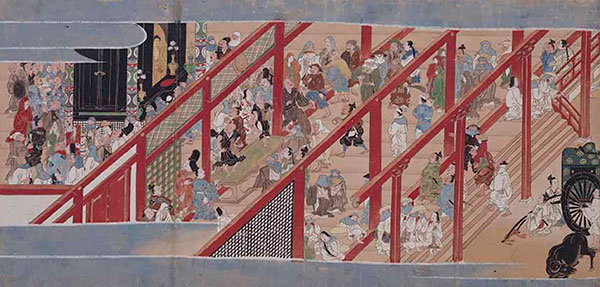
Important Cultural Property
Legendary Origins of the
Yūzū Nenbutsu Sect, Vol. 2
Attributed to Tosa Mitsunobu
Zenrin-ji Temple, Kyoto
Parinirvana: Picturing the Death of the Buddha
January 27–February 23, 2026
Buddhist Paintings|2F-2 gallery
The historical Buddha Shakyamuni is said to have died and entered parinirvana, his "final nirvana," on the fifteenth day of the second lunar month (March 15th by the Gregorian calendar). Japanese temples continue to hold the Nirvana Assembly (nehan-e) today. A Death of the Buddha painting is typically hung for this ceremony.
Many Death of the Buddha paintings are enormous——some are so large that they cannot be fully unrolled, even in grand temple halls. Why use such massive dimensions? Perhaps this gave the viewers a more immersive experience akin to a sort of virtual reality. During the Kamakura period (1185–1333), artists were increasingly incorporating new Chinese artistic styles into their Death of the Buddha paintings. These included realistic elements that must have been fascinating to contemporaneous viewers.
The Nirvana Assembly became widespread among many different sects, in part because it revolves around the Historical Buddha Shakyamuni. The grand scale and realism of Death of the Buddha paintings such as these may have also contributed to the Nirvana Assembly’s prevalence in Japan.
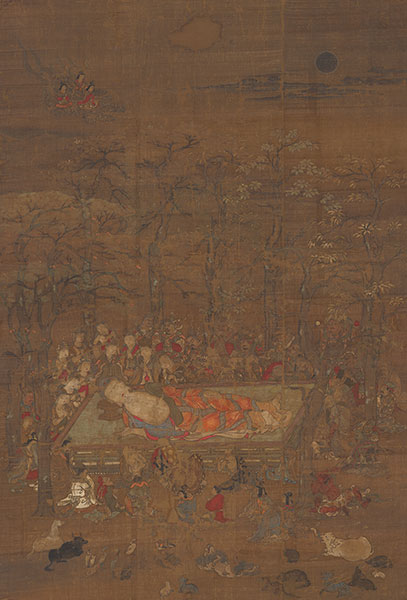
Death of the Buddha
Kyoto National Museum
Sliding Door Paintings of Daitoku-ji’s Former Subtemple Yōtoku-in, PartⅠ
January 27–February 23, 2026
Medieval Paintings|2F-3 gallery
The sliding door (fusuma) paintings Landscapes, The Four Accomplishments, and Wild Geese and Reeds in the collection of the Kyoto National Museum were originally part of a set that adorned the main hall of Yōtoku-in, a subtemple within the Zen complex of Daitoku-ji in Kyoto. Most of these works were painted around 1490 by Sōkei (dates unknown) and other artists connected to a lineage of official painters serving the Muromachi shogunate. Due to Yōtoku-in’s relocation and major remodeling during the medieval and early modern periods——as well as the dispersal of the sliding doors in the nineteenth century——these paintings underwent multiple large-scale alterations and retouching. As a result, it is extremely difficult to reconstruct their original appearance. Nonetheless, as the oldest surviving examples of ink-painted sliding door paintings in Japan, the Yōtoku-in screens hold a distinguished place in the history of Japanese art. The paintings were dismantled and conserved between 2020 and 2024; this exhibition marks their first public display since the completion of conservation.
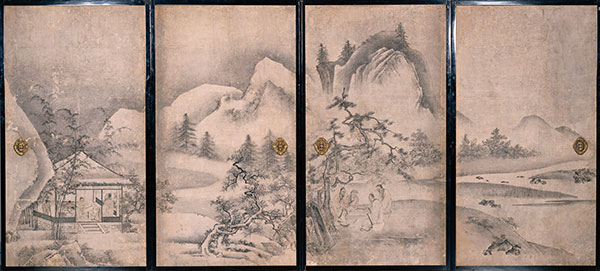
Important Cultural Property
The Four Accomplishments
By Sōkei
Kyoto National Museum
Buddhist Sculpture of the Heian Period
December 16, 2025–March 22, 2026
Sculpture|1F-1 gallery
The Heian period (794–1185) was one of the most dynamic eras within the history of Japanese sculpture. The impression of Buddhist icons from the ninth century, during which the monks Saichō (767–822) and Kūkai (774–835) introduced Esoteric Buddhism from China, differs greatly from the serene air of twelfth-century statues.
Most temples were located in Kyoto’s surroundings until the middle of the Heian period. However, from the late Heian period onwards, temple construction within the capital itself increased, accompanied by the active production of Buddhist sculptures. Although unfortunately some works have been lost due to wars and natural disasters, many others have been carefully protected and passed down throughout generations. This exhibition presents a variety of sculptures capturing the spirit of the Heian period.
Important Cultural Property
Standing Thousand-Armed Kannon (Sahasrabhuja Avalokiteśvara) Bodhisattva
Zenkai-ji Temple, Kyoto
Shinto Deities and Pairs of Guardian Lions and Lion-Dogs
December 16, 2025–March 22, 2026
Sculpture|1F-1 gallery
Originally, indigenous Japanese deities (kami) were thought to be invisible to humans, but the influence of Buddhism lead to the production of statues of Shinto gods. Many of them were small in scale, as they were enclosed within miniature shrines. Shinto sculptures also distinguished between male and female deities and had a human-like appearance, sometimes being depicted wearing the clothing and armor of nobles or monks.
Lions and lion dogs are stationed at shrine entrances to guard the deity inside. Within this protective pair, the open-mouthed creature without horns is the lion, while the close-mouthed and horned figure is the lion-dog. Pairs of lions are sometimes placed before Buddha sculptures, as within Buddhism the roar of the "king of the beasts" is likened to the Buddha’s voice preaching the dharma. This exhibition presents a variety of sculptures, including stone figures from China and wooden statues from Japan.
Standing Deity Traditionally Identified as Sarutahiko
Kyoto National Museum
Waka Poems and Classical Texts
January 27–February 23, 2026
Calligraphy|1F-3 gallery
A waka is a classical Japanese poem, most often written in a 31-syllable pattern of 5–7–5–7–7, expressing refined emotion or reflection on nature, love, or the seasons. Waka are often written in Japan’s native kana syllabary, while many other classical texts are brushed in Chinese characters (kanji). Kana, though derived from Chinese characters, developed into a rounded script, in contrast to the more angular forms of kanji. Reflecting these structural qualities, waka verses convey a soft impression, whereas classical texts appear rigid and formal. Among surviving calligraphic works, a surprising number feature these two supposed opposites coexisting on the front and back of the same sheet of paper. This exhibition presents exemplary works from the Heian (794–1185) through Muromachi (1392–1573) periods, exploring the contexts of their creation.
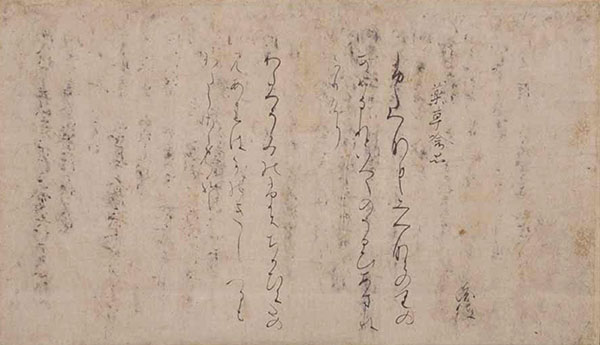
National Treasure
Poems on the Chapters of the Lotus Sutra
By Saigyō
Kyoto National Museum
Auspicious Motifs in Japanese Textiles
December 16, 2025–February 1, 2026
Textiles and Costumes|1F-4 gallery
Since ancient times, the most prized patterns for clothing were those with auspicious associations. Patterns adorning garments and personal belongings were imbued with wishes for fundamental desires such as success, familial prosperity, and a long life. Some auspicious patterns originated in ancient China, while others developed out of Japanese customs. This exhibition, organized to celebrate the New Year, features textiles bearing celebratory motifs deriving from both cultures.
Kosode (Kimono) with Pine and Checks
Kyoto National Museum
Sacred Offerings: Mirrors, Keman Ornaments, and Armor
December 16, 2025–February 1, 2026
Metalwork|1F-5 gallery
In Japan, people have long made a variety of offerings—— ranging from objects to performances of music and dance—— to honor Shinto and Buddhist deities and to express gratitude and prayer. Such offerings reflect the characteristics of the enshrined deity or principal image of worship, and, while following certain stylistic conventions, take a range of diverse forms. Among the many types of votive objects, this exhibition focuses on three principal themes: mirrors, Buddhist “flower garland” ornaments known as keman, and armor and garments dedicated to war deities.
National Treasure
Mirror with Maples and Pair of Cranes
From the Sacred Treasures of Asuka Shrine
Kyoto National Museum
Elegance Crafted in Kyoto: The Minoya Lacquer Collection
December 16, 2025–February 1, 2026
Lacquerware|1F-6 gallery
Founded in 1772, Minoya was a high-end lacquerware shop specializing in custom-made works reflecting the status and tastes of its clients. Unfortunately, the shop was forced to close its doors in 1945 due to concerns over declining quality amid shortages of materials and artisans. In 1990, the last head of Minoya generously donated several hundred sample works to the Kyoto National Museum. The collection reflects the meticulous craftsmanship that defined Minoya lacquers, produced through Kyoto’s distinctive system of divided labor: masters of woodturning and joinery crafted precise wooden bases, lacquer specialists applied perfectly even coats, and makie artists added intricate decorative motifs. This painstaking process would take one to three years from an initial order to delivery. We invite you to enjoy this selection of Kyoto lacquerware, whose subtle charm reflects Minoya’s rich collaboration with local workshops and the dedication of their artisans.
Dish for Sweets (Meimeibon) with Bird and Flowers
Kyoto National Museum
Also On View in the Collection Galleries特別展観覧料が必要
Polychrome Porcelain from the Late Ming and Early Qing Dynasties
December 16, 2025–March 15, 2026
Ceramics|3F-1 gallery
The late Ming and early Qing dynasties in China, spanning the end of the sixteenth to the seventeenth centuries, were an era of profound transformation, marked by intercultural exchange between the East and West as European culture spread throughout the globe. In Japan, such encounters exerted a wide-ranging influence and shaped the development of Edo-period (1615–1868) Japanese culture. This impacted numerous types of Japanese ceramics, ranging from Imari overglaze-enamel porcelain to Kyoto ware. This exhibition introduces a selection of Chinese polychrome porcelain——including iroe Shonzui, Nankin akae ("Nanjing red"), and famille verte (Kangxi wucai)——that shaped the emergence and development of Japan’s own overglaze enamel porcelain tradition.
Lobed Dish with Peach, Pine, and Deer
Inscription: "Made during the Jiajing era of the Ming dynasty"
Kyoto National Museum
Ceramics of Japan and East Asia
December 16, 2025–March 15, 2026
Ceramics|3F-1 gallery
Ceramics are not only admired for their beauty but are also broadly used in daily life, making them one of the most familiar forms of decorative arts. East Asian ceramics in particular feature a rich variety of patterns, forms, and colors, and have equally wide-ranging uses. Additionally, the type of ware (such as earthenware or porcelain), clay, glazes, decor, and firing techniques each vary depending on the region of production. Focusing on Japan, China, and the Korean Peninsula, this gallery presents a diverse selection of East Asian ceramics, showcasing their distinctive qualities and artistic appeal.
Important Cultural Property
Decorative Nail Covers
Attributed to Nonomura Ninsei
Kyoto National Museum
Archaeological Materials from Northern Kyoto
December 16, 2025–March 15, 2026
Archaeological Relics|3F-2 gallery
Northern Kyoto Prefecture has long served as a hub of both domestic and international exchange. Comprising the Tango region and part of the Tamba region, the area is bordered by the Sea of Japan and mountains. Archaeological excavations have revealed that during the latter half of the early Jōmon period (pre-10,000–ca. 5th c. BCE), dugout canoes were used to travel across the open sea, while during the Yayoi (ca. 5th c. BCE–ca. 3rd c. CE) and Kofun (ca. 3rd c.–6th c.) periods, large tombs were constructed. The unique culture of northern Kyoto led to it being referred to as the “Tango Kingdom.” From the Heian period (794–1185) onward, the region maintained close ties with the capital yet also nurtured its own distinctive art and religious traditions, as evidenced by artifacts excavated from sutra mounds. This exhibition provides a glimpse into the rich culture of northern Kyoto through archaeological materials from the Jōmon period to the medieval era.
Mirror with Bells
Excavated from Benzai Tumulus No. 1, Kyoto
Kyoto National Museum
Archaeological Artifacts of Japan
December 16, 2025–March 15, 2026
Archaeological Relics|3F-2 gallery
This exhibition explores the history of Japan through introducing a variety of archaeological relics. Many of these artifacts were excavated from ancient ruins. Some are special tools used in rituals and ceremonies, while others are objects used by people in their daily lives. Through exploring Japanese archaeology, we can gain a sense of the lives and experiences of people of the past.
Important Cultural Property
Sutra Container
Reportedly excavated in Wakayama
Kyoto National Museum
Legendary Origins of the Yūzū Nenbutsu Sect: The Power of the Nenbutsu Prayer
January 27–February 23, 2026
Illustrated Handscrolls|2F-1 gallery
The Yūzū Nenbutsu teachings——that reciting the nenbutsu incantation praising Amida (Amitābha) Buddha brings merit not only to oneself but to all living beings——were spread by the Buddhist monk Ryōnin (1073–1132). Illustrated handscrolls known as Legendary Origins of the Yūzū Nenbutsu Sect recount both Ryōnin’s life and the blessings brought about by chanting the nenbutsu. Many copies of these handscrolls were produced for temple fundraising and proselytization, and, during the Muromachi period (1392–1573), several versions were made to honor the memory of the Ashikaga shoguns. The Zenrin-ji Temple edition presented in this exhibition, thought to have been commissioned for the memorial services of the sixth Ashikaga shogun Yoshinori (1394–1441), is one of the most splendid renderings of this theme.
Important Cultural Property
Legendary Origins of the
Yūzū Nenbutsu Sect, Vol. 2
Attributed to Tosa Mitsunobu
Zenrin-ji Temple, Kyoto
Parinirvana: Picturing the Death of the Buddha
January 27–February 23, 2026
Buddhist Paintings|2F-2 gallery
The historical Buddha Shakyamuni is said to have died and entered parinirvana, his "final nirvana," on the fifteenth day of the second lunar month (March 15th by the Gregorian calendar). Japanese temples continue to hold the Nirvana Assembly (nehan-e) today. A Death of the Buddha painting is typically hung for this ceremony.
Many Death of the Buddha paintings are enormous——some are so large that they cannot be fully unrolled, even in grand temple halls. Why use such massive dimensions? Perhaps this gave the viewers a more immersive experience akin to a sort of virtual reality. During the Kamakura period (1185–1333), artists were increasingly incorporating new Chinese artistic styles into their Death of the Buddha paintings. These included realistic elements that must have been fascinating to contemporaneous viewers.
The Nirvana Assembly became widespread among many different sects, in part because it revolves around the Historical Buddha Shakyamuni. The grand scale and realism of Death of the Buddha paintings such as these may have also contributed to the Nirvana Assembly’s prevalence in Japan.
Death of the Buddha
Kyoto National Museum
Sliding Door Paintings of Daitoku-ji’s Former Subtemple Yōtoku-in, PartⅠ
January 27–February 23, 2026
Medieval Paintings|2F-3 gallery
The sliding door (fusuma) paintings Landscapes, The Four Accomplishments, and Wild Geese and Reeds in the collection of the Kyoto National Museum were originally part of a set that adorned the main hall of Yōtoku-in, a subtemple within the Zen complex of Daitoku-ji in Kyoto. Most of these works were painted around 1490 by Sōkei (dates unknown) and other artists connected to a lineage of official painters serving the Muromachi shogunate. Due to Yōtoku-in’s relocation and major remodeling during the medieval and early modern periods——as well as the dispersal of the sliding doors in the nineteenth century——these paintings underwent multiple large-scale alterations and retouching. As a result, it is extremely difficult to reconstruct their original appearance. Nonetheless, as the oldest surviving examples of ink-painted sliding door paintings in Japan, the Yōtoku-in screens hold a distinguished place in the history of Japanese art. The paintings were dismantled and conserved between 2020 and 2024; this exhibition marks their first public display since the completion of conservation.
Important Cultural Property
The Four Accomplishments
By Sōkei
Kyoto National Museum
Buddhist Sculpture of the Heian Period
December 16, 2025–March 22, 2026
Sculpture|1F-1 gallery
The Heian period (794–1185) was one of the most dynamic eras within the history of Japanese sculpture. The impression of Buddhist icons from the ninth century, during which the monks Saichō (767–822) and Kūkai (774–835) introduced Esoteric Buddhism from China, differs greatly from the serene air of twelfth-century statues.
Most temples were located in Kyoto’s surroundings until the middle of the Heian period. However, from the late Heian period onwards, temple construction within the capital itself increased, accompanied by the active production of Buddhist sculptures. Although unfortunately some works have been lost due to wars and natural disasters, many others have been carefully protected and passed down throughout generations. This exhibition presents a variety of sculptures capturing the spirit of the Heian period.
Important Cultural Property
Standing Thousand-Armed Kannon (Sahasrabhuja Avalokiteśvara) Bodhisattva
Zenkai-ji Temple, Kyoto
Shinto Deities and Pairs of Guardian Lions and Lion-Dogs
December 16, 2025–March 22, 2026
Sculpture|1F-1 gallery
Originally, indigenous Japanese deities (kami) were thought to be invisible to humans, but the influence of Buddhism lead to the production of statues of Shinto gods. Many of them were small in scale, as they were enclosed within miniature shrines. Shinto sculptures also distinguished between male and female deities and had a human-like appearance, sometimes being depicted wearing the clothing and armor of nobles or monks.
Lions and lion dogs are stationed at shrine entrances to guard the deity inside. Within this protective pair, the open-mouthed creature without horns is the lion, while the close-mouthed and horned figure is the lion-dog. Pairs of lions are sometimes placed before Buddha sculptures, as within Buddhism the roar of the "king of the beasts" is likened to the Buddha’s voice preaching the dharma. This exhibition presents a variety of sculptures, including stone figures from China and wooden statues from Japan.
Standing Deity Traditionally Identified as Sarutahiko
Kyoto National Museum
Waka Poems and Classical Texts
January 27–February 23, 2026
Calligraphy|1F-3 gallery
A waka is a classical Japanese poem, most often written in a 31-syllable pattern of 5–7–5–7–7, expressing refined emotion or reflection on nature, love, or the seasons. Waka are often written in Japan’s native kana syllabary, while many other classical texts are brushed in Chinese characters (kanji). Kana, though derived from Chinese characters, developed into a rounded script, in contrast to the more angular forms of kanji. Reflecting these structural qualities, waka verses convey a soft impression, whereas classical texts appear rigid and formal. Among surviving calligraphic works, a surprising number feature these two supposed opposites coexisting on the front and back of the same sheet of paper. This exhibition presents exemplary works from the Heian (794–1185) through Muromachi (1392–1573) periods, exploring the contexts of their creation.
National Treasure
Poems on the Chapters of the Lotus Sutra
By Saigyō
Kyoto National Museum
Auspicious Motifs in Japanese Textiles
December 16, 2025–February 1, 2026
Textiles and Costumes|1F-4 gallery
Since ancient times, the most prized patterns for clothing were those with auspicious associations. Patterns adorning garments and personal belongings were imbued with wishes for fundamental desires such as success, familial prosperity, and a long life. Some auspicious patterns originated in ancient China, while others developed out of Japanese customs. This exhibition, organized to celebrate the New Year, features textiles bearing celebratory motifs deriving from both cultures.
Kosode (Kimono) with Pine and Checks
Kyoto National Museum
Sacred Offerings: Mirrors, Keman Ornaments, and Armor
December 16, 2025–February 1, 2026
Metalwork|1F-5 gallery
In Japan, people have long made a variety of offerings—— ranging from objects to performances of music and dance—— to honor Shinto and Buddhist deities and to express gratitude and prayer. Such offerings reflect the characteristics of the enshrined deity or principal image of worship, and, while following certain stylistic conventions, take a range of diverse forms. Among the many types of votive objects, this exhibition focuses on three principal themes: mirrors, Buddhist “flower garland” ornaments known as keman, and armor and garments dedicated to war deities.
National Treasure
Mirror with Maples and Pair of Cranes
From the Sacred Treasures of Asuka Shrine
Kyoto National Museum
Elegance Crafted in Kyoto: The Minoya Lacquer Collection
December 16, 2025–February 1, 2026
Lacquerware|1F-6 gallery
Founded in 1772, Minoya was a high-end lacquerware shop specializing in custom-made works reflecting the status and tastes of its clients. Unfortunately, the shop was forced to close its doors in 1945 due to concerns over declining quality amid shortages of materials and artisans. In 1990, the last head of Minoya generously donated several hundred sample works to the Kyoto National Museum. The collection reflects the meticulous craftsmanship that defined Minoya lacquers, produced through Kyoto’s distinctive system of divided labor: masters of woodturning and joinery crafted precise wooden bases, lacquer specialists applied perfectly even coats, and makie artists added intricate decorative motifs. This painstaking process would take one to three years from an initial order to delivery. We invite you to enjoy this selection of Kyoto lacquerware, whose subtle charm reflects Minoya’s rich collaboration with local workshops and the dedication of their artisans.
Dish for Sweets (Meimeibon) with Bird and Flowers
Kyoto National Museum
Also On View in the Collection Galleries特別展観覧料が必要
Polychrome Porcelain from the Late Ming and Early Qing Dynasties
December 16, 2025–March 15, 2026
Ceramics|3F-1 gallery
The late Ming and early Qing dynasties in China, spanning the end of the sixteenth to the seventeenth centuries, were an era of profound transformation, marked by intercultural exchange between the East and West as European culture spread throughout the globe. In Japan, such encounters exerted a wide-ranging influence and shaped the development of Edo-period (1615–1868) Japanese culture. This impacted numerous types of Japanese ceramics, ranging from Imari overglaze-enamel porcelain to Kyoto ware. This exhibition introduces a selection of Chinese polychrome porcelain——including iroe Shonzui, Nankin akae ("Nanjing red"), and famille verte (Kangxi wucai)——that shaped the emergence and development of Japan’s own overglaze enamel porcelain tradition.
Lobed Dish with Peach, Pine, and Deer
Inscription: "Made during the Jiajing era of the Ming dynasty"
Kyoto National Museum
Ceramics of Japan and East Asia
December 16, 2025–March 15, 2026
Ceramics|3F-1 gallery
Ceramics are not only admired for their beauty but are also broadly used in daily life, making them one of the most familiar forms of decorative arts. East Asian ceramics in particular feature a rich variety of patterns, forms, and colors, and have equally wide-ranging uses. Additionally, the type of ware (such as earthenware or porcelain), clay, glazes, decor, and firing techniques each vary depending on the region of production. Focusing on Japan, China, and the Korean Peninsula, this gallery presents a diverse selection of East Asian ceramics, showcasing their distinctive qualities and artistic appeal.
Important Cultural Property
Decorative Nail Covers
Attributed to Nonomura Ninsei
Kyoto National Museum
Archaeological Materials from Northern Kyoto
December 16, 2025–March 15, 2026
Archaeological Relics|3F-2 gallery
Northern Kyoto Prefecture has long served as a hub of both domestic and international exchange. Comprising the Tango region and part of the Tamba region, the area is bordered by the Sea of Japan and mountains. Archaeological excavations have revealed that during the latter half of the early Jōmon period (pre-10,000–ca. 5th c. BCE), dugout canoes were used to travel across the open sea, while during the Yayoi (ca. 5th c. BCE–ca. 3rd c. CE) and Kofun (ca. 3rd c.–6th c.) periods, large tombs were constructed. The unique culture of northern Kyoto led to it being referred to as the “Tango Kingdom.” From the Heian period (794–1185) onward, the region maintained close ties with the capital yet also nurtured its own distinctive art and religious traditions, as evidenced by artifacts excavated from sutra mounds. This exhibition provides a glimpse into the rich culture of northern Kyoto through archaeological materials from the Jōmon period to the medieval era.
Mirror with Bells
Excavated from Benzai Tumulus No. 1, Kyoto
Kyoto National Museum
Archaeological Artifacts of Japan
December 16, 2025–March 15, 2026
Archaeological Relics|3F-2 gallery
This exhibition explores the history of Japan through introducing a variety of archaeological relics. Many of these artifacts were excavated from ancient ruins. Some are special tools used in rituals and ceremonies, while others are objects used by people in their daily lives. Through exploring Japanese archaeology, we can gain a sense of the lives and experiences of people of the past.
Important Cultural Property
Sutra Container
Reportedly excavated in Wakayama
Kyoto National Museum
Legendary Origins of the Yūzū Nenbutsu Sect: The Power of the Nenbutsu Prayer
January 27–February 23, 2026
Illustrated Handscrolls|2F-1 gallery
The Yūzū Nenbutsu teachings——that reciting the nenbutsu incantation praising Amida (Amitābha) Buddha brings merit not only to oneself but to all living beings——were spread by the Buddhist monk Ryōnin (1073–1132). Illustrated handscrolls known as Legendary Origins of the Yūzū Nenbutsu Sect recount both Ryōnin’s life and the blessings brought about by chanting the nenbutsu. Many copies of these handscrolls were produced for temple fundraising and proselytization, and, during the Muromachi period (1392–1573), several versions were made to honor the memory of the Ashikaga shoguns. The Zenrin-ji Temple edition presented in this exhibition, thought to have been commissioned for the memorial services of the sixth Ashikaga shogun Yoshinori (1394–1441), is one of the most splendid renderings of this theme.
Important Cultural Property
Legendary Origins of the
Yūzū Nenbutsu Sect, Vol. 2
Attributed to Tosa Mitsunobu
Zenrin-ji Temple, Kyoto
Parinirvana: Picturing the Death of the Buddha
January 27–February 23, 2026
Buddhist Paintings|2F-2 gallery
The historical Buddha Shakyamuni is said to have died and entered parinirvana, his "final nirvana," on the fifteenth day of the second lunar month (March 15th by the Gregorian calendar). Japanese temples continue to hold the Nirvana Assembly (nehan-e) today. A Death of the Buddha painting is typically hung for this ceremony.
Many Death of the Buddha paintings are enormous——some are so large that they cannot be fully unrolled, even in grand temple halls. Why use such massive dimensions? Perhaps this gave the viewers a more immersive experience akin to a sort of virtual reality. During the Kamakura period (1185–1333), artists were increasingly incorporating new Chinese artistic styles into their Death of the Buddha paintings. These included realistic elements that must have been fascinating to contemporaneous viewers.
The Nirvana Assembly became widespread among many different sects, in part because it revolves around the Historical Buddha Shakyamuni. The grand scale and realism of Death of the Buddha paintings such as these may have also contributed to the Nirvana Assembly’s prevalence in Japan.
Death of the Buddha
Kyoto National Museum
Sliding Door Paintings of Daitoku-ji’s Former Subtemple Yōtoku-in, PartⅠ
January 27–February 23, 2026
Medieval Paintings|2F-3 gallery
The sliding door (fusuma) paintings Landscapes, The Four Accomplishments, and Wild Geese and Reeds in the collection of the Kyoto National Museum were originally part of a set that adorned the main hall of Yōtoku-in, a subtemple within the Zen complex of Daitoku-ji in Kyoto. Most of these works were painted around 1490 by Sōkei (dates unknown) and other artists connected to a lineage of official painters serving the Muromachi shogunate. Due to Yōtoku-in’s relocation and major remodeling during the medieval and early modern periods——as well as the dispersal of the sliding doors in the nineteenth century——these paintings underwent multiple large-scale alterations and retouching. As a result, it is extremely difficult to reconstruct their original appearance. Nonetheless, as the oldest surviving examples of ink-painted sliding door paintings in Japan, the Yōtoku-in screens hold a distinguished place in the history of Japanese art. The paintings were dismantled and conserved between 2020 and 2024; this exhibition marks their first public display since the completion of conservation.
Important Cultural Property
The Four Accomplishments
By Sōkei
Kyoto National Museum
Buddhist Sculpture of the Heian Period
December 16, 2025–March 22, 2026
Sculpture|1F-1 gallery
The Heian period (794–1185) was one of the most dynamic eras within the history of Japanese sculpture. The impression of Buddhist icons from the ninth century, during which the monks Saichō (767–822) and Kūkai (774–835) introduced Esoteric Buddhism from China, differs greatly from the serene air of twelfth-century statues.
Most temples were located in Kyoto’s surroundings until the middle of the Heian period. However, from the late Heian period onwards, temple construction within the capital itself increased, accompanied by the active production of Buddhist sculptures. Although unfortunately some works have been lost due to wars and natural disasters, many others have been carefully protected and passed down throughout generations. This exhibition presents a variety of sculptures capturing the spirit of the Heian period.
Important Cultural Property
Standing Thousand-Armed Kannon (Sahasrabhuja Avalokiteśvara) Bodhisattva
Zenkai-ji Temple, Kyoto
Shinto Deities and Pairs of Guardian Lions and Lion-Dogs
December 16, 2025–March 22, 2026
Sculpture|1F-1 gallery
Originally, indigenous Japanese deities (kami) were thought to be invisible to humans, but the influence of Buddhism lead to the production of statues of Shinto gods. Many of them were small in scale, as they were enclosed within miniature shrines. Shinto sculptures also distinguished between male and female deities and had a human-like appearance, sometimes being depicted wearing the clothing and armor of nobles or monks.
Lions and lion dogs are stationed at shrine entrances to guard the deity inside. Within this protective pair, the open-mouthed creature without horns is the lion, while the close-mouthed and horned figure is the lion-dog. Pairs of lions are sometimes placed before Buddha sculptures, as within Buddhism the roar of the "king of the beasts" is likened to the Buddha’s voice preaching the dharma. This exhibition presents a variety of sculptures, including stone figures from China and wooden statues from Japan.
Standing Deity Traditionally Identified as Sarutahiko
Kyoto National Museum
Waka Poems and Classical Texts
January 27–February 23, 2026
Calligraphy|1F-3 gallery
A waka is a classical Japanese poem, most often written in a 31-syllable pattern of 5–7–5–7–7, expressing refined emotion or reflection on nature, love, or the seasons. Waka are often written in Japan’s native kana syllabary, while many other classical texts are brushed in Chinese characters (kanji). Kana, though derived from Chinese characters, developed into a rounded script, in contrast to the more angular forms of kanji. Reflecting these structural qualities, waka verses convey a soft impression, whereas classical texts appear rigid and formal. Among surviving calligraphic works, a surprising number feature these two supposed opposites coexisting on the front and back of the same sheet of paper. This exhibition presents exemplary works from the Heian (794–1185) through Muromachi (1392–1573) periods, exploring the contexts of their creation.
National Treasure
Poems on the Chapters of the Lotus Sutra
By Saigyō
Kyoto National Museum
Auspicious Motifs in Japanese Textiles
December 16, 2025–February 1, 2026
Textiles and Costumes|1F-4 gallery
Since ancient times, the most prized patterns for clothing were those with auspicious associations. Patterns adorning garments and personal belongings were imbued with wishes for fundamental desires such as success, familial prosperity, and a long life. Some auspicious patterns originated in ancient China, while others developed out of Japanese customs. This exhibition, organized to celebrate the New Year, features textiles bearing celebratory motifs deriving from both cultures.
Kosode (Kimono) with Pine and Checks
Kyoto National Museum
Sacred Offerings: Mirrors, Keman Ornaments, and Armor
December 16, 2025–February 1, 2026
Metalwork|1F-5 gallery
In Japan, people have long made a variety of offerings—— ranging from objects to performances of music and dance—— to honor Shinto and Buddhist deities and to express gratitude and prayer. Such offerings reflect the characteristics of the enshrined deity or principal image of worship, and, while following certain stylistic conventions, take a range of diverse forms. Among the many types of votive objects, this exhibition focuses on three principal themes: mirrors, Buddhist “flower garland” ornaments known as keman, and armor and garments dedicated to war deities.
National Treasure
Mirror with Maples and Pair of Cranes
From the Sacred Treasures of Asuka Shrine
Kyoto National Museum
Elegance Crafted in Kyoto: The Minoya Lacquer Collection
December 16, 2025–February 1, 2026
Lacquerware|1F-6 gallery
Founded in 1772, Minoya was a high-end lacquerware shop specializing in custom-made works reflecting the status and tastes of its clients. Unfortunately, the shop was forced to close its doors in 1945 due to concerns over declining quality amid shortages of materials and artisans. In 1990, the last head of Minoya generously donated several hundred sample works to the Kyoto National Museum. The collection reflects the meticulous craftsmanship that defined Minoya lacquers, produced through Kyoto’s distinctive system of divided labor: masters of woodturning and joinery crafted precise wooden bases, lacquer specialists applied perfectly even coats, and makie artists added intricate decorative motifs. This painstaking process would take one to three years from an initial order to delivery. We invite you to enjoy this selection of Kyoto lacquerware, whose subtle charm reflects Minoya’s rich collaboration with local workshops and the dedication of their artisans.
Dish for Sweets (Meimeibon) with Bird and Flowers
Kyoto National Museum
Also On View in the Collection Galleries特別展観覧料が必要
Polychrome Porcelain from the Late Ming and Early Qing Dynasties
December 16, 2025–March 15, 2026
Ceramics|3F-1 gallery
The late Ming and early Qing dynasties in China, spanning the end of the sixteenth to the seventeenth centuries, were an era of profound transformation, marked by intercultural exchange between the East and West as European culture spread throughout the globe. In Japan, such encounters exerted a wide-ranging influence and shaped the development of Edo-period (1615–1868) Japanese culture. This impacted numerous types of Japanese ceramics, ranging from Imari overglaze-enamel porcelain to Kyoto ware. This exhibition introduces a selection of Chinese polychrome porcelain——including iroe Shonzui, Nankin akae ("Nanjing red"), and famille verte (Kangxi wucai)——that shaped the emergence and development of Japan’s own overglaze enamel porcelain tradition.
Lobed Dish with Peach, Pine, and Deer
Inscription: "Made during the Jiajing era of the Ming dynasty"
Kyoto National Museum
Ceramics of Japan and East Asia
December 16, 2025–March 15, 2026
Ceramics|3F-1 gallery
Ceramics are not only admired for their beauty but are also broadly used in daily life, making them one of the most familiar forms of decorative arts. East Asian ceramics in particular feature a rich variety of patterns, forms, and colors, and have equally wide-ranging uses. Additionally, the type of ware (such as earthenware or porcelain), clay, glazes, decor, and firing techniques each vary depending on the region of production. Focusing on Japan, China, and the Korean Peninsula, this gallery presents a diverse selection of East Asian ceramics, showcasing their distinctive qualities and artistic appeal.
Important Cultural Property
Decorative Nail Covers
Attributed to Nonomura Ninsei
Kyoto National Museum
Archaeological Materials from Northern Kyoto
December 16, 2025–March 15, 2026
Archaeological Relics|3F-2 gallery
Northern Kyoto Prefecture has long served as a hub of both domestic and international exchange. Comprising the Tango region and part of the Tamba region, the area is bordered by the Sea of Japan and mountains. Archaeological excavations have revealed that during the latter half of the early Jōmon period (pre-10,000–ca. 5th c. BCE), dugout canoes were used to travel across the open sea, while during the Yayoi (ca. 5th c. BCE–ca. 3rd c. CE) and Kofun (ca. 3rd c.–6th c.) periods, large tombs were constructed. The unique culture of northern Kyoto led to it being referred to as the “Tango Kingdom.” From the Heian period (794–1185) onward, the region maintained close ties with the capital yet also nurtured its own distinctive art and religious traditions, as evidenced by artifacts excavated from sutra mounds. This exhibition provides a glimpse into the rich culture of northern Kyoto through archaeological materials from the Jōmon period to the medieval era.
Mirror with Bells
Excavated from Benzai Tumulus No. 1, Kyoto
Kyoto National Museum
Archaeological Artifacts of Japan
December 16, 2025–March 15, 2026
Archaeological Relics|3F-2 gallery
This exhibition explores the history of Japan through introducing a variety of archaeological relics. Many of these artifacts were excavated from ancient ruins. Some are special tools used in rituals and ceremonies, while others are objects used by people in their daily lives. Through exploring Japanese archaeology, we can gain a sense of the lives and experiences of people of the past.
Important Cultural Property
Sutra Container
Reportedly excavated in Wakayama
Kyoto National Museum
Legendary Origins of the Yūzū Nenbutsu Sect: The Power of the Nenbutsu Prayer
January 27–February 23, 2026
Illustrated Handscrolls|2F-1 gallery
The Yūzū Nenbutsu teachings——that reciting the nenbutsu incantation praising Amida (Amitābha) Buddha brings merit not only to oneself but to all living beings——were spread by the Buddhist monk Ryōnin (1073–1132). Illustrated handscrolls known as Legendary Origins of the Yūzū Nenbutsu Sect recount both Ryōnin’s life and the blessings brought about by chanting the nenbutsu. Many copies of these handscrolls were produced for temple fundraising and proselytization, and, during the Muromachi period (1392–1573), several versions were made to honor the memory of the Ashikaga shoguns. The Zenrin-ji Temple edition presented in this exhibition, thought to have been commissioned for the memorial services of the sixth Ashikaga shogun Yoshinori (1394–1441), is one of the most splendid renderings of this theme.
Important Cultural Property
Legendary Origins of the
Yūzū Nenbutsu Sect, Vol. 2
Attributed to Tosa Mitsunobu
Zenrin-ji Temple, Kyoto
Parinirvana: Picturing the Death of the Buddha
January 27–February 23, 2026
Buddhist Paintings|2F-2 gallery
The historical Buddha Shakyamuni is said to have died and entered parinirvana, his "final nirvana," on the fifteenth day of the second lunar month (March 15th by the Gregorian calendar). Japanese temples continue to hold the Nirvana Assembly (nehan-e) today. A Death of the Buddha painting is typically hung for this ceremony.
Many Death of the Buddha paintings are enormous——some are so large that they cannot be fully unrolled, even in grand temple halls. Why use such massive dimensions? Perhaps this gave the viewers a more immersive experience akin to a sort of virtual reality. During the Kamakura period (1185–1333), artists were increasingly incorporating new Chinese artistic styles into their Death of the Buddha paintings. These included realistic elements that must have been fascinating to contemporaneous viewers.
The Nirvana Assembly became widespread among many different sects, in part because it revolves around the Historical Buddha Shakyamuni. The grand scale and realism of Death of the Buddha paintings such as these may have also contributed to the Nirvana Assembly’s prevalence in Japan.
Death of the Buddha
Kyoto National Museum
Sliding Door Paintings of Daitoku-ji’s Former Subtemple Yōtoku-in, PartⅠ
January 27–February 23, 2026
Medieval Paintings|2F-3 gallery
The sliding door (fusuma) paintings Landscapes, The Four Accomplishments, and Wild Geese and Reeds in the collection of the Kyoto National Museum were originally part of a set that adorned the main hall of Yōtoku-in, a subtemple within the Zen complex of Daitoku-ji in Kyoto. Most of these works were painted around 1490 by Sōkei (dates unknown) and other artists connected to a lineage of official painters serving the Muromachi shogunate. Due to Yōtoku-in’s relocation and major remodeling during the medieval and early modern periods——as well as the dispersal of the sliding doors in the nineteenth century——these paintings underwent multiple large-scale alterations and retouching. As a result, it is extremely difficult to reconstruct their original appearance. Nonetheless, as the oldest surviving examples of ink-painted sliding door paintings in Japan, the Yōtoku-in screens hold a distinguished place in the history of Japanese art. The paintings were dismantled and conserved between 2020 and 2024; this exhibition marks their first public display since the completion of conservation.
Important Cultural Property
The Four Accomplishments
By Sōkei
Kyoto National Museum
Buddhist Sculpture of the Heian Period
December 16, 2025–March 22, 2026
Sculpture|1F-1 gallery
The Heian period (794–1185) was one of the most dynamic eras within the history of Japanese sculpture. The impression of Buddhist icons from the ninth century, during which the monks Saichō (767–822) and Kūkai (774–835) introduced Esoteric Buddhism from China, differs greatly from the serene air of twelfth-century statues.
Most temples were located in Kyoto’s surroundings until the middle of the Heian period. However, from the late Heian period onwards, temple construction within the capital itself increased, accompanied by the active production of Buddhist sculptures. Although unfortunately some works have been lost due to wars and natural disasters, many others have been carefully protected and passed down throughout generations. This exhibition presents a variety of sculptures capturing the spirit of the Heian period.
Important Cultural Property
Standing Thousand-Armed Kannon (Sahasrabhuja Avalokiteśvara) Bodhisattva
Zenkai-ji Temple, Kyoto
Shinto Deities and Pairs of Guardian Lions and Lion-Dogs
December 16, 2025–March 22, 2026
Sculpture|1F-1 gallery
Originally, indigenous Japanese deities (kami) were thought to be invisible to humans, but the influence of Buddhism lead to the production of statues of Shinto gods. Many of them were small in scale, as they were enclosed within miniature shrines. Shinto sculptures also distinguished between male and female deities and had a human-like appearance, sometimes being depicted wearing the clothing and armor of nobles or monks.
Lions and lion dogs are stationed at shrine entrances to guard the deity inside. Within this protective pair, the open-mouthed creature without horns is the lion, while the close-mouthed and horned figure is the lion-dog. Pairs of lions are sometimes placed before Buddha sculptures, as within Buddhism the roar of the "king of the beasts" is likened to the Buddha’s voice preaching the dharma. This exhibition presents a variety of sculptures, including stone figures from China and wooden statues from Japan.
Standing Deity Traditionally Identified as Sarutahiko
Kyoto National Museum
Waka Poems and Classical Texts
January 27–February 23, 2026
Calligraphy|1F-3 gallery
A waka is a classical Japanese poem, most often written in a 31-syllable pattern of 5–7–5–7–7, expressing refined emotion or reflection on nature, love, or the seasons. Waka are often written in Japan’s native kana syllabary, while many other classical texts are brushed in Chinese characters (kanji). Kana, though derived from Chinese characters, developed into a rounded script, in contrast to the more angular forms of kanji. Reflecting these structural qualities, waka verses convey a soft impression, whereas classical texts appear rigid and formal. Among surviving calligraphic works, a surprising number feature these two supposed opposites coexisting on the front and back of the same sheet of paper. This exhibition presents exemplary works from the Heian (794–1185) through Muromachi (1392–1573) periods, exploring the contexts of their creation.
National Treasure
Poems on the Chapters of the Lotus Sutra
By Saigyō
Kyoto National Museum
Auspicious Motifs in Japanese Textiles
December 16, 2025–February 1, 2026
Textiles and Costumes|1F-4 gallery
Since ancient times, the most prized patterns for clothing were those with auspicious associations. Patterns adorning garments and personal belongings were imbued with wishes for fundamental desires such as success, familial prosperity, and a long life. Some auspicious patterns originated in ancient China, while others developed out of Japanese customs. This exhibition, organized to celebrate the New Year, features textiles bearing celebratory motifs deriving from both cultures.
Kosode (Kimono) with Pine and Checks
Kyoto National Museum
Sacred Offerings: Mirrors, Keman Ornaments, and Armor
December 16, 2025–February 1, 2026
Metalwork|1F-5 gallery
In Japan, people have long made a variety of offerings—— ranging from objects to performances of music and dance—— to honor Shinto and Buddhist deities and to express gratitude and prayer. Such offerings reflect the characteristics of the enshrined deity or principal image of worship, and, while following certain stylistic conventions, take a range of diverse forms. Among the many types of votive objects, this exhibition focuses on three principal themes: mirrors, Buddhist “flower garland” ornaments known as keman, and armor and garments dedicated to war deities.
National Treasure
Mirror with Maples and Pair of Cranes
From the Sacred Treasures of Asuka Shrine
Kyoto National Museum
Elegance Crafted in Kyoto: The Minoya Lacquer Collection
December 16, 2025–February 1, 2026
Lacquerware|1F-6 gallery
Founded in 1772, Minoya was a high-end lacquerware shop specializing in custom-made works reflecting the status and tastes of its clients. Unfortunately, the shop was forced to close its doors in 1945 due to concerns over declining quality amid shortages of materials and artisans. In 1990, the last head of Minoya generously donated several hundred sample works to the Kyoto National Museum. The collection reflects the meticulous craftsmanship that defined Minoya lacquers, produced through Kyoto’s distinctive system of divided labor: masters of woodturning and joinery crafted precise wooden bases, lacquer specialists applied perfectly even coats, and makie artists added intricate decorative motifs. This painstaking process would take one to three years from an initial order to delivery. We invite you to enjoy this selection of Kyoto lacquerware, whose subtle charm reflects Minoya’s rich collaboration with local workshops and the dedication of their artisans.
Dish for Sweets (Meimeibon) with Bird and Flowers
Kyoto National Museum
Also On View in the Collection Galleries特別展観覧料が必要
Polychrome Porcelain from the Late Ming and Early Qing Dynasties
December 16, 2025–March 15, 2026
Ceramics|3F-1 gallery
The late Ming and early Qing dynasties in China, spanning the end of the sixteenth to the seventeenth centuries, were an era of profound transformation, marked by intercultural exchange between the East and West as European culture spread throughout the globe. In Japan, such encounters exerted a wide-ranging influence and shaped the development of Edo-period (1615–1868) Japanese culture. This impacted numerous types of Japanese ceramics, ranging from Imari overglaze-enamel porcelain to Kyoto ware. This exhibition introduces a selection of Chinese polychrome porcelain——including iroe Shonzui, Nankin akae ("Nanjing red"), and famille verte (Kangxi wucai)——that shaped the emergence and development of Japan’s own overglaze enamel porcelain tradition.
Lobed Dish with Peach, Pine, and Deer
Inscription: "Made during the Jiajing era of the Ming dynasty"
Kyoto National Museum
Ceramics of Japan and East Asia
December 16, 2025–March 15, 2026
Ceramics|3F-1 gallery
Ceramics are not only admired for their beauty but are also broadly used in daily life, making them one of the most familiar forms of decorative arts. East Asian ceramics in particular feature a rich variety of patterns, forms, and colors, and have equally wide-ranging uses. Additionally, the type of ware (such as earthenware or porcelain), clay, glazes, decor, and firing techniques each vary depending on the region of production. Focusing on Japan, China, and the Korean Peninsula, this gallery presents a diverse selection of East Asian ceramics, showcasing their distinctive qualities and artistic appeal.
Important Cultural Property
Decorative Nail Covers
Attributed to Nonomura Ninsei
Kyoto National Museum
Archaeological Materials from Northern Kyoto
December 16, 2025–March 15, 2026
Archaeological Relics|3F-2 gallery
Northern Kyoto Prefecture has long served as a hub of both domestic and international exchange. Comprising the Tango region and part of the Tamba region, the area is bordered by the Sea of Japan and mountains. Archaeological excavations have revealed that during the latter half of the early Jōmon period (pre-10,000–ca. 5th c. BCE), dugout canoes were used to travel across the open sea, while during the Yayoi (ca. 5th c. BCE–ca. 3rd c. CE) and Kofun (ca. 3rd c.–6th c.) periods, large tombs were constructed. The unique culture of northern Kyoto led to it being referred to as the “Tango Kingdom.” From the Heian period (794–1185) onward, the region maintained close ties with the capital yet also nurtured its own distinctive art and religious traditions, as evidenced by artifacts excavated from sutra mounds. This exhibition provides a glimpse into the rich culture of northern Kyoto through archaeological materials from the Jōmon period to the medieval era.
Mirror with Bells
Excavated from Benzai Tumulus No. 1, Kyoto
Kyoto National Museum
Archaeological Artifacts of Japan
December 16, 2025–March 15, 2026
Archaeological Relics|3F-2 gallery
This exhibition explores the history of Japan through introducing a variety of archaeological relics. Many of these artifacts were excavated from ancient ruins. Some are special tools used in rituals and ceremonies, while others are objects used by people in their daily lives. Through exploring Japanese archaeology, we can gain a sense of the lives and experiences of people of the past.
Important Cultural Property
Sutra Container
Reportedly excavated in Wakayama
Kyoto National Museum
Legendary Origins of the Yūzū Nenbutsu Sect: The Power of the Nenbutsu Prayer
January 27–February 23, 2026
Illustrated Handscrolls|2F-1 gallery
The Yūzū Nenbutsu teachings——that reciting the nenbutsu incantation praising Amida (Amitābha) Buddha brings merit not only to oneself but to all living beings——were spread by the Buddhist monk Ryōnin (1073–1132). Illustrated handscrolls known as Legendary Origins of the Yūzū Nenbutsu Sect recount both Ryōnin’s life and the blessings brought about by chanting the nenbutsu. Many copies of these handscrolls were produced for temple fundraising and proselytization, and, during the Muromachi period (1392–1573), several versions were made to honor the memory of the Ashikaga shoguns. The Zenrin-ji Temple edition presented in this exhibition, thought to have been commissioned for the memorial services of the sixth Ashikaga shogun Yoshinori (1394–1441), is one of the most splendid renderings of this theme.
Important Cultural Property
Legendary Origins of the
Yūzū Nenbutsu Sect, Vol. 2
Attributed to Tosa Mitsunobu
Zenrin-ji Temple, Kyoto
Parinirvana: Picturing the Death of the Buddha
January 27–February 23, 2026
Buddhist Paintings|2F-2 gallery
The historical Buddha Shakyamuni is said to have died and entered parinirvana, his "final nirvana," on the fifteenth day of the second lunar month (March 15th by the Gregorian calendar). Japanese temples continue to hold the Nirvana Assembly (nehan-e) today. A Death of the Buddha painting is typically hung for this ceremony.
Many Death of the Buddha paintings are enormous——some are so large that they cannot be fully unrolled, even in grand temple halls. Why use such massive dimensions? Perhaps this gave the viewers a more immersive experience akin to a sort of virtual reality. During the Kamakura period (1185–1333), artists were increasingly incorporating new Chinese artistic styles into their Death of the Buddha paintings. These included realistic elements that must have been fascinating to contemporaneous viewers.
The Nirvana Assembly became widespread among many different sects, in part because it revolves around the Historical Buddha Shakyamuni. The grand scale and realism of Death of the Buddha paintings such as these may have also contributed to the Nirvana Assembly’s prevalence in Japan.
Death of the Buddha
Kyoto National Museum
Sliding Door Paintings of Daitoku-ji’s Former Subtemple Yōtoku-in, PartⅠ
January 27–February 23, 2026
Medieval Paintings|2F-3 gallery
The sliding door (fusuma) paintings Landscapes, The Four Accomplishments, and Wild Geese and Reeds in the collection of the Kyoto National Museum were originally part of a set that adorned the main hall of Yōtoku-in, a subtemple within the Zen complex of Daitoku-ji in Kyoto. Most of these works were painted around 1490 by Sōkei (dates unknown) and other artists connected to a lineage of official painters serving the Muromachi shogunate. Due to Yōtoku-in’s relocation and major remodeling during the medieval and early modern periods——as well as the dispersal of the sliding doors in the nineteenth century——these paintings underwent multiple large-scale alterations and retouching. As a result, it is extremely difficult to reconstruct their original appearance. Nonetheless, as the oldest surviving examples of ink-painted sliding door paintings in Japan, the Yōtoku-in screens hold a distinguished place in the history of Japanese art. The paintings were dismantled and conserved between 2020 and 2024; this exhibition marks their first public display since the completion of conservation.
Important Cultural Property
The Four Accomplishments
By Sōkei
Kyoto National Museum
Buddhist Sculpture of the Heian Period
December 16, 2025–March 22, 2026
Sculpture|1F-1 gallery
The Heian period (794–1185) was one of the most dynamic eras within the history of Japanese sculpture. The impression of Buddhist icons from the ninth century, during which the monks Saichō (767–822) and Kūkai (774–835) introduced Esoteric Buddhism from China, differs greatly from the serene air of twelfth-century statues.
Most temples were located in Kyoto’s surroundings until the middle of the Heian period. However, from the late Heian period onwards, temple construction within the capital itself increased, accompanied by the active production of Buddhist sculptures. Although unfortunately some works have been lost due to wars and natural disasters, many others have been carefully protected and passed down throughout generations. This exhibition presents a variety of sculptures capturing the spirit of the Heian period.
Important Cultural Property
Standing Thousand-Armed Kannon (Sahasrabhuja Avalokiteśvara) Bodhisattva
Zenkai-ji Temple, Kyoto
Shinto Deities and Pairs of Guardian Lions and Lion-Dogs
December 16, 2025–March 22, 2026
Sculpture|1F-1 gallery
Originally, indigenous Japanese deities (kami) were thought to be invisible to humans, but the influence of Buddhism lead to the production of statues of Shinto gods. Many of them were small in scale, as they were enclosed within miniature shrines. Shinto sculptures also distinguished between male and female deities and had a human-like appearance, sometimes being depicted wearing the clothing and armor of nobles or monks.
Lions and lion dogs are stationed at shrine entrances to guard the deity inside. Within this protective pair, the open-mouthed creature without horns is the lion, while the close-mouthed and horned figure is the lion-dog. Pairs of lions are sometimes placed before Buddha sculptures, as within Buddhism the roar of the "king of the beasts" is likened to the Buddha’s voice preaching the dharma. This exhibition presents a variety of sculptures, including stone figures from China and wooden statues from Japan.
Standing Deity Traditionally Identified as Sarutahiko
Kyoto National Museum
Waka Poems and Classical Texts
January 27–February 23, 2026
Calligraphy|1F-3 gallery
A waka is a classical Japanese poem, most often written in a 31-syllable pattern of 5–7–5–7–7, expressing refined emotion or reflection on nature, love, or the seasons. Waka are often written in Japan’s native kana syllabary, while many other classical texts are brushed in Chinese characters (kanji). Kana, though derived from Chinese characters, developed into a rounded script, in contrast to the more angular forms of kanji. Reflecting these structural qualities, waka verses convey a soft impression, whereas classical texts appear rigid and formal. Among surviving calligraphic works, a surprising number feature these two supposed opposites coexisting on the front and back of the same sheet of paper. This exhibition presents exemplary works from the Heian (794–1185) through Muromachi (1392–1573) periods, exploring the contexts of their creation.
National Treasure
Poems on the Chapters of the Lotus Sutra
By Saigyō
Kyoto National Museum
Auspicious Motifs in Japanese Textiles
December 16, 2025–February 1, 2026
Textiles and Costumes|1F-4 gallery
Since ancient times, the most prized patterns for clothing were those with auspicious associations. Patterns adorning garments and personal belongings were imbued with wishes for fundamental desires such as success, familial prosperity, and a long life. Some auspicious patterns originated in ancient China, while others developed out of Japanese customs. This exhibition, organized to celebrate the New Year, features textiles bearing celebratory motifs deriving from both cultures.
Kosode (Kimono) with Pine and Checks
Kyoto National Museum
Sacred Offerings: Mirrors, Keman Ornaments, and Armor
December 16, 2025–February 1, 2026
Metalwork|1F-5 gallery
In Japan, people have long made a variety of offerings—— ranging from objects to performances of music and dance—— to honor Shinto and Buddhist deities and to express gratitude and prayer. Such offerings reflect the characteristics of the enshrined deity or principal image of worship, and, while following certain stylistic conventions, take a range of diverse forms. Among the many types of votive objects, this exhibition focuses on three principal themes: mirrors, Buddhist “flower garland” ornaments known as keman, and armor and garments dedicated to war deities.
National Treasure
Mirror with Maples and Pair of Cranes
From the Sacred Treasures of Asuka Shrine
Kyoto National Museum
Elegance Crafted in Kyoto: The Minoya Lacquer Collection
December 16, 2025–February 1, 2026
Lacquerware|1F-6 gallery
Founded in 1772, Minoya was a high-end lacquerware shop specializing in custom-made works reflecting the status and tastes of its clients. Unfortunately, the shop was forced to close its doors in 1945 due to concerns over declining quality amid shortages of materials and artisans. In 1990, the last head of Minoya generously donated several hundred sample works to the Kyoto National Museum. The collection reflects the meticulous craftsmanship that defined Minoya lacquers, produced through Kyoto’s distinctive system of divided labor: masters of woodturning and joinery crafted precise wooden bases, lacquer specialists applied perfectly even coats, and makie artists added intricate decorative motifs. This painstaking process would take one to three years from an initial order to delivery. We invite you to enjoy this selection of Kyoto lacquerware, whose subtle charm reflects Minoya’s rich collaboration with local workshops and the dedication of their artisans.
Dish for Sweets (Meimeibon) with Bird and Flowers
Kyoto National Museum
Title and URL copied to clipboard
- Share


