


- TOP
- Exhibitions
- Feature Exhibitions
- Feature Exhibition Forging Bonds Through Blades: Learning Sword Appreciation Through National Treasures and Important Cultural Properties
Title and URL copied to clipboard
- Share


General Information
- Exhibition Title
-
Feature Exhibition
Forging Bonds Through Blades: Learning Sword Appreciation Through National Treasures and Important Cultural Properties
- Period
-
February 4–March 22, 2026
- Venue
-
Heisei Chishinkan Wing, Galleries 1F-4, 5
- Closed
-
- Mondays, except February 23, 2026.
- February 24, 2026
- Museum Hours
-
9:30 a.m.–5:00 p.m. (entrance until 4:30 p.m.)
Open until 8:00 p.m. on Fridays (entrance until 7:30 p.m.)
- Admission
-
Adult 700 yen University Student
(ID required)350 yen - Admission fee includes admission to all galleries in the Heisei Chishinkan Wing.
- Admission is free for high school students and other youths age 0 – 17, seniors over 70, visitors with disabilities and one caretaker, and for Campus Members (including faculty). Please show ID.
- Admission for school groups: Admission to the Collection Galleries is free for elementary school, middle school, and high school students on school fieldtrips as well as teachers serving as their guides.
Description of Exhibition
There are many ways to engage with artworks and historical objects. This exhibition presents National Treasures and Important Cultural Properties from the Kyoto National Museum’s collection as teaching materials to understand the distinctive appeal of Japanese swords, objects rarely encountered in our modern everyday lives. Four key themes——form, inscriptions, blade patterns (hamon), and carved decoration——introduce the essential points for appreciating the artistry of the Japanese sword.
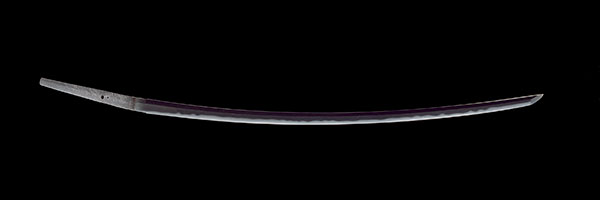
National Treasure
Tachi (Slung Sword) Blade
Inscription: “Yasuie”
Kyoto National Museum
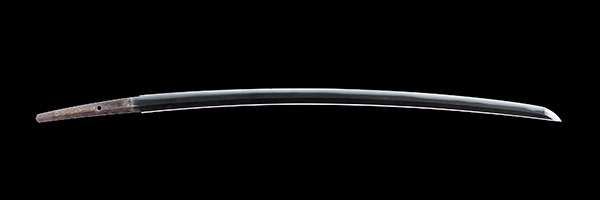
Important Cultural Property
Katana Blade, Known as “Meibutsu Kuwana Gō”
Later added gold inlaid stylized inscription: “Possession of Honda Mino no Kami / Yoshihiro Hon’a.”
Kyoto National Museum
Form
Japanese swords share a basic structure—single-edged with a curved shape—yet the balance of different elements within a given blade varies depending on the era in which it was made. By observing the overall length, degree of curvature, size of the tip area (kissaki), and shape of the tang (nakago), we can appreciate how the form of the Japanese sword was shaped by changes in its intended use, its cultural context, the conflicts during a given period, and the people who wielded it.
Inscriptions (Mei)
Some Japanese swords bear inscriptions carved into the tang (nakago)—the area at the base of the blade encased by the hilt. The contents of an inscription may include not only the name of the smith, but also their place of residence, the date of production, later appraisals, records of manufacture, and the names of past owners. While some inscriptions follow set conventions, others are more freely expressive, encompassing messages to future generations, boasts of the owner’s martial achievements, or results of test cutting. These inscriptions help us gain insight into the thoughts and intentions of people of the past.
Blade Patterns (Hamon)
The process of quenching a blade (yaki-ire) gives it the hardness and flexibility required to function as a weapon or a tool. The distinctive patterns along the cutting edge, known as the hamon, are formed as a by-product of microstructural changes in the metal caused by quenching. These blade patterns have various forms and are one of the key features used to appreciate swords. Even hamon that appear straight at first glance exhibit subtle changes when viewed up close. Examining blade patterns reveals the dynamic ingenuity of Japanese swordsmiths.
Carved Decoration
Some Japanese swords feature carvings engraved directly into their blades. This practice has ancient origins, with examples dating back to the Kofun period (ca.3rd–6th c.) when steel swords first came into widespread use. Some carvings express the religious faith of the smith, while others serve the practical purpose of reducing a blade’s weight. Such blade carvings—sometimes unexpectedly humorous or charming, despite being engraved onto weapons—constitute a distinctive mode of Japanese artistic expression.
Title and URL copied to clipboard
- Share