

- TOP
- Exhibitions
- Feature Exhibitions
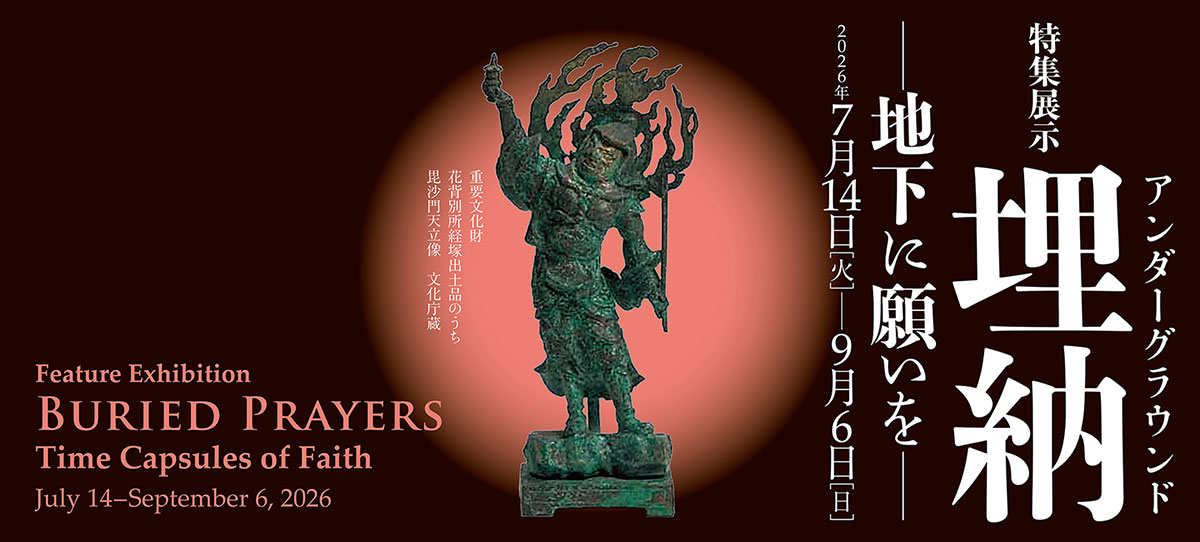
- Feature Exhibition Buried Prayers: Time Capsules of Faith
Title and URL copied to clipboard
- Share


General Information
- Exhibition Title
-
Feature Exhibition
Buried Prayers: Time Capsules of Faith
- Period
-
July 14–September 6, 2026
- Venue
-
Heisei Chishinkan Wing, Galleries 1F-3, 4
- Closed
-
- Mondays, except July 20, 2026
- July 21, 2026
- Museum Hours
-
9:30 a.m.–5:00 p.m. (entrance until 4:30 p.m.)
Open until 8:00 p.m. on Fridays (entrance until 7:30 p.m.)
- Admission
-
Adult 700 yen University Student
(ID required)350 yen - Admission fee includes admission to all galleries in the Heisei Chishinkan Wing.
- Admission is free for high school students and other youths age 0–17, seniors over 70, visitors with disabilities and one caretaker, and for Campus Members (including faculty). Please show ID.
- Admission to the Collection Galleries is free for teachers accompanying groups of preschool through high school students on fieldtrips.
- Catalogue
-
For availability and purchasing information, see Exhibition Catalogues and Related Publications
Description of Exhibition
Since ancient times, people have imbued objects with their prayers and buried them in the ground. Such interments were deeply intertwined with Buddhist thought, functioning like time capsules that combined supplications to purify and protect the land with aspirations to transmit teachings to the distant future.
This exhibition focuses primarily on deposited objects excavated in the Kyoto–Osaka region, tracing examples from different time periods: the interment of earthenware in the Kofun period (ca. 3rd–6th c.); offerings buried beneath building foundations (chindangu) and coins from the Asuka (592–710) and Nara (710–794) periods onward; and sutra deposits and sutra mounds (kyōzuka) from the Heian (794–1185) and Kamakura (1185–1333) periods. It also provides an overview of the history of such practices through the Muromachi (1392–1573) and Edo (1615–1868) periods. The exhibition further highlights the diverse beliefs—including Buddhism—that underlie the practice of depositing objects, exploring the wishes and prayers people consigned to the earth.
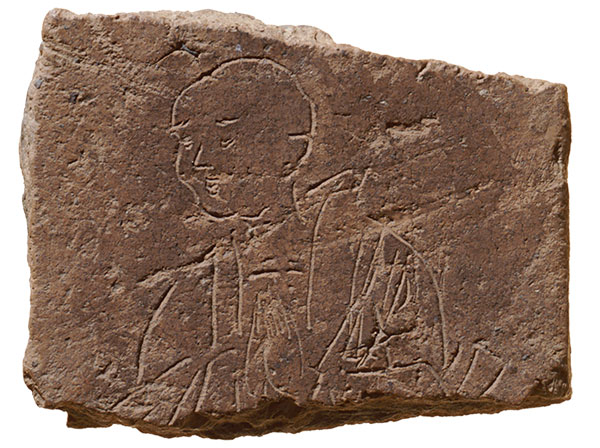
Tile Incised with Monk
Excavated from Katagihara Bonyama, Kyoto
Kyoto National Museum
Title and URL copied to clipboard
- Share