


- TOP
- Exhibitions
- Special Exhibitions
- Special Exhibition The Tale of Genji: Radiant Culture of the Japanese Imperial Court
Title and URL copied to clipboard
- Share


General Information
- Exhibition Title
-
Special Exhibition
The Tale of Genji: Radiant Culture of the Japanese Imperial Court
- Period
-
October 6–November 29, 2026
The exhibition has two installations:
Part I: October 6–November 1, 2026
Part II: November 3–November 29, 2026
Some artworks may be rotated within these installation periods.
- Venue
-
Kyoto National Museum, Heisei Chishinkan Wing
- Closed
-
- Mondays *The museum will be open on Monday, October 12, and Monday, November 23, 2026.
- Tuesday, October 13, 2026
- Tuesday, November 24, 2026
- Special Exhibition Hours
-
9:00 a.m.–5:30 p.m. (entrance until 5:00 p.m.)
Fridays, 9:00 a.m.–8:00 p.m. (entrance until 7:30 p.m.)
- Special Exhibition Admission
-
Adult 2,200 yen
(2,000 yen)University Student 1,200 yen
(1,000 yen)High School Student 700 yen
(500 yen)- The discounted prices in parentheses ( ) are advance ticket and group ticket rates.
- Group ticket rates apply to groups of 20 people or more.
- Advance tickets will be on sale between August 6 and October 5 at major ticket outlets and the official online ticket site.
- See the online ticket site (ARTPASS; https://art-ap.passes.jp/user/e/genjiten-kyoto?lang=en)for more information about tickets.
- Please show student ID for student admission.
- Admission is free for junior high school students and other youths age 0–15, as well as for visitors with disabilities and one caretaker. Please show ID.
- Admission is reduced by 500 yen for Campus Members (including faculty) able to produce ID (applicable only to the purchase of same-day tickets at the South Gate ticket office).
- Special Exhibition Workshop
-
See the Japanese page.
*The Special Exhibition Workshop will be conducted in Japanese.
- Special Exhibition Lecture
-
See the Japanese page.
*The Special Exhibition Lecture will be conducted in Japanese.
- Symposia
-
- Date and Time
- Sunday, October 25, 2026
1:00 p.m.–5:00 p.m. (doors open at 12:30 p.m.) - Location
- Heisei Chishinkan Lecture Theater
In-person only; no online streaming available. - Languages
- Japanese (intermittent English interpretation)
- How to Participate
- Advance registration is required. If you wish to participate, please register via the symposium page.
- Registration Period
- October 6, 2026, 9:00 a.m.–October 21, 2026, 5:00 p.m. (JST)
*Registration will close once capacity is reached.
- Audio Guide
-
Venue Rental Edition
- Fee
- 700 yen (includes tax)
- Duration
- Approx. 35 min
- Languages
- Japanese, English
- Rental Hours
- 9:00 a.m.–5:00 p.m. (return by 5:30 p.m.)
Fridays, 9:00 a.m.–7:30 p.m. (return by 8:00 p.m.)
App Edition
- Fee
- 800 yen (includes tax)
- Languages
- Japanese
- Period of Availability
- October 6, 2026– March 14, 2027 (planned)
- Catalogue
-
For availability and purchasing information, see Exhibition Catalogues and Related Publications
- Organized by
-
Kyoto National Museum; Nikkei Inc.; NHK Kyoto Station; NHK Enterprises, Inc., Osaka Branch Office
- With the support of
-
Iwatani Corporation; Osaka Shoko Shinkin Bank; SHOYEIDO INCENSE CO.; SCREEN Holdings Co., Ltd.; DAIKIN INDUSTRIES, LTD.; Nissha Co., Ltd.; Sumitomo Mitsui Trust Bank, Limited; Mitsui Fudosan Co., Ltd.; Murata Machinery, Ltd.; MOMOTANI JUNTENKAN LTD.; Richemont Japan LLC
- With the special cooperation of
-
Classical Day Promotion Committee
- With the cooperation of
-
Japan Airlines Co., Ltd.
- Special Exhibition Official Website
- Special Exhibition Official Social Media
Description of Exhibition
The Tale of Genji stands as the crown jewel of Japanese literature. Written by the court lady Murasaki Shikibu over a thousand years ago during the Heian period (794–1192), it is sometimes referred to as the world’s first novel. The celebrated narrative weaves together the romantic entanglements and human dramas of Hikaru Genji, the “Shining Prince,” and the vividly portrayed women who inhabit his world—all unfolding amidst the splendor of the imperial court at its zenith. Cherished by readers across the centuries, Genji has also given rise to a remarkable wealth of artistic creation.
This exhibition brings together a diverse array of paintings and works of decorative art depicting scenes and motifs from The Tale of Genji, alongside manuscripts of the text and its commentaries. It also traces the novel’s far-reaching influence on the performing arts and popular culture, inviting visitors to discover the timeless appeal of a masterpiece that has profoundly enriched Japanese cultural life.
The Tale of Genji has captivated readers for over a millennium and continues to speak to audiences around the world today. This special exhibition offers visitors an unprecedented opportunity to immerse themselves in the elegance of the Heian court as brought to life through this enduring literary classic.
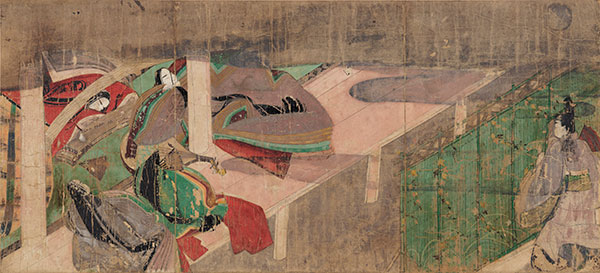
National Treasure
“The Divine Princess at Uji Bridge” (Hashihime), from The Tale of Genji (Genji monogatari emaki)
The Tokugawa Art Museum, Aichi
© Tokugawa Museum of Art Image Archive / DNP Art Communications Co., Ltd.
[this scene on view: November 3–November 15, 2026]
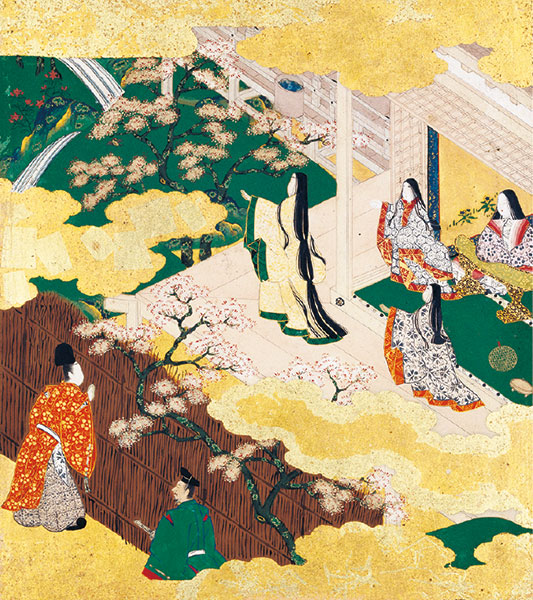
Important Cultural Property
“Little Purple Gromwell” (Wakamurasaki), from Illustrations and Calligraphic Excerpts from The Tale of Genji
By Tosa Mitsuyoshi and Chōjirō
Kyoto National Museum
[this scene on view: October 6–November 1, 2026]
Chapter 1 Copying The Tale of Genji
In earlier times, books were copied by hand and circulated among individual readers, passing from one generation to the next. No autograph manuscript by Murasaki Shikibu herself survives, yet The Tale of Genji has been passed down since the Heian period (794–1192) through the devoted efforts of countless scribes over the centuries. Along the way, however, omissions, alterations, transcription errors, and the combining of passages from different copies gave rise to multiple textual lineages. This chapter introduces a selection of early manuscripts, each with its own distinctive character, which have long been considered essential to the study of this masterpiece of classical literature.
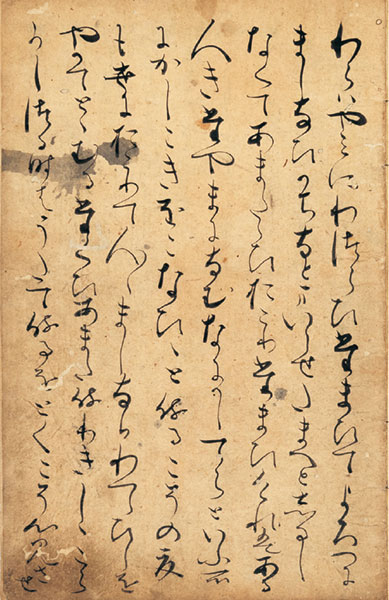
“Little Purple Gromwell” (Wakamurasaki), from The Tale of Genji (Teika Edition)
Photo courtesy of Yagi Shoten
Chapter 2 Murasaki Shikibu, Author of The Tale of Genji
The Tale of Genji was written by a woman known as Murasaki Shikibu (dates unknown), who developed a talent for literature from an early age. The novel appears to have gained a wide readership while Murasaki was serving as lady-in-waiting to Empress Shōshi (988–1074), daughter of Fujiwara no Michinaga (966–1028), the most powerful courtier of his day. Much about Murasaki Shikibu’s life remains unknown, yet the enduring popularity of her diary and the many portraits of her produced over the centuries attest to her longstanding fame as the author of The Tale of Genji. This chapter presents historical documents and paintings to explore both the historical figure of Murasaki Shikibu and how she was reimagined by later generations.
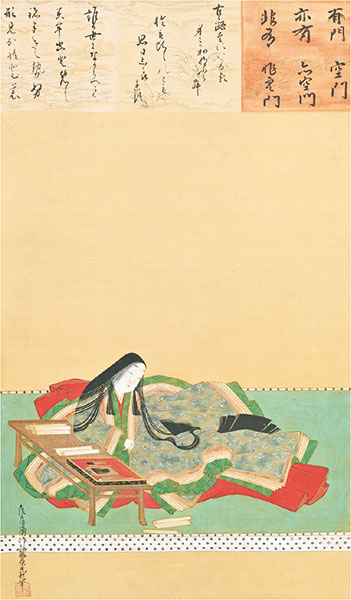
Portrait of Murasaki Shikibu
By Tosa Mitsuoki
Ishiyama-dera Temple, Shiga
[on view: October 6–November 1, 2026]
Chapter 3 The National Treasure Genji Handscrolls
The National Treasure-designated illustrated handscrolls The Tale of Genji (Genji monogatari emaki) are not only the oldest surviving depictions of the story but also rank among the greatest masterpieces of Japanese handscroll painting. Within images little more than twenty centimeters in height, refined compositions, subtly harmonized colors, and meticulous brushwork combine to evoke the emotional depth of each scene with extraordinary nuance. The elegance of the calligraphy and the decoration of the paper are equally deserving of close attention. These handscrolls offer an unparalleled glimpse into the refined aesthetics of the Heian aristocracy.
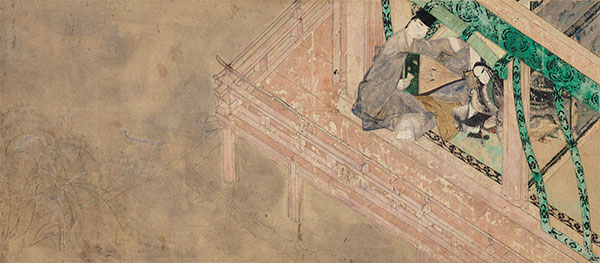
National Treasure
“Trees Encoiled in Vines of Ivy” (Yadorigi) III, from The Tale of Genji (Genji monogatari emaki)
The Tokugawa Art Museum, Aichi
© Tokugawa Museum of Art Image Archive / DNP Art Communications Co., Ltd.
[this scene on view: November 17–November 29, 2026]
Chapter 4 The Making of a Literary Classic
From the Kamakura period (1192–1333) onward, the text of The Tale of Genji was increasingly standardized, spawning a number of commentaries. This deepening engagement with the novel accelerated its transformation into a venerated classic, setting it apart from other works of court literature. The production of Genji-related imagery flourished at the imperial palace and among the aristocracy as a means of displaying sophistication and cultural standing. Manuscripts of selected passages from The Tale of Genji copied by emperors, as well as the many Genji paintings produced through the Muromachi period (1392–1573), reflect its rarefied cultural status.
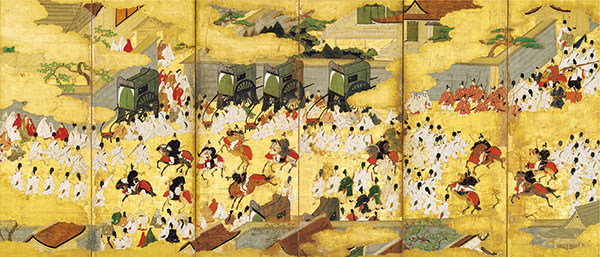
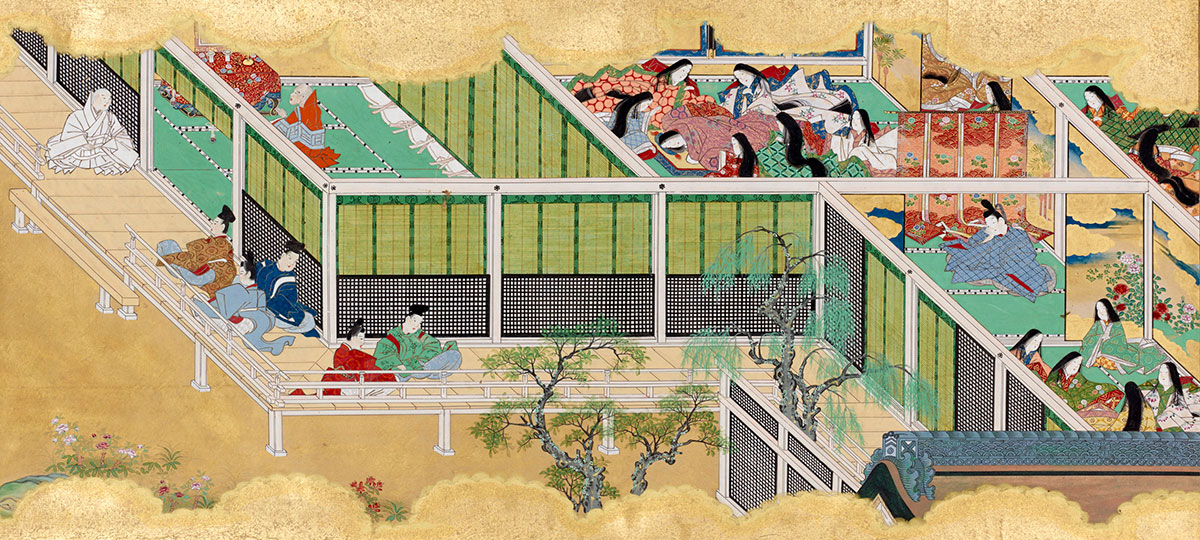
Battle of the Carriages (right screen)
By Tosa Mitsumochi
Ninna-ji Temple, Kyoto
[on view: October 6–November 1, 2026]
Chapter 5 Genji Adornment
The Tale of Genji also provided a rich source of design inspiration for works of decorative art. In many cases, rather than depicting figures directly, artists evoked specific scenes through symbolic motifs devoid of human presence—a convention known as “motifs of absence” (rusu mon’yō). As the novel gained currency as a work of cultural refinement, it became customary for aristocratic and warrior families to include a multivolume set of books of The Tale of Genji as part of the trousseau carried to a bride’s new home. Bespoke book chests were crafted specifically to house these volumes. Indeed, Genji-related designs came to adorn the full range of bridal furnishings.
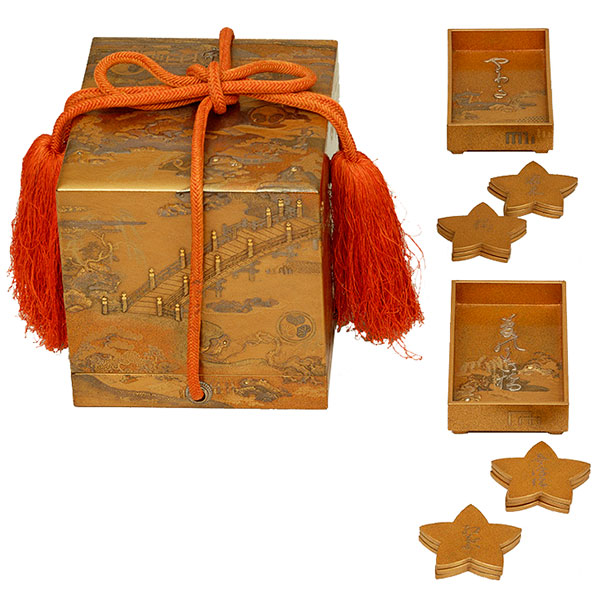
National Treasure
Box with Guessing Tablets for The Tale of Genji “Ten Uji Chapters Incense Game,” part of the “First Song of Spring” (Hatsune) Wedding Trousseau
By Kōami Chōjū
The Tokugawa Art Museum, Aichi
© Tokugawa Museum of Art Image Archive / DNP Art Communications Co., Ltd.
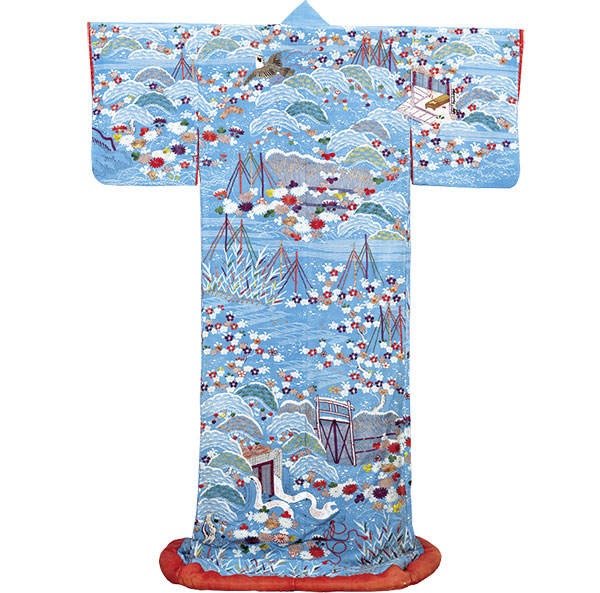
Kosode (Kimono) with Hawks, Court Carriages, and Palace Buildings
Kyoto National Museum
[on view: November 3–November 29, 2026]
Topic Genji and Noh
The Tale of Genji, a literary classic symbolizing Heian court culture, and Noh, a medieval theater tradition rooted in the aesthetic of yūgen (mysterious profundity), are two great pillars of Japanese culture. The fusion of these traditions gave rise to numerous celebrated Noh plays. Noh playwrights embraced Heian aristocratic figures from The Tale of Genji as “seeds of the flower of yūgen” (yūka no tane), inspiring a body of plays known collectively as “Genji Noh.” Works such as Aoi no Ue (Lady Aoi), Nonomiya (The Shrine in the Fields), Yūgao (Evening Faces), and Genji Kuyō (A Memorial Service for Genji) remain in the active repertoire of Noh plays today, offering a vivid window onto how the Genji narrative was read, performed, and reimagined from the medieval period onward.
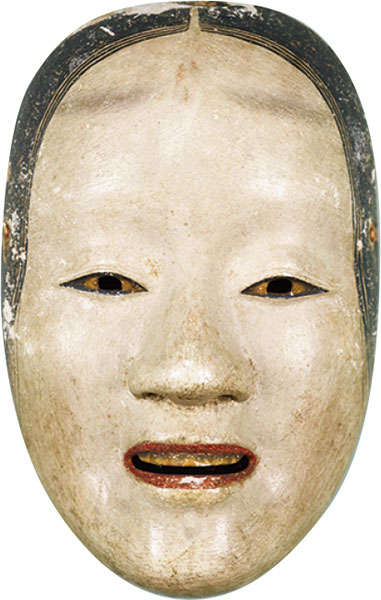
Important Cultural Property
Noh Mask, Deigan (ex Konparu Family Collection)
Seal “Tenkaichi Kawachi”
Tokyo National Museum
Chapter 6 Images of Genji
From the Azuchi-Momoyama period (1573–1603) onward, The Tale of Genji inspired great numbers of paintings. In addition to poem cards (shikishi), handscrolls, and fans, large-scale formats including folding screens and sliding door panels were increasingly used to depict Genji-themed imagery. Such paintings came to be appreciated not merely as illustrations of a literary narrative, but also as elegant decorations for interior spaces and as auspicious subjects expressing wishes for marital happiness and long life. Among the many Genji paintings of the early modern period, this chapter presents works of exceptional distinction, inviting visitors to immerse themselves in the story.
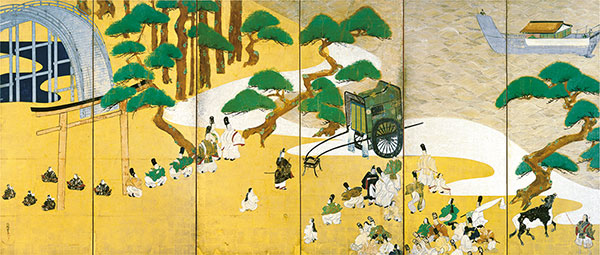
National Treasure
Scenes from “The Barrier Gate” (Sekiya) and “Channel Markers”(Miotsukushi), from The Tale of Genji
By Tawaraya Sōtatsu
Seikadō Bunko Art Museum, Tokyo
Seikadō Bunko Art Museum / DNP Art Communications Co., Ltd.
[on view: October 6–November 1, 2026]

“Leaves of Wild Ginger” (Aoi), from The Tale of Genji (Moriyasu Version, known as the Phantom Genji Scrolls)
Kyoto National Museum
[this scene on view: October 6–November 1, 2026]
Chapter 7 Playing with Genji
During the Edo period (1603–1868), The Tale of Genji became widely beloved across society. Incense aficionados developed an incense-comparing game known as “Genji Incense” (Genji kō), in which the possible matching patterns among five incense samples were represented by diagrammatic symbols, each associated with one chapter of The Tale of Genji. These Genji kō incense symbols came to be widely used as decorative motifs. Numerous woodblock prints transposed Genji characters and scenes into contemporary settings complete with fashions and customs of the day, giving rise to a culture of playful and witty reinterpretation. In the early 1800s, the contemporary adaptation A Fraudulent Murasaki’s Rustic Genji (Nise Murasaki inaka Genji) became a runaway bestseller. This “Genji boom” had a transformative impact on the publishing world of the time.
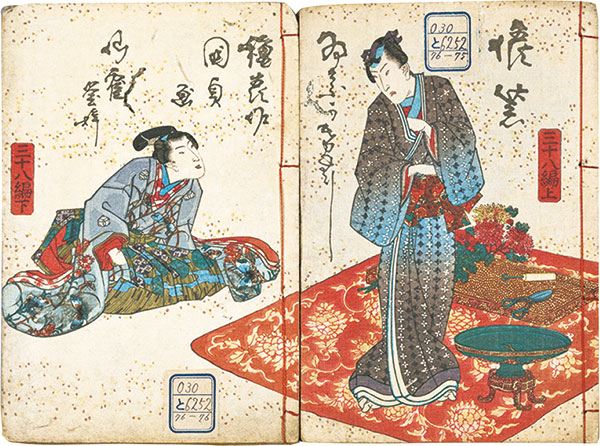
A Fraudulent Murasaki’s Rustic Genji (Nise Murasaki inaka Genji)
Written by Ryūtei Tanehiko; illustrated by Utagawa Kunisada
Tokyo National Museum
Epilogue Genji Reimagined
The tradition of Genji painting, so richly developed in the early modern period, took on new forms in the modern era. Late nineteenth- and twentieth-century artists approached the material afresh, drawing on earlier Genji paintings while bringing their own individual interpretations to the subject. In The Uji Princesses, Nihonga painter Matsuoka Eikyū (1881–1938) synthesizes his study of classical works—including the National Treasure The Tale of Genji handscrolls—in a monumental format. This landmark of modern Genji painting brings the exhibition to a close.
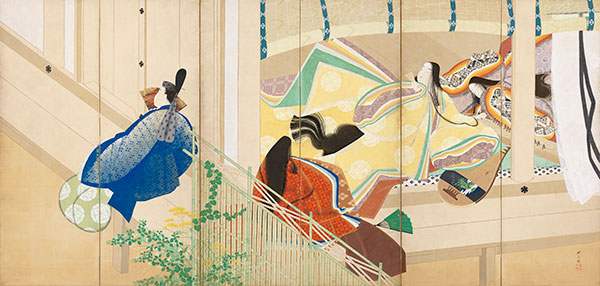
The Uji Princesses (right screen)
By Matsuoka Eikyū
Himeji City Museum of Art, Hyogo
Photo courtesy of Himeji City Museum of Art
Title and URL copied to clipboard
- Share