


- TOP
- Exhibitions
- Special Exhibitions
- Special ExhibitionKitano Tenjin: Legends of a Shinto God
Title and URL copied to clipboard
- Share


General Information
- Exhibition Title
-
Special Exhibition
Kitano Tenjin: Legends of a Shinto God
- Period
-
April 18–June 14, 2026
The exhibition has two installations:
Part I: April 18–May 17, 2026
Part II: May 19–June 14, 2026
Some artworks may be rotated during the exhibition period.
- Venue
-
Kyoto National Museum, Heisei Chishinkan Wing
- Closed
-
Mondays
*Open May 4. Open continuously from April 28 through May 10, 2026.
- Special Exhibition Hours
-
9:00 a.m.–5:30 p.m. (entrance until 5:00 p.m.)
Fridays, 9:00 a.m.–8:00 p.m. (entrance until 7:30 p.m.)
- Special Exhibition Admission
-
Adult 2,000 yen
(1,800 yen)University Student 1,400 yen
(1,200 yen)High School Student 900 yen
(700 yen)- The discounted prices in parentheses ( ) are advance ticket and group ticket rates.
- Group ticket rates apply to groups of 20 people or more.
- Advance tickets will be on sale between January 16 and April 17, 2026 at the official online ticket site and major ticket outlets.
- See the online ticket site for more information about tickets.
- Please show student ID for student admission.
- Admission is free for junior high school students and other youths age 0–15, as well as for visitors with disabilities and one caretaker. Please show ID.
- Admission is reduced by 500 yen for Campus Members (including faculty) able to produce ID (applicable only to the purchase of same-day tickets at the South Gate ticket office).
- Special Exhibition Workshop
-
See the Japanese page.
*The Special Exhibition Workshop will be conducted in Japanese.
- Special Exhibition Lecture
-
See the Japanese page.
*The Special Exhibition Lecture will be conducted in Japanese.
- Audio Guide
-
- Fee
- 700 yen (includes tax)
- Duration
- Approx. 35 min
- Languages
- Japanese, English
- Rental Hours
- 9:00 a.m.–5:00 p.m. (return by 5:30 p.m.)
Fridays, 9:00 a.m.–7:30 p.m. (return by 8:00 p.m.)
- Catalogue
-
For availability and purchasing information, see Exhibition Catalogues and Related Publications
- Organized by
-
Kyoto National Museum; Kitano Tenmangū Shrine; The Yomiuri Shimbun
- With the Support of
-
Iwatani Corporation; West Japan Railway Company; Daiwa House Industry Co., Ltd.; Non-Destructive Inspection Co., Ltd.
- With the Special Cooperation of
-
Zenkoku Tenmangū Baifūkai
- In Conjunction with
-
Kyoto City Tourism Association
- Special Exhibition Official Website
-
- The official exhibition website is no longer in service.
- Special Exhibition Official Social Media
-
- The official social media is no longer in service.
Description of Exhibition
Kitano Tenmangū Shrine, located in a sacred area of northwestern Kyoto, venerates the deified
Sugawara no Michizane (845–903), a preeminent scholar and statesman of the Heian period.
Michizane served as a trusted courtier of Emperor Uda (867–931, r. 887–897) and rose to the rank
of Minister of the Right under the succeeding Emperor Daigo (885–930, r. 897–930). Yet despite
this illustrious career, he was later demoted and exiled to the city of Dazaifu in Kyushu as the
result of slander, dying there without ever returning to the capital in Kyoto. The hardships of
Michizane’s final years combined with his distinguished lifelong achievements gave rise to
numerous legends after his death. Earning the sympathy, awe, and reverence of the people,
Michizane eventually came to be widely known and popularly worshipped as “Tenjin,” a Shinto
deity of profound spiritual power.
This museum exhibition has been organized in anticipation of the Hanmantōsai, a grand
memorial observance to be held at Kitano Tenmangū in 2027, during which thousands of
lanterns will be lit to commemorate the 1,125th anniversary of Sugawara no Michizane’s death.
The show brings together a vast assemblage of masterpieces, featuring ancient shrine treasures
of Kitano Tenmangū, sacred works from Tenmangū and Tenjin shrines across Japan, as well as
related works from other temples and shrines.
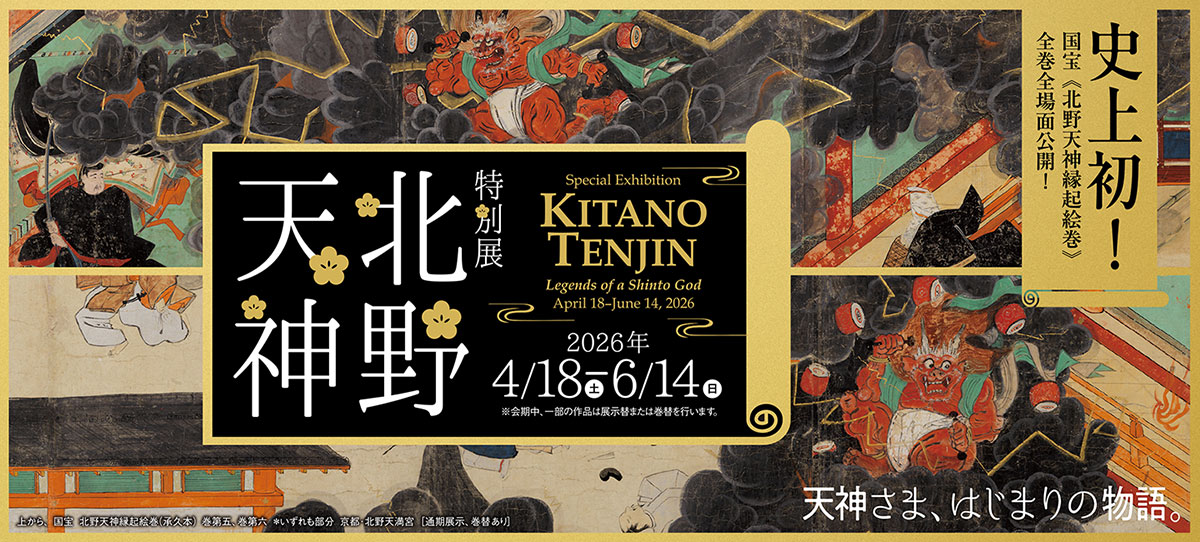
Highlights of the exhibition include the first-ever complete public display of all scenes from
the National Treasure handscrolls Illustrated Legends of the Kitano Tenjin Shrine (Kitano Tenjin engi
emaki), Jōkyū version, together with other versions of the same work produced in different
periods and by different hands——including the Kōan, Mitsunobu, and Mitsuoki versions. The
display of these handscrolls provides an unprecedented opportunity to explore the various
narrative representations of the origins of the Kitano Tenjin deity.
Tracing the journey of Tenjin worship from its cradle at Kyoto’s Kitano Tenmangū to every
corner of the nation, the exhibition presents an unprecedented opportunity to explore the many
dimensions of this religious tradition and its enduring influence on Japan’s cultural landscape.
![National Treasure. llustrated Legends of the Kitano Tenjin Shrine (Kitano Tenjin engi emaki) (Jōkyū Version), Volume 6. Kitano Tenmangū Shrine, Kyoto [this scene on view: May 19–June 14, 2026]](/jp/exhibitions/assets/special/2026_kitano/2026_kitano_01.jpg)
National Treasure
Illustrated Legends of the Kitano Tenjin Shrine (Kitano Tenjin engi emaki) (Jōkyū Version), Volume 6
Kitano Tenmangū Shrine, Kyoto
[this scene on view: May 19–June 14, 2026]
Chapter Ⅰ Tenjin Worship
Sugawara no Michizane (845–903) was a Heian-period scholar, poet, and court official from a noble
scholarly family. Following in the footsteps of his father, Sugawara no Koreyoshi (812–880), he
became a Court Professor of Classical Chinese (monjō hakase), while demonstrating his political
acumen as a close adviser to Emperor Uda. His career was cut short, however, by slanderous
accusations from the rival aristocrat Fujiwara no Tokihira (871–909). Consequently, Michizane was
exiled to Kyushu, where he died in 903, never to return to Kyoto. Shortly after Michizane’s death,
Tokihira also died. The disasters and lightning strikes that increasingly plagued the capital
thereafter came to be attributed to the vengeful spirit (onryō) of Michizane, who was deemed to
have died an unjust death. As this perception took hold, oracles calling for his enshrinement were
received both in the capital and in outlying regions.
In 947, a sanctuary was established in the Kitano district northwest of the city, marking the
origin of Kitano Tenmangū. Following the construction of shrine buildings in 959 under the
patronage of Tokihira’s nephew, Fujiwara no Morosuke, divine appellations such as “Tenman
Tenjin Shrine” and “Tenman Tenjin Mausoleum” were adopted, and Michizane gradually assumed
the character of a benevolent god. Even during his lifetime, Michizane was revered for his
scholarly learning and poetic talents, and was celebrated as “Tenjin, progenitor of the literary path
and master of the poetic realm.”
1. Sugawara no Michizane
Born in 845, Sugawara no Michizane was the third son of Sugawara no Koreyoshi (812–880). He
went on to gain the confidence of Emperor Uda and, following in his father’s footsteps, served as
Court Professor of Classical Chinese (monjō hakase), before holding a succession of posts including
Governor of Sanuki, Head Chamberlain, Councilor, and Senior Assistant Minister of Ceremonial
Affairs. In 894, he famously proposed the abolition of Japan’s envoys to Tang China and in other
ways played an active role as a close imperial adviser. The text Imperial Admonitions of the Kanpyō Era
(Kanpyō no goyūikai) (no. 4) records that Emperor Uda highly valued Michizane’s political abilities.
In 892, Michizane compiled the Categorized National History (Ruijū kokushi), and in 900, at the
request of Emperor Daigo, he produced the poetry and prose anthology Collected Literary Writings
of the Sugawara Family (Kanke bunsō) (no. 5), attesting to his deep learning as both scholar and poet.
This section of the exhibition also showcases a group of objects traditionally believed to have been
his beloved personal possessions, collectively known as the Heirloom Objects Supposedly Owned by
Lord Sugawara no Michizane (no. 1).
![National Treasure. Comb with Tortoiseshell Ornaments, from the Heirloom Objects Supposedly Owned by Lord Sugawara no Michizane. Dōmyō-ji Tenmangū Shrine, Osaka. [on view: May 12– June 14, 2026]](/jp/exhibitions/assets/special/2026_kitano/tenjin_01-01_001.jpg)
National Treasure
Comb with Tortoiseshell Ornaments, from the Heirloom Objects
Supposedly Owned by Lord Sugawara no Michizane
Dōmyō-ji Tenmangū Shrine, Osaka
[on view: May 12– June 14, 2026]
2. Michizane Deified
During the Heian period, epidemics, natural disasters, and other calamities were feared as
manifestations of vengeful spirits (onryō) arising from those who had met unjust deaths. A popular
belief known as goryō worship sought to quell such spirits in order to restore social order. The text
Abridged History of Japan (Nihon kiryaku) (no. 6) records how Michizane was initially feared as a
vengeful spirit, stating that such disasters were “The work of the embittered soul of Master
Sugawara, harboring resentment.” After receiving a divine title and being enshrined at Kitano,
however, Michizane’s character increasingly took on that of a benevolent deity, and he came to be
revered as a god of literary arts and scholarship.
Tenjin, who embodies both vengeful and benevolent aspects, appears in a variety of forms but
is most basically represented holding a scepter as seen in Tenjin in Court Dress (Known as Konpon
miei) (no. 19).
![Tenjin in Court Dress (Known as Konpon Miei). Kitano Tenmangū Shrine, Kyoto. [on view: May 5– June 14, 2026]](/jp/exhibitions/assets/special/2026_kitano/tenjin_01-02_019.jpg)
Tenjin in Court Dress (Known as Konpon Miei)
Kitano Tenmangū Shrine, Kyoto
[on view: May 5– June 14, 2026]
3. Kami–Buddha Combinatory Practice
In the course of Buddhism’s transmission to and reception in Japan, a doctrinal framework
emerged in which Shinto gods, called kami, were understood as provisional manifestations
(suijaku) of Buddhist deities (honji), who assumed temporary forms in order to save sentient beings
in Japan. This mode of identifying Shinto and Buddhist deities with one another is known as
kami–buddha combinatory practice (shinbutsu shūgō). Within this framework, the Shinto kami
Tenjin came to be regarded as one and the same as the Buddhist deity Eleven-Headed Kannon
(Ekādaśamukha Avalokiteśvara).
Early in the formation of Tenjin worship, it developed close ties with the Shingon and Tendai
schools of Buddhism. Particular emphasis was placed on Tenjin’s association with the
Eleven-Headed Kannon sculpture at Hase-dera Temple in Nara. This relationship is also reflected
in Buddhist sculptures that are preserved at other shrines and temples affiliated with him,
including Standing Thousand-Armed Kannon (no. 41), and Standing Eleven-Headed Kannon (no. 48),
both attributed to Michizane’s creation.
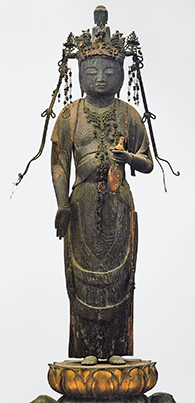
Standing Eleven-Headed Kannon
(Ekādaśamukha Avalokiteśvara)
Manshu-in Temple, Kyoto
Chapter Ⅱ The History of Kitano Tenmangū
The circumstances leading to Michizane’s enshrinement at Kitano involve a mixture of religious
legend and historical fact. Further examination is required to clarify how devotion to Michizane
actually arose and developed at this site, but there is general consensus that faith in Tenjin had
become firmly established by the mid-tenth century.
Tenjin worship, which began as goryō belief aimed at pacifying a vengeful spirit, gradually
expanded to include other divine roles, including those of a fire god, a thunder god, a plague god,
and a martial god. Through association with thunder god worship, Tenjin also came to be revered
as an agricultural deity. Through analogy with Michizane’s learning and poetic talent during his
lifetime, he was further venerated as a deity of Chinese poetry, Japanese waka poetry, and
scholarship. Reflecting the injustices Michizane suffered in his later years, Tenjin additionally
became regarded as a god who offers redress for wrongful accusations. Such was the magnitude of
Tenjin’s divine power that he came to be revered as a “guardian deity of the imperial capital,”
receiving the devotion not only of the emperor but also of the powerful aristocratic Fujiwara clan,
who might otherwise have been considered his enemies.
The handscrolls known as Illustrated Legends of the Kitano Tenjin Shrine (Kitano Tenjin engi
emaki) recount Michizane’s life before his deification, as well as bringing together stories of the
shrine’s origins and tales of its miraculous efficacy.
1. The World of the Illustrated Legends of the Kitano Tenjin Shrine
Many versions of the handscroll set Illustrated Legends of the Kitano Tenjin Shrine (Kitano Tenjin engi emaki) have been produced since early times. Among them, the so-called “Jōkyū Version” (no. 50), which bears the date Jōkyū 1 (1219) in its text, is the oldest surviving example of its type and also the finest. At Kitano Tenmangū it is regarded as the foundational engi (origin tale) and is positioned as the shrine’s most important treasure. With paintings measuring an extraordinary 52 centimeters in height, it is among the largest of Japanese narrative handscrolls, and its dynamic depictions of figures and landscapes make it one of the most important emaki of the Kamakura period (1185–1333). Later Tenjin engi handscrolls follow the same basic structure, yet each displays its own individuality. Taken together, they demonstrate the immeasurable influence Tenjin worship has exerted on Japan’s religious history
![National Treasure. llustrated Legends of the Kitano Tenjin Shrine (Kitano Tenjin engi emaki) (Jōkyū Version), Volume 1. Kitano Tenmangū Shrine, Kyoto. [this scene on view: April 18–May 17, 2026]](/jp/exhibitions/assets/special/2026_kitano/tenjin_02-01_050-01.jpg)
National Treasure
Illustrated Legends of the Kitano Tenjin Shrine (Kitano Tenjin engi emaki) (Jōkyū Version), Volume 1
Kitano Tenmangū Shrine, Kyoto
[this scene on view: April 18–May 17, 2026]
2. The Landscape of the Kitano Shrine and the People of Kyoto
From the medieval period onward, the shrine complex at Kitano underwent repeated rebuilding.
The Kitano Shrine Mandala (no. 65) conveys the appearance of the shrine complex of that time,
including structures with surrounding covered corridors. As kami–buddha combinatory practice
became established within the precincts, numerous Buddhist halls were also incorporated. Among
these, the Kitano Kyōōdō (Hall of the Supreme Sutra), built by Shogun Ashikaga Yoshimitsu
(1358–1408), was particularly well known. Centuries later, as a result of the anti-Buddhist policies
of the Meiji period (1868–1912), the sacred texts and Buddhist sculptures previously enshrined in
the Kyōōdō (nos. 81–83) were relocated. They are now preserved elsewhere, including at the
nearby temple of Daihōon-ji in Kyoto.
In 1607, Toyotomi clan leader Toyotomi Hideyori (1593–1615) carried out a large-scale
reconstruction of the shrine, building the existing National Treasure–designated shrine complex,
composed of eight interconnected structures in the yatsumune-zukuri style—including the Main
Sanctuary (Honden), Stone-Floored Intermediate Hall (Ishi no Ma), Worship Hall (Haiden), and
Music Hall (Gaku no Ma). Today, the complex ranks among the finest surviving examples of
Momoyama-period architecture (nos. 75–77).
Chapter Ⅲ Kitano Tenmangū and the Performing Arts and Culture
As Tenjin worship evolved over time, Kitano Tenmangū emerged as an important center for artistic
and cultural life. Tenjin was regarded as the “progenitor of the literary path and master of the
poetic realm,” and in the early modern period he also came to be revered as a deity of waka poetry.
Emperors, retired emperors, and court nobles dedicated poems of their own composition, written
on folded paper (kaishi) or poetry slips (tanzaku), as offerings to the shrine.
Kitano Tenmangū figures prominently in the origins of one of Japan’s best-known stage
traditions. Performances by a female actor and dancer named Okuni, apparently held on the shrine
precincts in its early years, laid the foundation for what would later develop into the kabuki
theater.
At the same time, transcending his earlier characterization as a fearsome vengeful spirit who
brought calamity, Tenjin also came to embody martial valor. This aspect as a war god constitutes
another important pillar of Tenjin worship. From the medieval period onward, the deity most
strongly venerated by the warrior class was Hachiman. While many weapons survive bearing
Hachiman’s divine name, a single sword blade (no. 122) inscribed on front and back with
“Hachiman Daibosatsu (Great Bodhisattva Hachiman)” and “Tenman Daijizai Tenjin (Tenman Tenjin
of Supreme Sovereignty)” illustrates how Tenjin, too, came to be worshipped as a martial god.
1. Deity of Scholarship and the Performing Arts
Materials Related to Sacred Shrine Hōraku Linked Verse Offerings (no. 90) and Kitano Tenmangū Sacred Shrine Hōraku Waka Poetry (no. 91) are valuable sources that demonstrate, in both quality and quantity, the widespread veneration of Tenjin as a deity presiding over poetry. Images of Tenjin crossing to Tang China—— depicted wearing Chinese Daoist vestments with a bag for his Buddhist clerical robe slung over one shoulder and holding a branch of plum blossoms—— are based on a well-known legend. According to this tradition, Tenjin, following the advice of Enni (1202–1280), founding priest of Tōfuku-ji in Kyoto, crosses to China in a single night, studies Zen under the eminent Southern Song master Wuzhun Shifan (1177–1249), and receives Wuzhun’s robe of dharma transmission. Gone from his expression is the anger of a vengeful spirit; instead, one senses the full emergence of Tenjin’s character as a benevolent deity, and in particular as a god of learning and the arts.
![Important Cultural Property. Women’s Kabuki Performance by Okuni. Kyoto National Museum. [on view: April 18– May 17, 2026]](/jp/exhibitions/assets/special/2026_kitano/tenjin_03-01_110.jpg)
Important Cultural Property
Women’s Kabuki Performance by Okuni
Kyoto National Museum
[on view: April 18– May 17, 2026]
2. Deity of Martial Arts
The armored Standing Heavenly King (no. 14), whose appearance evokes a fierce Buddhist guardian deity, is associated with a medieval narrative (no. 13) describing Sugawara no Michizane as resembling a Niō statue. In the medieval period, suits of armor associated with powerful warrior families such as Kitabatake Tomonori (1528–1576) and Ōuchi Moriharu (1377–1431) (nos. 123–130) were dedicated to regional Tenmangū and Tenjin shrines. From the early modern period onward swords (nos. 113–117) were donated to Kitano Tenmangū by successive heads of the Maeda family——lords of the Kaga Domain who bore the Sugawara surname. Two celebrated blades (nos. 131, 132), linked by tradition to the famed Genji heirloom swords Higekiri and Hizamaru, have proven especially compelling within monster-slaying narratives associated with martial valor, and they continue to inspire new stories to this day.
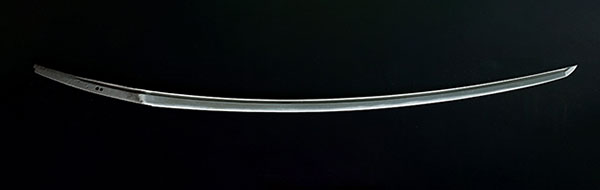
Important Cultural Property
Tachi (Slung Sword), Inscribed “Kunitsuna,” Known as “Onikirimaru / Higekiri”
Kitano Tenmangū Shrine, Kyoto
![Important Cultural Property. Tachi (Slung Sword), Inscribed “[...]tada,” Known as “Usumidori / Hizamaru.” Daikaku-ji Temple, Kyoto](/jp/exhibitions/assets/special/2026_kitano/tenjin_03-02_132.jpg)
Important Cultural Property
Tachi (Slung Sword), Inscribed “[...]tada,” Known as “Usumidori / Hizamaru”
Daikaku-ji Temple, Kyoto
![The Legend of Rajōmon (Rajōmon emaki), Volume 1. Kyoto National Museum. [on view: April 18– May 17, 2026]](/jp/exhibitions/assets/special/2026_kitano/tenjin_03-02_134.jpg)
The Legend of Rajōmon (Rajōmon emaki), Volume 1
Kyoto National Museum
[on view: April 18– May 17, 2026]
Title and URL copied to clipboard
- Share